

The emerging masterplan, which has gone out for a third round of public consultation ahead of a planning application in spring 2027, features a 30-storey hospital tower next to the Grand Union Canal, overseen by HOK.
The 185m-tall, 800-bed west London scheme will have a ‘smaller and simpler footprint than the current hospital’ and bring together clinical services which are currently spread across more than 20 different buildings around the 3.5ha St Mary’s estate. As well as a rooftop helipad, the 135,000m² hospital will also have a 14th floor ‘sky lobby’, connecting the hospital’s main clinical zones above and below.
The consolidation of the hospital facilities into a single vertical block will pave the way for surplus land to become part of the expansion of the Paddington Life Sciences cluster. Allies and Morrison is heading up the design of this campus and the practice is also leading on the site-wide masterplan.
Overall, the scheme will nearly double the amount of space for pharmaceutical and technology companies. The Trust says the expanded campus could help create close to 11,000 additional jobs and generate up to £1.3 billion more a year in economic activity.
The emerging plans also include improved routes through the site, two new green public spaces – Mint Square and Canalside Square – and would restore the Grade II-listed Clarence Memorial Wing and western part of the Mint Building. Gillespies is advising on the landscape planning.
The design team says the ‘much more detailed‘ proposals released this week respond to feedback about the importance of ‘accessibility and wayfinding’ by creating more green spaces and incorporate insights from disability groups as well as ensuring the wider development responds to surrounding neighbourhoods.
There have also been changes to the massing of some blocks which, taking on board comments from earlier consultation, will be reduced in height and stepped back from Paddington Basin.
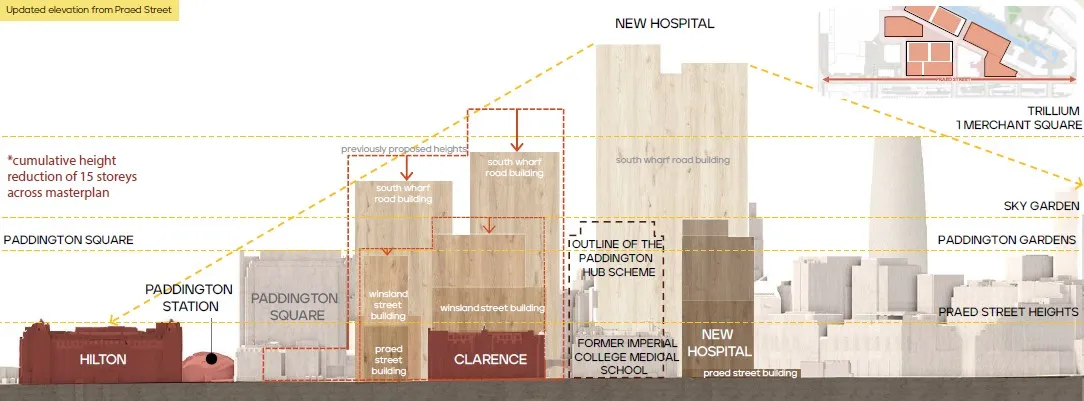
Diagram to show how the design has evolved – height and massing
The scheme will be built out through a phased approach – the construction of the ‘taller hospital on a smaller footprint’ will get under way while the current hospital continues to run. Once HOK’s tower is completed, services would move into the new hospital, releasing the rest of the site for redevelopment.
Julian Redhead, chief executive of Imperial College Healthcare NHS Trust, said: ‘[Much] of our estate is now very old and increasingly difficult to maintain, with building failures an increasingly regular occurrence, despite spending millions every year on essential maintenance.
‘We have a once-in-a-generation opportunity to create a new hospital that meets the needs of our patients, staff and communities and regenerate the whole site into an expanded life sciences campus, attracting jobs and investment.’
Some parts of the St Mary’s estate date back to 1845 and the Trust admitted it had the largest backlog maintenance liability – the estimated cost of work needed to bring its buildings up to an acceptable condition – ‘in the whole of the NHS’. It added that ‘despite spending millions of pounds every year’, there were still regular floods, outages and structural problems.
The Trust believes that, without planning delays and through alternative financing, the hospital could be delivered by the end of 2023. However, if it has to wait for government funding through the existing New Hospital Programme timetable, delivery may not happen until 2045.
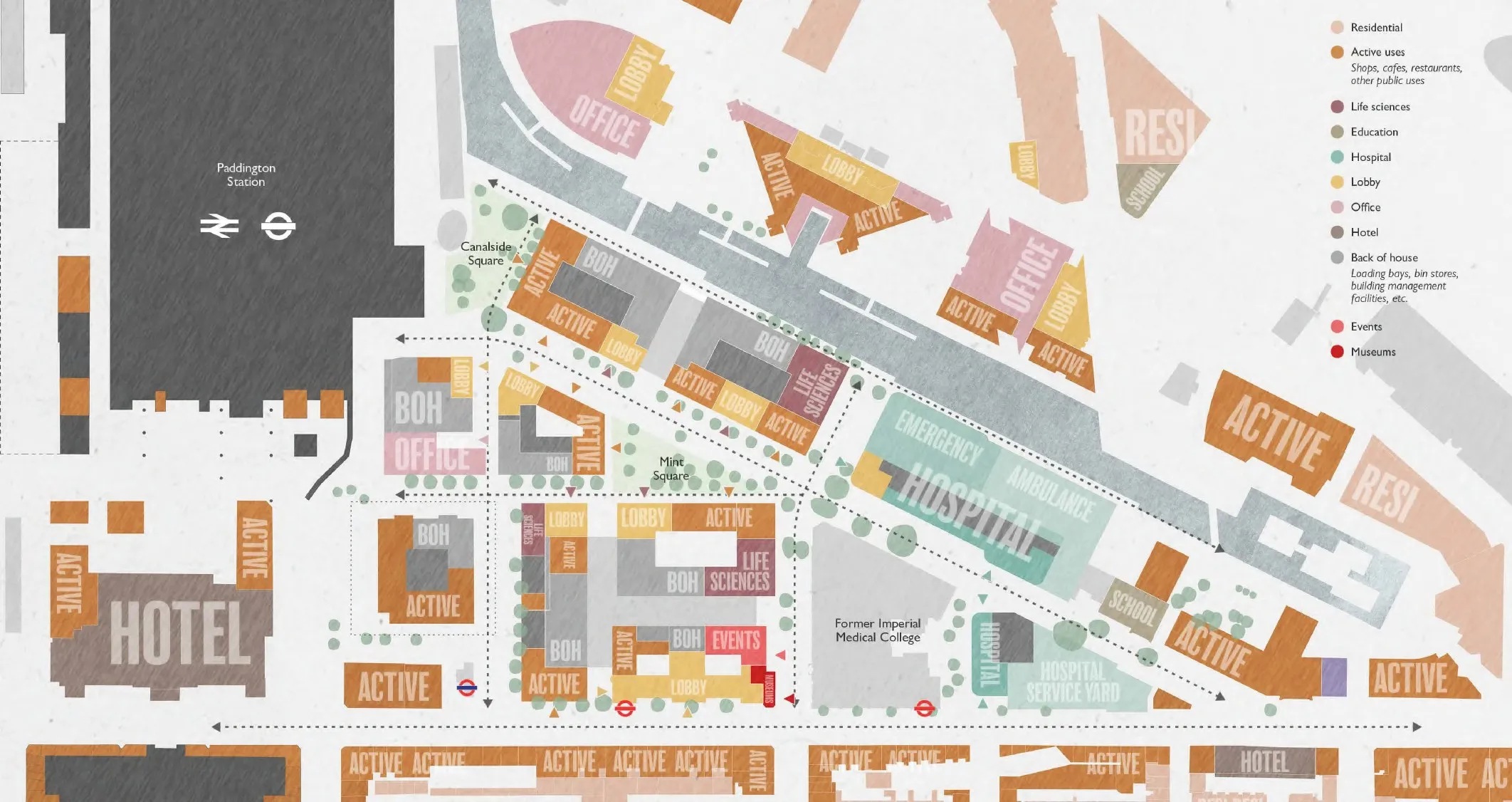
Masterplan uses
Last year HOK also submitted plans to Westminster City Council for a 48,800m2 clinical life sciences hub on the site of the former Imperial College Medical School (see above). Although surrounded by the St Mary’s estate masterplan, the proposal for the block between Praed Street and South Wharf Road does not form part of the Trust’s emerging scheme.
This separate though-linked development is backed by Bartlet Asset Management. Its aim is to support ‘bench to bedside’ innovation, from discovery in specialised laboratories to patient care. The teams says the project will allow clinical trials, diagnostics and ‘emerging health technologies within one integrated setting’.
Elsewhere in Paddington Basin, Stanton Williams won planning approval for its new Fleming Centre in April. Westminster City Council’s planning committee voted unanimously in favour of the proposed canalside research centre next to Paddington Station.
That 3,800m2 scheme, which the practice won through a design competition in early 2025, is backed by Imperial College Healthcare NHS Trust and and Imperial College London.

Wider site development and life science campus by Allies and Morrison – view of Paddington Basin looking towards Stanton Williams’ proposed Fleming Centre
2018 predictions: Will the profession continue to be marginalised?