
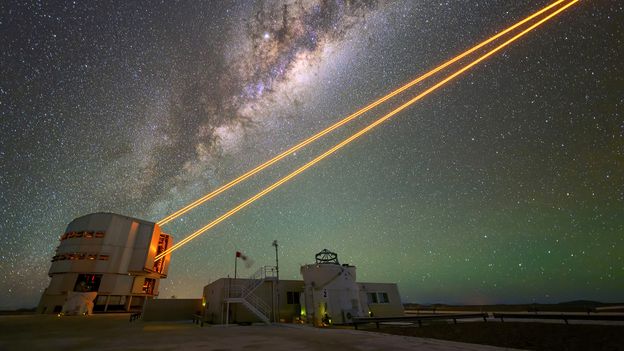
As of 2026, the four main telescopes of the VLT (Antu, Kueyen, Melipal and Yepun) can now also combine forces – in an act of astronomical Power Rangers – to fire lasers at the same time, assembling into a single, giant “virtual” telescope with a wider field of view. By working together, the four big mirrors in each of those four telescopes can capture details many times sharper than one alone.
The VLT has been responsible for some of the most significant astronomical discoveries of the 21st Century, including the first image of an extrasolar planet (one that lives outside of our Solar System), and the positions of individual stars moving around the supermassive black hole at the Milky Way’s centre.
More like this:
• This huge telescope in Chile could reveal alien life
• The hotel where astronomers live like James Bond spies
• The light disturbing a dark zone full of telescopes
One final question you might wonder: what happens if a plane passes over? After all, even the smallest laser pointers pose a risk of dazzling pilots.
“Planes can of course pass above the observatory, but we have a safety mechanism,” explains astronomer Itziar de Gregorio Monsalvo, Eso’s representative in Chile. “If the planes cross near where we are observing, automatically the lasers switch off.”
So, that means if you wanted to see a very large telescope firing its very large lasers in the Atacama, you’d probably have to approach on the ground. But if you did, you’d encounter a scene rarely encountered in day-to-day life: a telescope lighting up an artificial star on the edge of our planet’s atmosphere.
—
If you liked this story, sign up for The Essential List newsletter – a handpicked selection of features, videos and can’t-miss news, delivered to your inbox twice a week.
For more science, technology, environment and health stories from the BBC, follow us on Facebook and Instagram.