

This is Everyday Science with Clare Wilson, a subscriber-only newsletter from The i Paper. If you’d like to get this direct to your inbox every week, you can sign up here.
I’m usually sceptical about claims that, thanks to climate change, we will soon be eating strange foods like insect burgers and lab-grown steaks.
But I recently met some researchers who convinced me that the warming climate is already affecting what we eat, and means we have to start investigating some new crops.
In time, we may be eating a range of novel produce, including lupin bhajis, lablab pea stir fries and hummus made from British-grown chickpeas.
Last week I got a taste of some of these foods of the future at Southampton University. They weren’t bad – most of them, anyway…
Extreme temperature more frequent and intense
Almost everyone must by now be aware that climate change is real, but it can feel like something way into the future or which affects places far from home.
Global temperatures have risen by 1.2°C since industrialisation. That might not seem much, considering it is less than the average year-to-year variation in maximum daily temperatures of British summers.
But that modest-sounding average rise masks the fact that temperature extremes are becoming more frequent and more intense. The average hottest day of the year has warmed by over 4.5°C in the south and east of England since the 1960s, according to the most recent State of the UK Climate report from the Met Office.
That report was released in March, but if anyone needed more convincing, this year’s extremely hot and dry summer should have brought it home. My garden in south-west London really suffered.
Once the hosepipe ban came in, any watering had to be done by hand, which limits how much you can do. Many of the perennial flowers in my garden completely died off, and at my allotment, yields of courgettes, sweetcorn and lettuce were badly affected.
Drought disastrous for British crops
This summer’s drought was also bad for farmers. Yields were down for many crops including wheat, oats and spring barley, according to a report last week from the Agriculture and Horticulture Development Board.
Harvests were also down for crops like broccoli, peas and potatoes, pushing up prices in supermarkets because of the need to import from elsewhere.
“In 30 or 40 years, we’re going to have to be able to do something different,” said Professor Mark Chapman, an expert on plant and food security at Southampton. “If wheat and barley has already crashed, we mustn’t be too late to fill that gap.”
Chapman is head of a new government-funded research group investigating how crops grown by British farmers will need to change. The Novel and Underutilised Crop Network spans multiple universities, food companies and farmers’ groups.
What piqued my interest was that they are already working with chefs and supermarkets to develop and taste-test new foods made from some of these crops – including lupin beans.
 Chef Lewis Huggins has been charged with making tasty dishes using lupin flour (Photo: Stuart Martin/The i Paper)
Lupin flour a superfood
British home gardeners may think of lupins as tall spikes of rainbow-hued flowers, but the beans of some lupin varieties are eaten pickled in the Mediterranean and South America. In a similar way to soya beans, they can also be processed into flour and used to make something like tofu.
But be warned! Edible lupins are a different variety to those grown as flowers – which cannot be eaten without processing to get rid of toxins.
Lupin flour could become a staple crop in the UK in future because it is resistant to drought and is tolerant of a wide range of temperatures, said Chapman, when I met him at Southampton. His colleague, chef Lewis Huggins, had turned lupin flour into two intriguing dishes for me to try.
First up were lupin pancakes, served with nectarine jam and cream. These were delicious, although that probably owed a lot to the jam and cream.
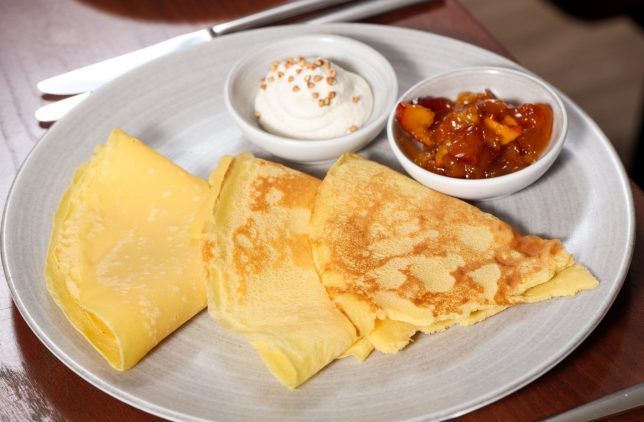 Pancakes – made with lupin flour (Photo: Stuart Martin/The i Paper)
The good news for those trying to cut carbohydrates is that lupin flour is also lower in starch and higher in protein than ordinary wheat flour.
Because the protein in lupin beans is high in nutritional quality, with all the essential amino acids needed in the human diet (unlike most other plant proteins), lupins were crowned a “superfood” of 2026 by Swiss agriculture body Biovision.
But the low carbs also means that cooking with lupin flour can be a bit different to using wheat flour, said Huggins.
The lupin onion bhajis that I tried next were yummy, but their texture was a little stodgier than normal – although not unpleasantly so. Their mouth feel was more like falafel.
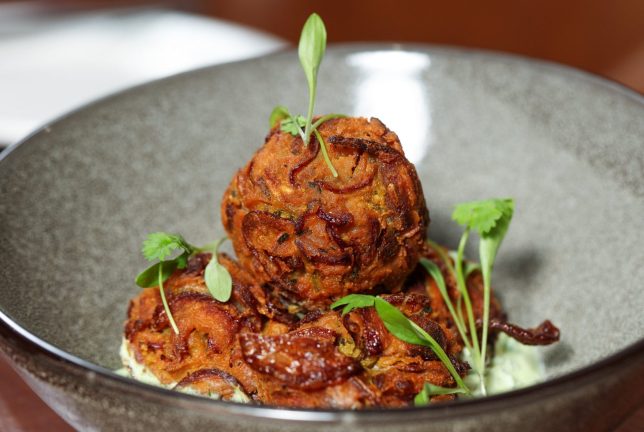 The texture of bhajis made with lupin flour was similar to falafel (Photo: Stuart Martin/The i Paper)
Lupins are not the only new food crops that may be coming to Britain. Chapman next showed me a chickpea bush he was growing. Chickpeas are already cultivated by a few UK farmers.
Chickpeas are also drought tolerant so could become a new staple crop if summers continue getting hotter and drier.
And the leaves are a delicacy, Chapman claimed, although the ones I tried were on the chewy side! I later learned I went wrong by picking some older, tougher leaves – I should have tried the fresh tips.
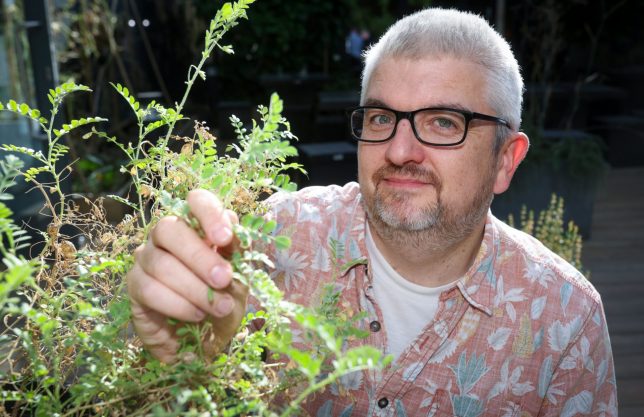 Mark Chapman shows off his chickpea plant (Photo: Stuart Martin/The i Paper)
Chickpeas themselves are much tastier, and Chapman said work needs to start to see where in the UK they grow best, which varieties are most suitable and whether there are risks from pests and diseases. “We need to get the research done now so we can be prepared,” he said. “We can’t have farmers growing thousands of hectares of them – then it all fails.”
Best crops for your home garden
What home gardeners grow is also going to need change, said Guy Barter, chief horticultural adviser at the Royal Horticultural Society.
There will generally be a northward shift of which crop varieties do best. “At the moment, apples and pears are mostly grown in Kent, Essex and Sussex,” he said. “It’s likely that fruits like that will be more successful further north.”
People living in the south of England will find it easier to grow produce we normally think of as continental, like melons, apricots and nectarines.
Chapman has been experimenting at home, growing a drought-tolerant pea-like plant from Africa called lablab. “I use the pods like mange-tout, and they’re really tasty in a stir fry,” he said.
Crops that currently do better in greenhouses, like some cucumber and tomato varieties, may be grown outside in future. And some crops like broccoli and cauliflower that are usually sown in spring could be sown in the autumn, as they can survive milder winters.
But we can’t assume all crops will be able to move northwards or into different seasons without a hitch. Fruit trees that like a hotter, drier summer may not cope with late spring frosts in Britain that could kill off their blossom, and stop fruits from forming, said Barter.
Climate change won’t be all bad for British growers, but it is hard to predict exactly which crops will be the winners and losers. The RHS is currently running a survey to find out how this year’s exceptional heat and drought affected British gardens.
As for me, one lesson I’m taking away is that lupin flowers are a must for my garden next year.
They are hardy perennials, so should survive even the coldest British winters, but more importantly, their drought tolerance means they should survive a summer like the one we have just had. And they will look beautiful too.
I’ve been reading
This year’s winner of the Royal Society’s Trivedi Science Book Prize is The Age of Alchemy: How Early Innovators Shaped Modern Chemistry, by Kit Chapman.
While we might think of chemistry as something that began in the European Renaissance, our Stone Age ancestors were the first pioneers of this scientific field. The book explores our early forays into metallurgy, medical potion-making and even attempts at making gold by processing vast quantities of urine.