
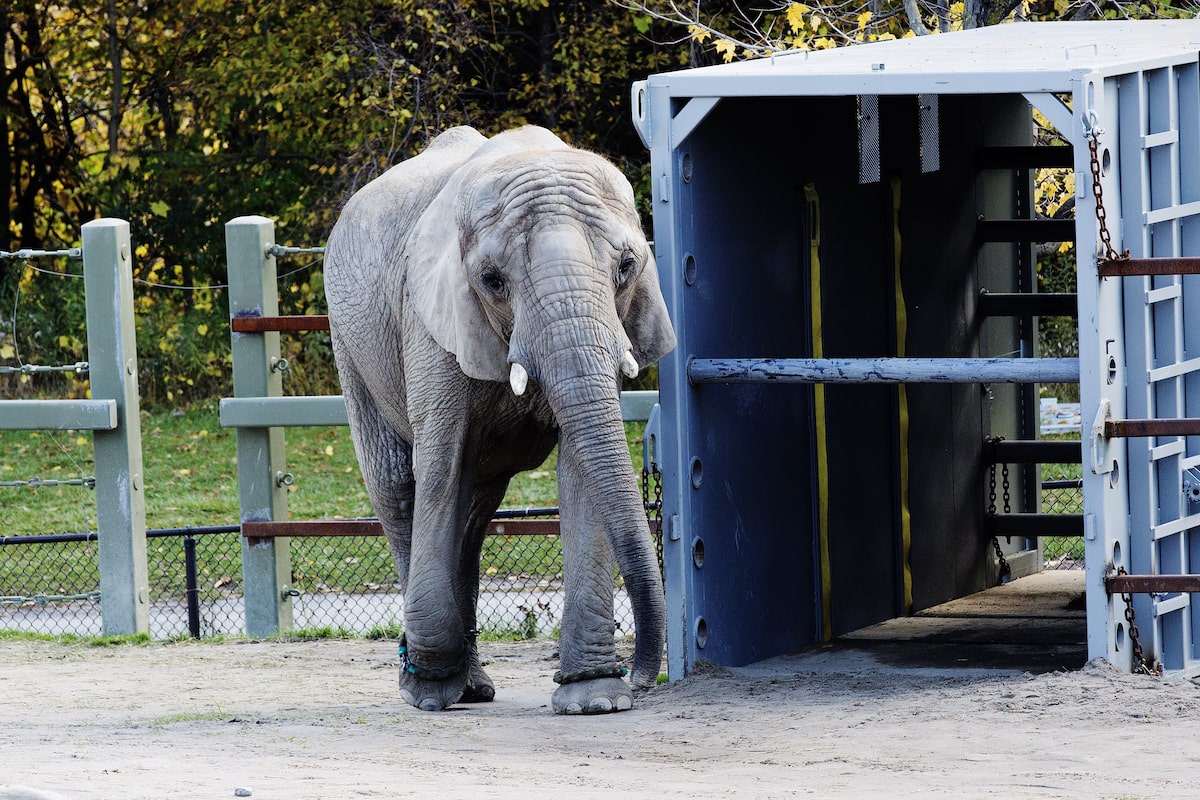
An elephant at the Toronto Zoo stands in his pen in October, 2013.Michelle Siu/The Globe and Mail
Andrew Westoll is the author of Born to be Wild: Reckoning with the Zoo in the Age of Extinction.
If there is a silver lining, however faint, to the Trump administration’s recent efforts to defang the Endangered Species Act, it is that we’ve all been reminded, for the first time in what feels like forever, of the fundamental crisis underlying every other crisis we’re facing right now: the biodiversity on our planet, otherwise known as “life itself,” is fast collapsing.
Rogue technologies and authoritarians may dominate the news cycle, but just off-camera, the Sixth Extinction – the disappearance of plant and animal species at an unprecedented rate, a cataclysm driven by human activity – continues to rage.
The modern zoo has long pitched itself as a force for good in the face of this emergency. To listen to most zoo leaders and their marketing departments, the zoo exists to help right the ecological wrongs of our species, to help inspire the next generation of animal advocates, and, most importantly, to help protect wild species and wild habitats into the future.
Since the late 1970s, when zoos first hitched themselves to the nascent environmental movement, these claims have become the equivalent of cultural wallpaper. To question them seems, to some, as ridiculous as questioning oxygen, or money.
Opinion: Why do we still accept the captivity of wild animals?
But I’ve just spent the past six years visiting major zoos in North America and Europe, interviewing dozens of zoo professionals and scholars, and immersing myself in the zoo literature, and I’ve emerged from these experiences convinced the story of the modern zoo is more accurately understood as a tale of broken promises.
When I think of the classic zoo animal, I don’t think of elephants, lions or gorillas. I think of the golden lion tamarin. The GLT, as it’s known among admirers, is a monkey about the size of a tree squirrel, covered head-to-tail in bright-orange hair. Ridiculously cute and curious, perhaps the closest thing to a Lorax come to life, the GLT is ubiquitous at major zoos around the world.
In the 1970s, wild tamarins were nearing oblivion, with only a few hundred left in Brazil’s Atlantic forests. Then a collection of zoos came to their aid. Through co-ordinated captive breeding programs and one of the most successful wildlife reintroduction efforts in history, 41 zoos in eight countries on three continents helped save the GLT from extinction.
The rescue of the golden lion tamarin is akin to legend in zoo circles. The same goes for the California condor, the Arabian oryx, the Przewalski’s horse and a handful of others. These stories are routinely trotted out by zoo associations as proof that the modern zoo is punching above its weight in terms of wildlife conservation.
But the truth is, successes like these are incredibly rare. The vast majority of zoo-led reintroductions of endangered species across the 20th century failed to result in self-sustaining populations in the wild. It turns out that restocking a wild population is far too complicated, expensive and risky for zoos to reliably pull off.
Golden lion tamarins can be found at major zoos around the world.Pedro Carrilho/Getty Images
Instead of becoming a “guiding light” for the industry, write zoo veterans Mark Stanley Price and John E. Fa, the introduction of zoo-bred animals into the wild “proved to be a shooting star … providing an eye-catching attraction but not long-term illumination for conservation.”
So, if zoo animals aren’t heading back to their native habitats, how else might we understand the modern zoo’s purpose? What do you call a lifeboat that is destined to remain at sea? The philosopher and ornithologist Robert Loftin thinks of zoos as “perpetual Arks,” since 99 per cent of those aboard will never disembark. And once you dig deeper into the makeup of zoo collections, even the Ark metaphor loses its sheen.
If the zoo was really an Ark, the animals aboard would be those most in need of our assistance. But studies routinely show that zoo collections are biased toward species that zoo-goers want most to see, not those most threatened with extinction. Only about a quarter of terrestrial vertebrates found in zoos are facing extinction in the wild.
Breeding programs at zoos don’t prioritize threatened species, either. More than half the mammal and bird species with co-ordinated breeding programs in North American zoos aren’t even threatened in the wild. As zoo consultant Sarah Spooner writes in Biological Conservation, “The current global zoo population is no more representative of threatened species than if it were selected at random.”
It is this reality that leads historian Elizabeth Hansen to write that breeding programs serve “both the ideology of environmentalism and the day-to-day needs of zoos to maintain their collections.” The babies that result may be redundant to actual conservation efforts, but they sure are a hit at the box office.
Marsha Lederman: Why are we still keeping elephants in zoos?
Meanwhile, the populations managed by zoos simply aren’t viable. According to the Conservation Breeding Specialist Group at the International Union for Conservation of Nature, “most zoo populations are not being managed at adequate population sizes, reproductive rates, genetic diversity levels, and projected long-term viability that would allow them to contribute positively to species conservation.”
Let all of this sink in for a moment. Zoos are failing at the very tasks that should be their bread and butter. If the zoo is indeed an Ark, it appears to be slowly sinking. And hardly anyone aboard is sounding the alarm.
Another promise the modern zoo makes is that to pass through the turnstiles is to embark on a profoundly educational experience. Every parent, elementary school principal and summer camp director takes the zoo at its word here, that to buy a ticket is to purchase some measure of environmental enlightenment.
But research into the educational impact of a zoo visit is still in its infancy, and the results so far are underwhelming. The most encouraging study was a large meta-analysis from 2025 that suggests zoos do facilitate a detectable increase in conservation knowledge in their visitors. But the impact was modest at best, especially in light of the modern zoo’s claim that education is a fundamental pillar of the institution.
And if we’re going to talk about education, it seems reasonable to consider what else a visit to the zoo might be teaching our children. If the medium is indeed the message, what else might our kids intuit from spending the day at a place founded on the art and science of holding magnificent animals captive, a place purpose-built to separate humans from every other creature on Earth?
Far from home, Hong Kong’s wild cockatoos could save their species from extinction
I concluded my years of reporting on the modern zoo with an expedition into the rainforests of Central Africa, to a region known as “the place where humans don’t go.” Given the zoo industry’s claims that field conservation is their very top priority, I wanted to experience a major conservation project that was actually being led by a zoo.
After three days of gruelling travel, I met Dr. David Morgan from the Lincoln Park Zoo at a remote gorilla and chimpanzee research station set deep in the Congo jungles. The Goualougo Triangle Ape Project is indeed a world-class undertaking. Thanks to the remarkable discoveries Dr. Morgan and his co-director, Dr. Crickette Sanz, have made about chimpanzee tool-use there, Goualougo is now a legendary scientific outpost and a protected area, having been wrapped into the boundaries of a nearby national park.
But the more I looked into the actual contributions of zoos to field conservation, the more I realized that Lincoln Park’s continuing investment into Goualougo is a dramatic outlier. The world zoo community gives about USD$350-million a year to field conservation, which sounds like a lot. But when major players such as London, the Bronx, San Diego, Houston and Disney’s Animal Kingdom are removed from the equation, that number plummets.
The reality is, when it comes to field conservation, just a handful of major zoos are doing the majority of the heavy lifting for the industry. Most zoos give less than 2 per cent of their operating budgets over to wildlife and habitat conservation, supposedly their top institutional priority.
This should surprise us all. I’ve long been skeptical of the zoo’s benevolent claims, but until I started digging into them, I had no idea the extent to which I was in the dark.
Cheetah cubs play in their enclosure at the Prague Zoo in the Czech Republic in September.Eva Korinkova/Reuters
And notice that I haven’t even raised the most common (and damning) criticisms of the modern zoo: those that involve the welfare of the animals themselves. There is good evidence that many of the most popular, large-bodied, or wide-ranging species in zoos – such as elephants, gorillas, chimpanzees, giraffes, and big cats – regularly engage in stereotypies, or abnormal behaviours, which are considered by experts to be reliable indicators of compromised welfare. Some scholars even believe these behaviours are indicative of central nervous system disruption, otherwise known as brain damage.
The ethical quandary at the heart of the modern zoo – the consequences of breeding wild animals for a life they didn’t evolve, or choose, to live – is the problem that just won’t go away. But even without solving for it, the argument that the modern zoo has lost its way, or never really found it in the first place, is now extremely convincing.
Some zoo professionals genuinely believe, without a trace of irony, that the zoo’s time has finally come, a mere 250 years after its modern invention. But others I spoke with believe the zoo has been in a losing battle to maintain its social licence for about 50 years now, and given the limitations they face and the magnitude of the Sixth Extinction, the permission we’ve granted the zoo to conduct its business on our behalf is increasingly in peril.
Progressive zoo leaders have been calling for a “zoo renaissance” for decades now. But having spent the past six years peering over their walls, it’s clear to me that rebirth is barely on the horizon. The modern zoo has clearly broken its promise to society. The question that remains is whether society should break its promise with the zoo.