
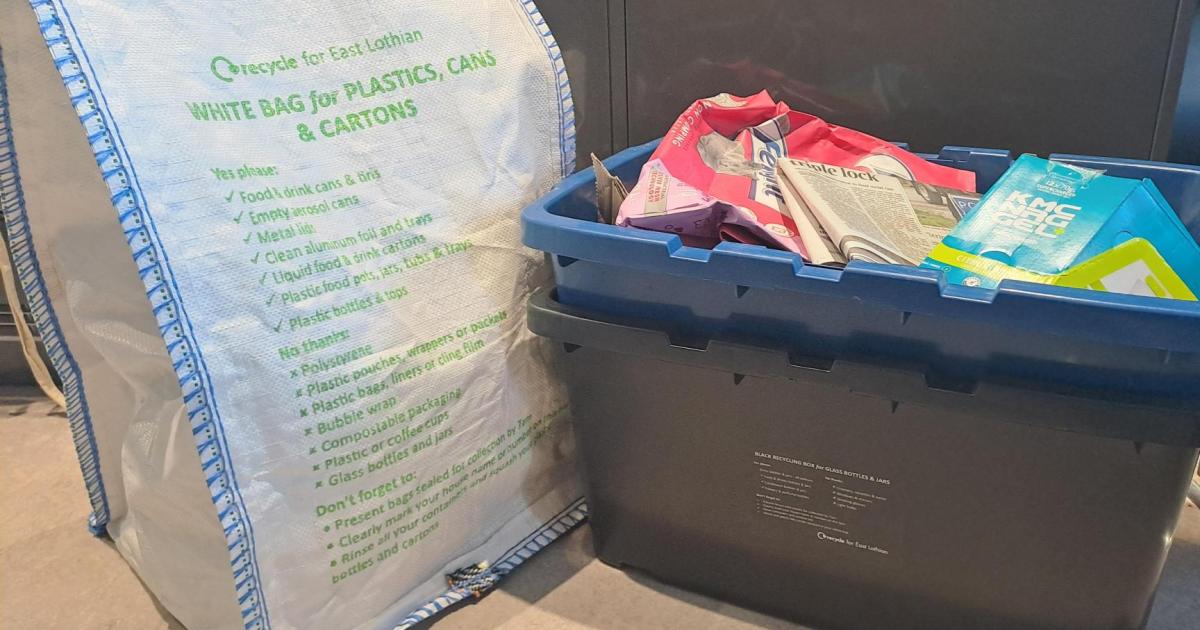
Households in the county saw just 3.95 per cent of their kerbside recycling rejected due to contamination during 2024/25.
The figures, obtained in a new Freedom of Information (FOI) request, put East Lothian top of the lowest-contamination local authorities.
A spokesperson for East Lothian Council thanked residents across the county for their efforts.
They said: “We’ve invested in more ways to help households recycle and our kerbside sorting system greatly minimises any contamination of mixed products.
“The council’s service provision of delivering weekly recycling collections and three-weekly general waste pick-ups is having a significant impact on raising our recycling levels and lowering the amount of waste going to landfill.
“We also want to thank residents for their continued use and support of our recycling services, which plays an important role in protecting our environment while helping to tackle the climate emergency.”
Among other councils in Scotland that supplied usable data, East Lothian Council’s rate compared with 12 per cent in Scottish Borders and 23.7 per cent in the City of Edinburgh.
East Lothian Council is ranked ahead of City of York (four per cent), Milton Keynes (five per cent), Ceredigion in Wales (seven per cent) and the London Borough of Southwark (10 per cent).
At the other end of the scale, Bradford (35 per cent) was ranked as having the most household recycling rejected.
The research was commissioned by recycling not-for-profit Every Can Counts.
The organisation claimed that the scale of the variation showed that contamination remained a significant challenge.
Every Can Counts submitted FOI requests to 171 UK local authorities in April.
Of the 120 councils that responded, 55 supplied a usable contamination rate for the 2024/25 financial year and form the final league table.
Chris Latham-Warde, programme manager for Every Can Counts, said: “Contamination is a real problem, but it is one we can do something about.
“Clear and easy-to-understand guidance from local authorities can help residents know exactly what belongs in their recycling and how items should be prepared, so they can use their local recycling system correctly.
“The UK has effective and efficient infrastructure for recycling drink cans, but consumers need to know how to recycle them correctly in order to play their part.
“A can recycled today can be back on the shelf as a new can in as little as 60 days, ready to be recycled all over again – so every can really does count.”