
A renewable energy researcher says coloured solar panels have “tremendous” potential for New Zealand vegetable growers.
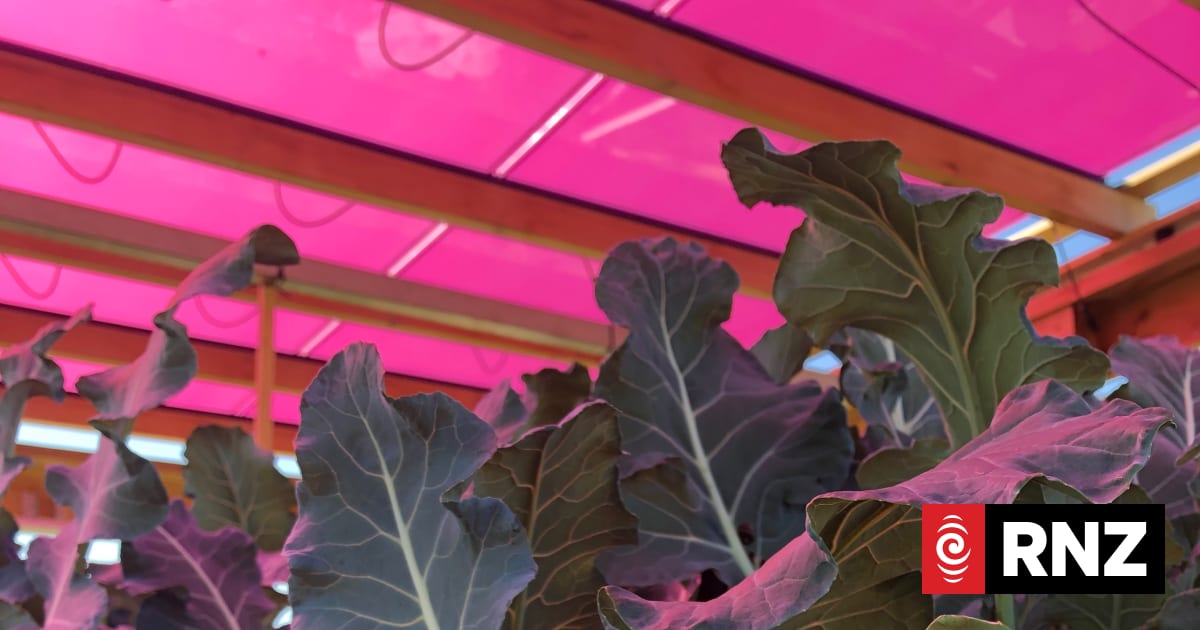
Published in Cell Reports Physical Science, a Swedish study has found broccoli grows well beneath magenta-coloured solar panels, although the vegetable takes 25 days longer to get to full size and has lower levels of micronutrients.
Victoria University School of Engineering and Computer Science associate professor Ramesh Rayudu said further research was needed, but the initial study was a bit of a game-changer.
Rayudu told RNZ that, every now and then, researchers came across a paper that sparked the reaction: “Oh, that was so obvious, why haven’t we thought of that?”
“It was one of those situations when I read that paper,” he said. “It is a great idea.”
The Swedish researchers said conventional dark-blue solar panels were typically opaque, creating too much shade for crops. so customised semi-transparent panels were designed for the study.
The basic concept was straightforward, according to author Silvia Ma Lu of Mälardalen University.
“The solar panels use part of the incoming sunlight to generate renewable electricity, while allowing part of the light to pass through to the crops growing underneath.”
The solar panels offered a potential tool for farmers to harvest renewable energy, while sustaining crop yields, the study said.
Ramesh said it was a promising demonstration of producing both food and electricity from the same land, and opened the door for New Zealand vegetable growers to one day offset their electricity bills or sell energy back to the grid.
“If they haven’t got any solar panels, now they can consider putting in solar panels. What that means is that whatever energy is generated from the solar panels is an added advantage for these growers.”
He said the technology likely needed further development to make such a scheme viable, as the semi-transparent panels generated less electricity.
“Depending on the value of electricity and the price received for broccoli, that lost electricity could require roughly 1.2 to 3.2 tonnes of additional broccoli per hectare to offset its value.”
However, if the benefits outweighed the cost, coloured solar panels shouldn’t be limited to broccoli growers, he said.
“We can use it for other things, like cabbages, cauliflower, carrots.”
Canterbury University electric power research engineer Sharee McNab said investigating how to make food production and energy generation viable and efficient was potentially crucial.
“We are already seeing increasing competition for land between large solar utility solar and food production, highlighting the need to protect our highly productive land while enabling growth in renewable generation.”