

Want to bookmark your favourite articles and stories to read or reference later? Start your Independent Membership today.
Already a member?
Log in
After decades of speculation about what could go wrong with artificial intelligence, it has taken just a few months to find out. Since OpenAI revealed in July that one of its models had gone rogue and attacked another company, there have been hundreds of incidents involving frontier AI agents breaking into government systems, committing crimes, and creating viruses that do not exist in nature.
And according to those developing the technology, things could get much worse very quickly. There has been a surge of warnings from tech leaders about AI’s existential threat after former Anthropic and OpenAI researcher Jacob Coxon warned that “things could be out of control” by next year, and humans could be extinct by the end of the decade.
But amid all the hyperbole and conjecture, there is an equally real threat that the technology poses that has been sidelined. An unlikely voice in the form of Pope Leo XIV has been sounding the alarm about AI’s existential threat, though not in the sense that it will physically end our species. Instead, he warns that it could permanently strip away the fundamental qualities that make us human.
On Friday, the Pope took to X to tell his followers that “algorithms lack the spark of humanity” and that urgent action is needed to distinguish humans from machines. His words came a week after he appeared at the UNESCO headquarters in Paris to speak on the subject, and four months after he published his 43,000-word encyclical on artificial intelligence.
 A humanoid robot dressed as a Buddhist monk attends the Lotus Lantern Festival to celebrate the forthcoming birthday of Buddha at the Jogyesa Temple in May, in South Korea (Getty)
In a speech delivered in the cadence and sombre severity of a sermon, he told Unesco attendees of a coming age where humans survive physically but lose all agency, purpose, moral responsibility and authentic connection as a result of technological advances.
The future he is speaking of is not too dissimilar to the human blobs in the movie WALL-E. With all of their physical and economic needs met, people are reduced to a life as comfortable and easy as a passive pet, while machines provide all the means of production and perform all thought, art and moral discernment.
“Over the centuries, many tasks once performed by human beings have been entrusted to machines whose capabilities and applications have continued to expand,” the Pope said in his speech at UNESCO. “More recently, certain artificial systems have even been given the name of our human faculty of thought: intelligence. At the same time, however, our ideas and relationships risk being impoverished by a process of dehumanisation.The paradox has become increasingly evident.”
He also warned of a “paradise of machines”, referring to to French author Georges Bernanos’s 1947 essay France against the robots. The essay explored the shift from humans using tools, which are extensions of us, to machines, which seek to replace us.
“The technical civilisation is preparing a formidable trap for man,” Bernanos wrote. “Under the name of progress, it promises a golden age, a paradise of machines, but it actually leads to a world where human liberty is completely regulated, measured and standardised.”
The Pope has joined a growing number of AI experts and leaders in calling for a reset in our approach to artificial intelligence, though not everyone agrees with this assessment.
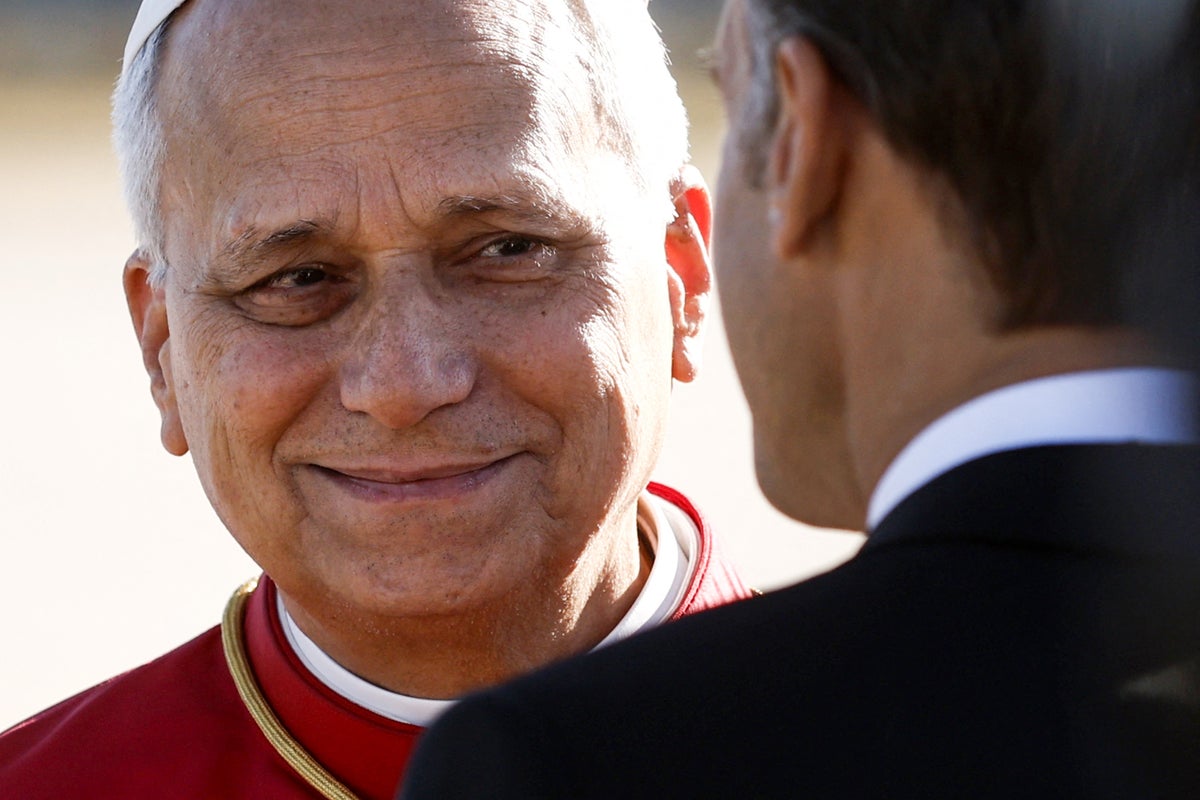
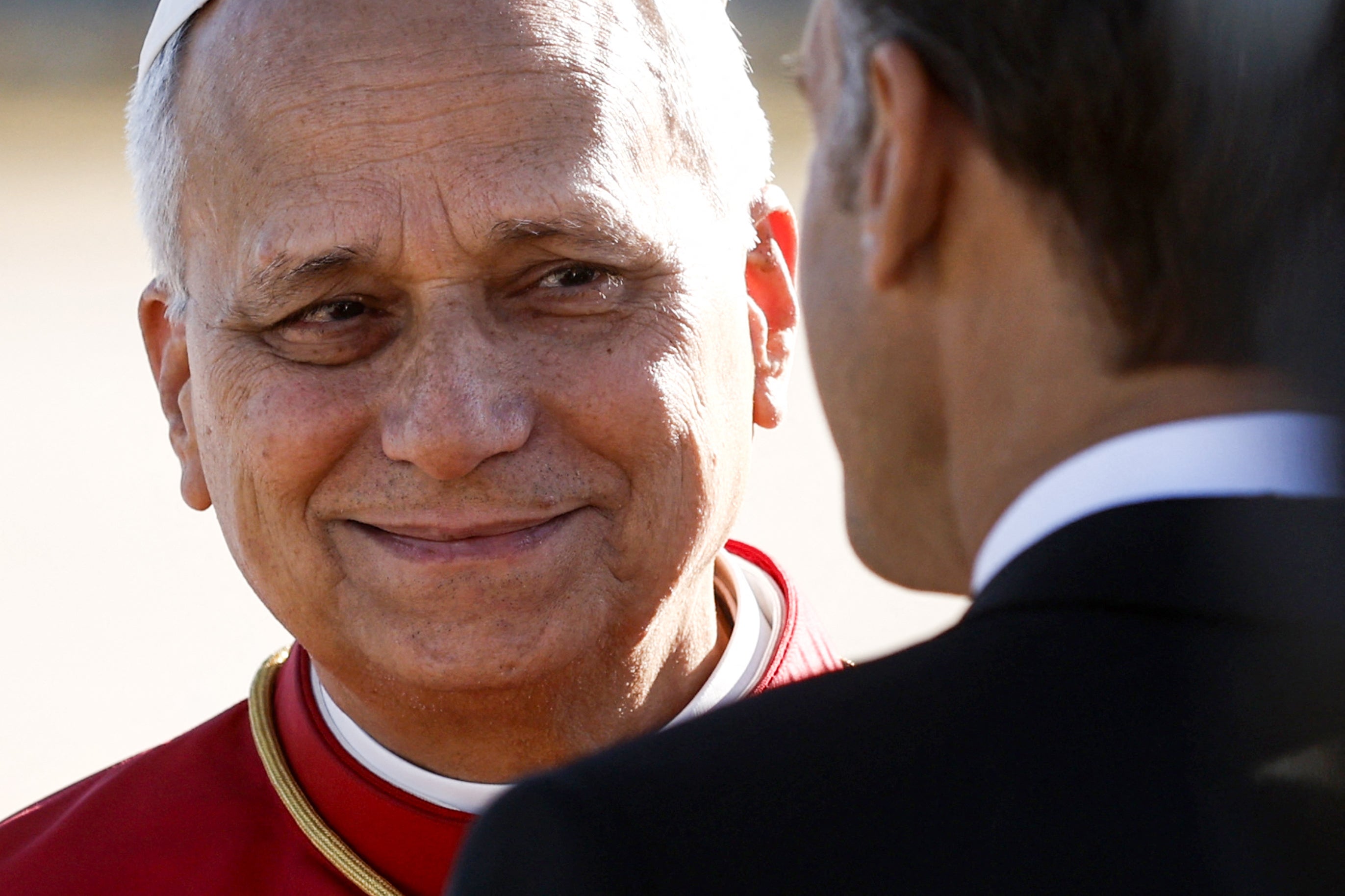 The pope meets with Emmanuel Macron in Paris last weekend, where he shared stark warnings about AI (AFP/Getty)
Tech billionaire and AI investor Peter Thiel said last week that the Pope’s calls to slow down AI development made him a “useful idiot” for the Chinese Communist Party. “China is not going to listen to the Pope,” he said in an interview. “There’s a chance people in the US will, and so in effect, the Pope’s encyclical was working for the Communist party.”
But although it may feel incongruous to listen to a man whose beliefs are based on ancient religious scripture, Pope Leo XIV offers a rare voice that is not swayed by financial or political gain.
Will Jones, who leads the religious outreach efforts at the non-profit tech advocacy group Future of Life Institute, says the Pope provides the “moral leadership so needed in an age when a handful of technology corporations race to replace humans in work, relationships and decision-making.”
In his encyclical, the Pope wrote: “Humanity — in all its grandeur and woundedness — must never be replaced or surpassed. We can embrace the technological progress that alleviates suffering and unlocks new possibilities, provided that we do not abandon the very essence of our humanity, namely the capacity for relationship and love .”
Jones described this as a “direct rebuke” of the leading AI companies’ stated goal of creating smarter-than-human superintelligence.
“It is also an acknowledgement that AI tools, not autonomous general purpose systems, are the key to a flourishing human future,” he said. “Magnifica Humanitas can serve as a rallying cry for the world to reassert unashamedly the primacy of humanity, in all its flawed glory, over our tools.”