
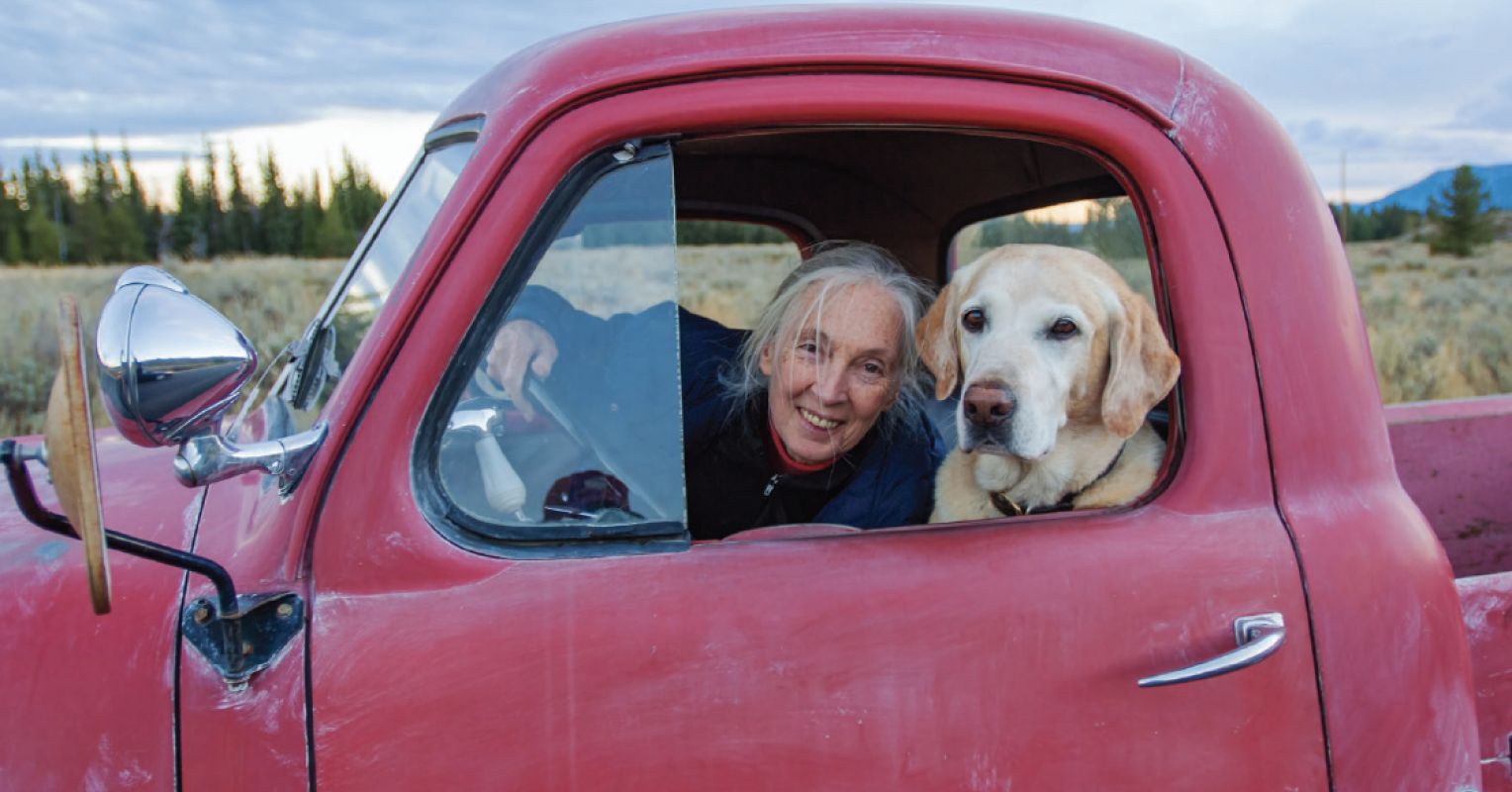
By Marc Bekoff, Ph.D. and Carolyn Cott
On October 1, 2025, Dr. Jane Goodall passed away at the age of 91. In her 65 years of research, advocacy, and persistence, she reshaped our understanding of non-human animals and dismantled the longstanding myth of human exceptionalism and separateness.
Before she stepped into the dense canopy of Gombe Stream, Tanzania, in 1960, mainstream science treated non-human animals largely as stimulus-response, instinct-driven mechanisms. Before her work, ethology—the scientific study of animal behavior—dismissed the suggestion that animals have minds, emotions, and individuality as unscientific—the cardinal sin of anthropomorphism.
Goodall proved her critics wrong, not with hostility but with rigorous, decades-spanning evidence.
The research that shifted our lens on who we are and who other animals are
Goodall’s scientific research permanently altered the artificial boundary between humans and the rest of the natural world. Her book The Chimpanzees of Gombe, published in 1986, remains a classic, and she wrote or coauthored many other books. Goodall also won many awards for her scientific and humanitarian work. Her significant contributions include, but are not limited to, these areas:
Making and using tools by nonhumans: In November 1960, she observed David Greybeard (one of her named chimpanzees) stripping leaves off a twig to “fish” for termites, shattering the long-held belief that humans alone made and used tools. People didn’t believe her until she showed them a video. The discovery prompted her mentor, Louis Leakey, to cable his now-famous line to Jane: “Now we must redefine tool, redefine Man, or accept chimpanzees as humans.”
Changing the emotional landscape: Goodall documented deep maternal bonds, the profound grief of orphaned chimps, playful joy, spontaneous acts of compassion, and enduring social ties.
Changing how we refer to animals: She also named the chimpanzees and talked about their unique personalities, which, at the time, was taboo for most scientists. This had a lifelong influence on Marc’s research.
Documenting unique complex cultural traditions, patterns of social communication, and social relationships: Goodall demonstrated that primates possess distinct regional customs, complex non-verbal communication, and intricate social dynamics, including calculated diplomacy, coalition building, and strategic warfare.
Suggesting that chimpanzees performing what she called “waterfall dances” are experiencing wonder and awe.
From discovery to ethical obligation: Using what we know on behalf of other animals
For Goodall, scientific discovery was never an isolated end in itself—it was an invitation to apply that knowledge to improve the welfare of the other sentient beings with whom we share the earth.
Following a 1986 conference in Chicago where she saw covert footage of research chimpanzees in barren steel cages showing signs of severe psychological distress, Jane transitioned from field researcher to full-time advocate.
She campaigned tirelessly to end invasive medical testing on chimps, serving as a key voice in the advocacy coalition that secured passage of the U.S. CHIMP Act to retire laboratory primates to sanctuaries. In 2015, her persistent advocacy contributed to a historic ruling that eliminated the regulatory loophole classifying captive chimps as merely “threatened” and secured full legal protection for them under the Endangered Species Act.
Through works like Harvest for Hope: A Guide to Mindful Eating, her ethical scope reached far beyond primates to challenge factory farming by affirming that farmed animals possess an equal capacity for fear, affection, and family.
The Power of “Jane Magic”
Goodall recognized that all living beings share an inextricably linked fate—that what we do to the natural world, to animals, we ultimately do to ourselves. Human and non-human animals share a single tapestry of life—and every individual within it holds an intrinsic right to exist free from harm. Her vision helped inspire the principles of compassionate conservation—a holistic ethic uniting human progress, animal well-being, and planetary health. She and Marc argued that conservation goals must never treat individual animals as disposable objects. A firm, quiet, and lighthearted warmth anchored her global influence.
Jane’s contributions are immeasurable. Having worked very closely with her for close to 30 years, I (Marc) don’t think a day went by where I didn’t learn something from her, sometimes directly, sometimes indirectly, often tangible, often intangible. When we were together or talking over Zoom, we would toast one another because we shared a great liking for peaty single malt scotch, which she called her “cough medicine.” Jane was a first-rate scientist, a careful reader and micro-editor, a superb and engaging storyteller, an indefatigable humanitarian, and she had a heart of gold.
Jane was a bottomless well; she sent out messages of peace and hope. I feel blessed to have had countless conversations with her in person, on the phone, and over Zoom, and to have travelled with her to discuss science and share stories and jokes. She had a wonderful sense of humor and often complained that people didn’t realize that she had that light side.
I miss Jane every day, but I still talk with her, sometimes to ask her opinion on things, sometimes to say hello and tell her a joke. All in all, Dr. Jane, as many people referred to her, may be one of a kind. I will do all I can to keep “Jane Magic” alive forever.
The Science of Empathy, Kindness, and Sentience
Animal Behavior Essential Reads
What Jane Goodall understood and demonstrated is that empathy and kindness are not the enemies of scientific rigor. Recognizing that another living being is sentient, has feelings, and a distinct worldview clears our vision rather than clouds it.
She also declared, “Every individual matters. Every individual has a role to play. Every individual makes a difference.”
A year after her passing, her radiance and mission endure. Perhaps the greatest tribute we can offer here is simple: Always treat every single living being with the compassion and reverence they deserve.
Carolyn Cott is the founder and writer of TheKindLife.