
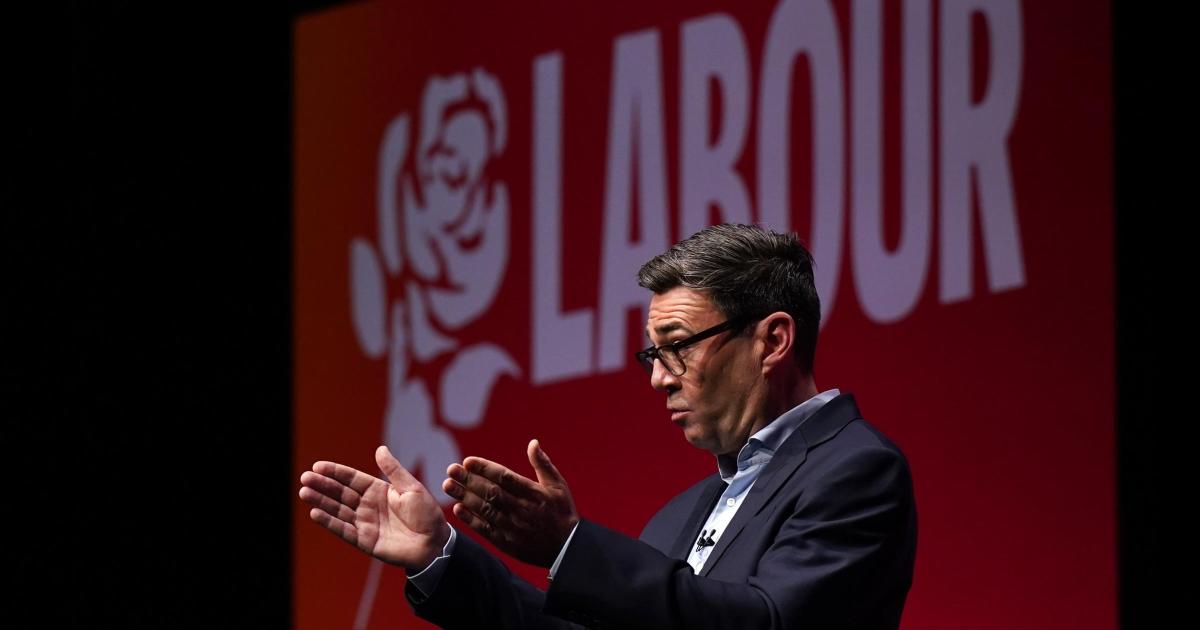
I added the last of those three suggestions because I have been reflecting on my reaction to Andy Burnham’s speech at the Labour Party conference last week.
I should lay my cards face up on the table. I have never been a fan of Burnham. I wasn’t when he stood to be Labour Party leader in 2010.
Andy Burnham
When he lost to Jeremy Corbyn in 2015, his arguments on the economy were neoliberal to the core, at a time when I was arguing for Jeremy and how we could take a very different approach to economic management in this country.
Since then, and especially since he became Prime Minister and appointed John Healey as Chancellor of the Exchequer, nothing has persuaded me that Burnham has learned anything about our economy and how it works.
The man is still the unreformed neoliberal he was as a junior minister in the Treasury under Gordon Brown before the global financial crisis of 2008.
It was not, however, Burnham’s economics that irritated me most about his speech, even though almost every promise he made within it will be impossible to deliver if Labour are going to, as his Chancellor has promised, stick to the fiscal rules that Rachel Reeves passed on to Burnham, but which she in turn inherited from Jeremy Hunt, Kwasi Kwarteng, Rishi Sunak and all those who went before them.
Instead, it was his comments about the identity of the country he thinks he governs that left me fuming that day and now.
READ MORE: Nigel Farage interviewed by standards commissioner over £5m undeclared gift
I was furious that Burnham could stand on a Labour Party stage and declare himself a patriot, aping the performances of Nigel Farage and Rupert Lowe when he did so. This is gutter politics from the far right.
I was as annoyed when he attacked John Swinney and linked to the death of Burnham’s father Swinney’s comment that Burnham would be the last prime minister of the UK. Swinney was entirely unaware of Burnham’s bereavement when he launched an entirely appropriate political attack.
What irritated me most of all, however, was the paradox of this man of Irish origin, who has now adopted the mantle of English imperialist exceptionalism to appease the far right.
Burnham is using his position to claim his right to deny the people of Scotland, Wales and Northern Ireland choice about their countries’ futures while, at the same time, from the same stage, suggesting that the issue of rejoining the European Union could be considered.
As everyone who supports the cause of Scottish independence knows, the late Alex Salmond’s comment about the once-in-a-generation opportunity which the 2014 referendum represented, made as a minor remark, has been exploited by Unionist politicians ever since to represent that this was the fixed and agreed position of all parties at that time, when it was, of course, nothing of the sort.
Now we hear Burnham making the same argument with regard to independence for the three Celtic nations within the United Kingdom, all of which have governments committed to that cause, when at the same time he is now suggesting that a referendum that had massive constitutional consequences for the UK, and in particular Northern Ireland, might be revisited, and even then without any mention of another referendum being on the agenda at all.
The total arrogance of Burnham’s implicit suggestion that alone he can decide what Scotland, Wales and Northern Ireland want because he is the Prime Minister of England (and let’s be clear, most of what he talked about in his speech did only refer to England) left me feeling more alienated from Labour than I have been for a very long time, and I did not think that was going to be possible, having seen the back of Keir Starmer.
At the same time, Burnham’s comments about the EU left me questioning his judgment on that issue as well. What he, and few others, seem to appreciate is that whatever the EU was when we left it, it is no longer that.
Andy Burnham
The rise of the far right in Germany and France now affects both countries’ involvement in the EU hierarchy of power, potentially destabilising its future.
At the same time, we know the EU handled Viktor Orban’s government in Hungary and its far-right policies very poorly, and it did little better when the far right was in power in Poland.
If the EU cannot stand up against the rise of fascism, which was the primary motive for its creation in the 1950s, then what is it for?
If the answer to that comes down to economics, there is little reason for encouragement either.
Neither the UK now, nor Scotland when it gets its independence, should possibly want to be a member of the euro. One of the most critical powers that defines a country’s existence is its ability to create its own currency and impose taxes payable in that currency, which then gives it control of its economy. That exercise should, if it is run by a government that believes it is operating on behalf of, and in the interests of, the people of that place, provide it with the power to deliver the kinds of social democratic policy that I believe the people of Scotland will demand when they can choose their own genuinely independent government in Edinburgh.
Using the euro as a currency virtually denies that ability to any country that uses it.
While I am aware that Sweden, Poland and others manage to resist the pressure to use the euro, there is no guarantee that the conditions for new entry to membership will provide that opportunity, and that now makes me exceptionally wary of any such process.
What Andy Burnham is doing by suggesting that the UK might rejoin the EU, then, is suggesting that he might abandon sovereignty over the whole of the United Kingdom for the sake of a goal whose advantages are not now at all clear.
So, in my opinion, align with the customs union and the single market, by all means. Seek free movement of people to the greatest degree possible, most certainly, because this is a cause which should matter to all those who value freedom and human rights.
But sign up to all the rest now? If you’d asked me between 2016 and 2020, I would have argued that we should return. But now? I am not so sure. A wise person looks at the evidence, reflects, and changes their mind when it is appropriate, and the case for the EU is looking increasingly weak to me.
That fact, and the deliberate ploy Andy Burnham exercised to bring this back into play, just fuelled the anger for the other reasons already noted. Everything about his speech confirmed all that I feared. This is a man unwilling to play politics on a level playing field.
This is a man who is out of his depth beyond the boundaries of Liverpool and Manchester. And this is a man who is contemptuous of the Celtic nations of this country. He deserves a contemptuous response as a consequence.