
Marc David Jacobs, an amateur film historian and writer, has discovered evidence that the world’s first ever feature film was in fact recorded and premiered in Scots and not in English.
Jacobs, who has a keen interest in Scottish film especially in the period around the 1930s, discovered that a Glaswegian play, Till the Bells Ring, premiered in Edinburgh a whole year before the widely considered first sound feature, The Jazz Singer, debuted in New York in 1927.
It wasn’t until Jacobs was looking through the British Film Catalogue that he realised there were some irregularities around Till the Bells Ring’s date citations.
READ MORE: Anger as pipers call on BBC to U-turn on axing World Pipe Band Championship coverage
“It just didn’t tally,” Jacobs told The National, adding: “I started delving into it, especially because it said it was from 1933 and I saw some other stuff that said it was from 1926.
“The more and more I looked into it, clearly the production was made by a Scottish company, by a Scottish writer-director, Scottish cast, Scottish setting, all this stuff, but then also it clearly had this sort of place in history in terms of it kept being referred to as kind of the first modern film.”
Jacobs discovered that Glaswegian playwright Graham Moffat had hired De Forest Phonofilms, based in London at the time, to make an adaptation of his 1908 play Till the Bells Ring.
The film’s sound technology was widely seen at the time as a novelty best suited to lectures and short comedies.
However, Moffat’s ambitious project featured his entire touring company performing with synchronised dialogue, which he described as Lowland braid Scots, throughout the film’s 44-minute run time.
The film cast six actors and a dog, and starred Graham Moffat and his wife, Margaret, who was also one of the first Scots arrested for suffragist actions, alongside their daughter Winifred Moffat.
Jacobs explained that after a disastrous private demonstration with faulty equipment, possibly followed by a trial run at a London music hall, the film was finally presented for the first time in any cinema on October 11, 1926, as the main feature at Poole’s Synod Hall in Edinburgh.
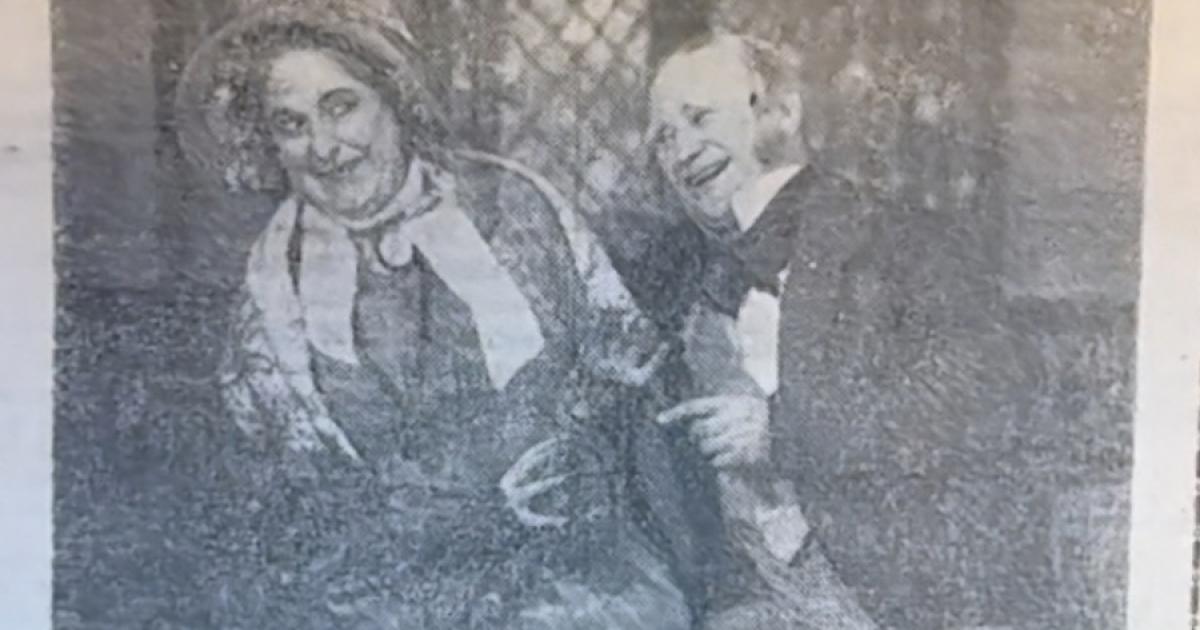
The Edinburgh Evening News hailed Till the Bells Ring as a cinematic landmark, with one reviewer claiming “even America has never attempted such a work”.
Till the Bells Ring review in the paper in 1926 (Image: Marc David Jacobs)
The review added: “So perfect was the synchronisation between the image on the screen and the broad Scots dialogue spoken by the image, that one might quite well have been listening to a legitimate stage version of the comedy.”
Jacobs said: “It became apparent that this was the very first example of that anywhere in the world, you know, a year before Hollywood, three years before the rest of the British film actually caught up to it.”
However, he explained the film then disappeared for several years until it was re-released in 1933 as a tax dodge by an unscrupulous exhibitor, who marketed it as a new film, leading in later decades to its being mislabelled as a 1930s production.
READ MORE: SNP urge Andy Burnham to ‘wake up’ as key policy pledge delayed
Jacobs said it was “ironic” that the company De Forest Phonofilms, who’d been ahead of the game with its technology, had gone out of business because they had run out of money running all their experiments, so had to sell their library.
“This guy finds out that there’s this film from 1926 that’s never kind of really been talked about and so he could buy it, market it as a new film, and therefore meet his British quota,” he said.
“So weirdly because that’s the first time any proper reviews of it are written about because it’s the first time that sort of somebody’s put it out as a distributor rather than a kind of independent production.
“It then gets misread by people later on.”
Jacobs, who moved from Los Angeles to Galashields in 2011 and is one of the co-founders of the Scottish Queer International Film Festival, said that he initially made the discovery three and a half years ago.
Marc David Jacobs (Image: Lisa Evans)
But he said that despite presenting his findings to the British Film Institute (BFI), nobody has yet acknowledged the implications it has on the history of world cinema.
“Having uncovered it, I was even more astonished by the complete lack of interest in that story,” he said.
“Maybe I shouldn’t have been: British cinema has always been neglected, and nowhere more than in Britain itself.
“It was as if it was impossible for anyone to believe that a crucial piece of world cinema history could have come out of a tiny London studio hired by a pawky Glaswegian playwright. But it did. And nearly a century after it was last seen, the time has finally come for the world to recognise Graham and Maggie Moffat’s world-beating achievement.”
Jacobs said he also believes one of the main reasons the film is “completely forgotten” is because it’s not a film that had been written about by “a London journalist”.
He said: “It’s almost this kind of footnote in history because it only ever shows in one cinema, effectively publicly.”
READ MORE: Scottish Deputy FM fires warning shot to Westminster at Plaid conference
Jacobs added: “It’s one of these things, I think just because it doesn’t fit the narrative, people have almost thought like it’s, it’s kind of like junk data.”
The amateur film historian also managed to locate an incomplete nitrate print of Till the Bells Ring in the BFI National Archive in Hertfordshire, which he says is likely the only surviving copy of any part of the film.
The print has over half its original length, and crucially includes the film’s opening and closing reels, which appear to date from its original 1926 exhibition.
Jacobs said it has likely never been shown privately or publicly since being acquired by the BFI over half a century ago.
“It’s sort of a miracle of miracles that there’s a copy of the film that exists,” he said. “Especially from an era where like more than half of the films have been lost.”
Till the Bells Ring (Image: Marc David Jacobs)
Jacobs explained that, due to the print’s age, its condition is “not great” and is likely to deteriorate more.
He said: “I think it deserves to be restored as a landmark of not even film culture, just sort of world culture period.”
Jacobs hopes the film can be restored and preserved due to its cultural importance not just to Scotland’s film landscape but to the world.
He is also calling on the BFI to supply the print so that the film can be shown once again in Edinburgh for the centenary of its release.
“It would be amazing to bring it back to Edinburgh for the second time that it was ever shown in a cinema,” he said.