
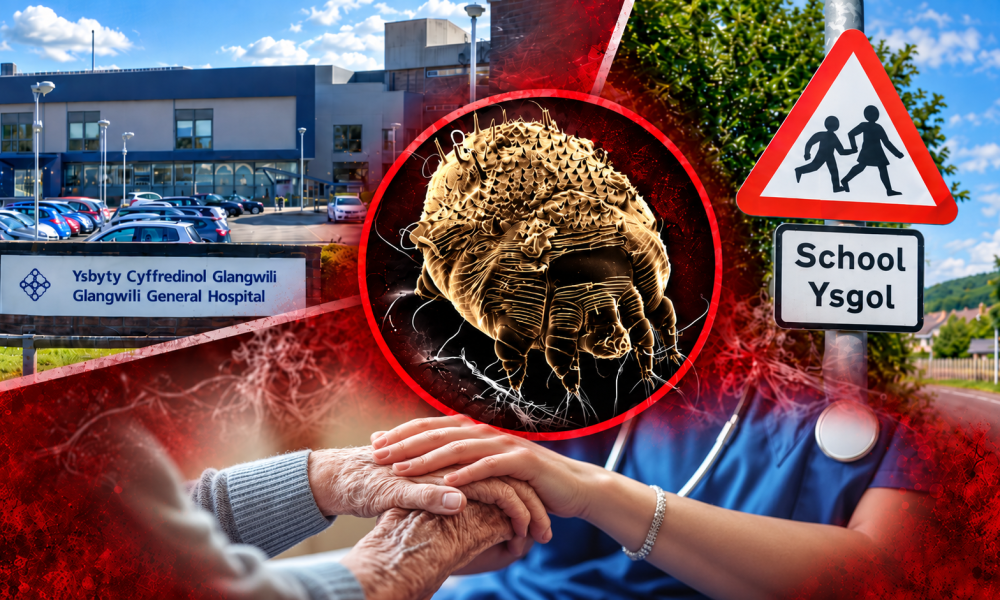
CONCERNS are growing over the spread of scabies across west Wales after parents reported children repeatedly developing the highly contagious skin condition, while hospitals have already faced outbreaks serious enough to force restrictions on visiting.
The Pembrokeshire Herald has launched an investigation into the scale of the problem, contacting five public bodies amid concerns about infections in schools, nurseries, residential care homes and the wider community.
One mother of three schoolchildren in Pembroke told the Herald that her children had contracted scabies and were sent home for treatment, only to become infected again after returning to school.
“We’re fighting a losing battle,” she said.
Her experience raises questions about whether sufficient measures are being taken to prevent recurring infections in educational settings, particularly where several children or families may be affected simultaneously.

Although the mother believes her children were reinfected at school, the source of any subsequent infection has not been independently established.
The Herald has also received information from parents concerning scabies at Flying Start provision in Milford Haven.
Pembrokeshire County Council has been asked to confirm whether cases have been recorded, how many educational and childcare settings have been affected and what guidance has been provided to parents.
The reports concerning Flying Start have not yet been independently confirmed.

Hospital wards affected
The growing concern follows confirmed outbreaks at hospitals across west Wales.
At Prince Philip Hospital in Llanelli, visiting restrictions were introduced on September 27 following an outbreak involving several wards.
Patients, staff and close contacts received treatment, while additional cleaning and infection-control measures were introduced.

On Wednesday (October 7), Hywel Dda University Health Board announced that general visiting restrictions had been lifted and Wards 4 and 7 had reopened.
However, restrictions remained at the Mynydd Mawr Rehabilitation Unit.
Significantly, the health board confirmed that patients were continuing to arrive at hospital with scabies acquired in the wider community.
The health board has maintained that the risk to the wider public remains low.
Scabies also caused disruption at Glangwili Hospital in Carmarthen, where a ward was closed during September as additional precautions were introduced to prevent further transmission.
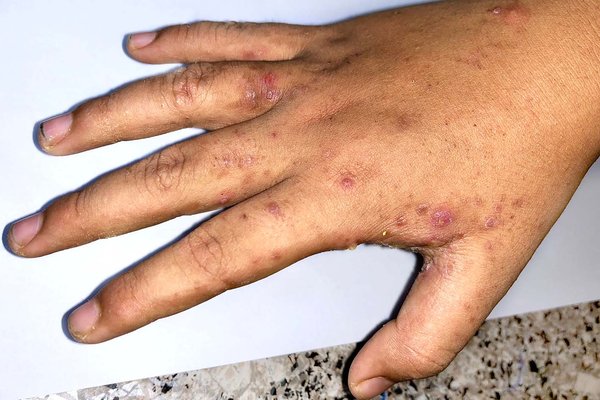 Scabies can produce an intensely itchy rash (Herald file image)
What is scabies?
Scabies is caused by microscopic mites which burrow into the skin, producing an intensely itchy rash.
The itching is often particularly severe at night and can lead to disturbed sleep, scratched skin and secondary infections.
The condition spreads primarily through prolonged skin-to-skin contact, making environments such as households and residential care facilities particularly vulnerable to transmission.
Children can also become infected through close physical contact.
Symptoms may take several weeks to appear following an initial infection, meaning somebody can spread scabies before realising they have it.
Although conventional treatments are normally effective, successful elimination often depends on treating close household contacts together, even when they have no symptoms.
A failure to coordinate treatment can result in apparent recurring infections, while itching can persist for weeks after the mites have been eliminated.
Care workers also affected
The Herald has also heard from a west Wales healthcare worker who described months of distress associated with suspected recurring scabies despite undergoing prescribed treatment.
The account raises questions about the support available to people experiencing prolonged symptoms and the difficulties of managing infections in residential care environments.
However, prolonged itching does not necessarily indicate continuing infestation, and clinical reassessment is important where treatment appears unsuccessful.
There is currently no verified evidence that a new or unusually resistant strain of scabies is responsible for the cases reported locally.
Questions over infection control
The concerns are particularly relevant to schools and nurseries, where parents may be instructed to treat affected children before they return.
But if other infectious cases remain unidentified, further transmission can occur.
Public health guidance emphasises the importance of appropriate treatment, identifying close contacts and following infection-control procedures.
The Herald is seeking clarification on how schools and childcare providers are advised to manage multiple cases, when parents should be notified and what arrangements exist for identifying repeated outbreaks.
The newspaper has asked Pembrokeshire County Council for figures showing how many schools, nurseries and Flying Start settings have reported infections since January 2026.
It is also seeking information about whether those numbers have increased compared with previous years.
Concerns raised in Senedd
The issue has also reached the Welsh Parliament.
During proceedings on Tuesday (October 6), concerns were raised about scabies outbreaks in the Hywel Dda University Health Board area and the adequacy of infection-control measures.
An urgent statement was requested from the Welsh Government amid wider concern about the impact on vulnerable patients and residents.
The discussion included reference to a reported death linked to complications associated with scabies, although the circumstances have not been independently established.
Five agencies asked for answers
The Pembrokeshire Herald has now contacted Pembrokeshire County Council, Public Health Wales, Hywel Dda University Health Board, Care Inspectorate Wales and the Welsh Government.
The newspaper is seeking confirmed outbreak figures, information about schools and care homes, details of treatment arrangements and clarification about whether health authorities have identified any evidence of resistance to conventional scabies medication.
Responses have been requested by 5pm on Monday, October 12.
The Herald will report the findings as part of its continuing investigation.
In the meantime, anyone who suspects they or a family member may have scabies should seek advice from a pharmacist or GP and follow the full recommended treatment programme.
Scabies can affect anyone, regardless of personal hygiene, and it is not ordinarily necessary to destroy household belongings to eradicate the infection.
Have your children been affected?
The Pembrokeshire Herald would like to hear from parents, teachers, nursery employees and care workers who have experienced scabies outbreaks.
Have your children required repeated treatment? Were you informed about cases at their school or nursery? Have you experienced difficulties obtaining appropriate treatment?
Readers can contact the Herald confidentially at [email protected]