
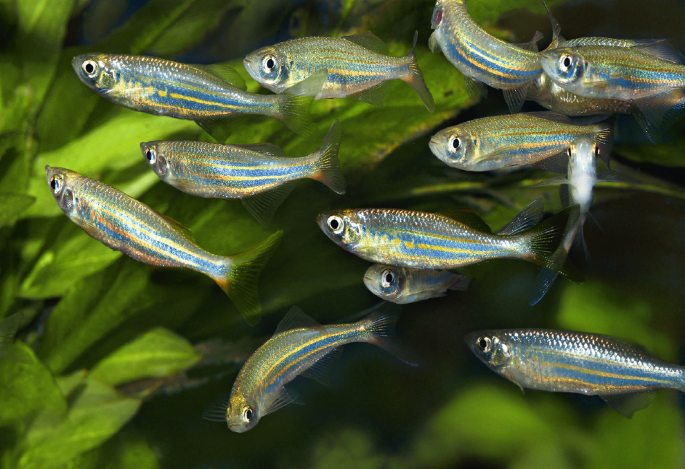
The team created a hydrodynamic maze in a laboratory water channel using an array of jets. This produced alternating regions of fast, turbulent water and relatively calm flow. They then used a high-speed camera to record 20 giant danio (Devario aequipinnatus, pictured) fish swimming through the maze with three different flow conditions. Calicchia and Ni observed that, as the jet speed increased, the fish became increasingly concentrated in the calmer spaces between the jets. A closer look at their movements revealed that, upon entering energetically costly regions, the fish turned their bodies at an angle with respect to the flow and moved sideways towards more favourable locations.
By turning their bodies relative to the incoming flow current, fish can generate lift-like forces — the same type of force that acts on an aircraft wing. These forces may help carry the fish sideways across the flow. Calicchia and Ni further found that the fish maintained this angled orientation without a considerable increase in drag.