
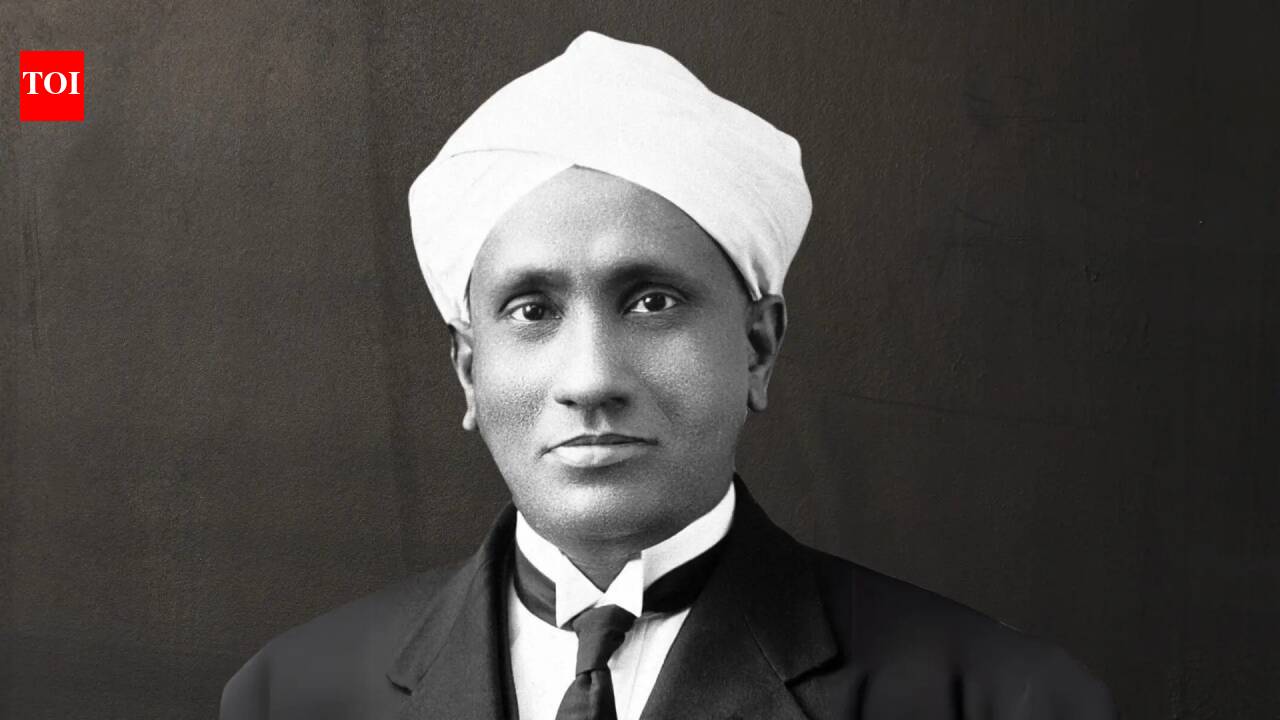
 In 1930, Indian physicist Sir C.V. Raman won the Nobel Prize in Physics for the discovery of Raman effect: From a child prodigy who passed his BA at 15 to becoming the first Asian and non-White person to win the Nobel Prize Back in 1928, on February 28, an Indian physicist hailing from Kolkata, then Calcutta, made a discovery that changed how scientists understood the interaction between light and matter. In 1930, that same physicist, Sir Chandrasekhara Venkata Raman, made history. Not just because he picked up the Nobel Prize in Physics, but because he was the first Asian, and the first non-White scientist, to ever win that award.In 1928, working in a laboratory in Calcutta, Raman and his collaborators found that light scattered by transparent substances could emerge with a different wavelength from the light that had entered them. The phenomenon, later known as the Raman effect, offered scientists a new way to investigate the molecular structure of matter. Just two years later, in 1930, Raman received the Nobel Prize in Physics, etching his name in history forever. At a time when much of the scientific establishment was concentrated in Europe and North America, Raman demonstrated that internationally significant research could emerge from an Indian laboratory, using careful observation, inventive experimentation, and a determination to pursue questions that fascinated him.Today, Raman’s story is not way more than just a list of accomplishments. It’s a tale of curiosity, perseverance, and bold choices in an era when few thought someone from colonial India could shake up the world of science.
From child prodigy to a pioneering physicist
For those who didn’t know, Raman was a child prodigy. And there’s no exaggeration here: he matriculated at 11 and passed his BA at 15, topping his class. Born in British India in 1888, he was surrounded by science from the start. His father, a teacher of mathematics and physics, fed him ideas and sparked his interest early on. By the time Raman entered Presidency College in Madras, he was already well ahead of his peers. He finished his bachelor’s and master’s degrees at the top of his class, collecting medals. He was brilliant, but back then, a career in science wasn’t exactly an obvious path for an Indian student. Most ended up in government posts, instead of research labs.Raman wasn’t any different at first. He joined the Indian Finance Department after passing the civil service exam. But the job turned out to be just a paycheck. His real passion kept him busy after office hours, tinkering away at the Indian Association for the Cultivation of Science (IACS). He dove into acoustics, i.e., the physics of music, and light, always pushing boundaries with whatever resources he could scrounge up. It wasn’t until 1917 that he took his leap of faith, leaving a stable government job to become the Palit Professor of Physics at the University of Calcutta. It was a turning point: he was finally free to make research his central focus.
How the blue Mediterranean Sea inspired the Raman effect
One of the moments in Raman’s life that really captures what made him tick is when, in 1921, during a sea voyage from England back to India, the deep blue of the Mediterranean struck him. Everyone assumed the sea reflected the sky, but Raman wasn’t satisfied with that explanation. He wanted to know what was really happening: how sunlight interacted with water molecules, what caused that vivid blue. That curiosity didn’t fade; instead, it kicked off years of experiments back in Calcutta.By 1928, Raman and his collaborator K.S. Krishnan were investigating how light scattered off liquids and other transparent substances. On February 28, 1928, they noticed something strange: a small fraction of the scattered light came out with a different wavelength than when it went in. That meant the light had exchanged energy with the molecules in the material, a groundbreaking insight. This became known as the Raman effect. The world noticed: Nature published their findings, and suddenly scientists everywhere had a new tool to explore molecules, without destroying or messing with the samples.
What’s the Raman effect?
In simple language, it’s what happens when light hits a material and interacts with its molecules. Some of the light, scattered off, comes out changed in wavelength, which gives clues about the arrangement and identity of those molecules. Raman spectroscopy, the technique inspired by his discovery, is now everywhere. Chemists use it to identify substances, materials scientists rely on it to study new compounds, and pharmaceutical researchers turn to it when they want to analyze drugs. Lasers and modern detectors have made Raman’s method even more powerful, but the basic principle comes straight from his work.
C.V. Raman’s Nobel Prize in Physics in 1930
Raman’s Nobel Prize in 1930 wasn’t just a personal triumph. It sent a message that brilliant science could emerge from Indian labs, not just from Europe or America. He was already a Fellow of the Royal Society and had been knighted in 1929, but the Nobel cemented his status as a pioneer. His research showed that world-class discoveries didn’t depend on geography; they depended on curiosity and determination.After the Nobel, Raman kept working. He became director of the Indian Institute of Science in Bangalore, helped set up the Indian Academy of Sciences, and founded the Raman Research Institute. Even as he aged, his passion never dimmed. He earned the Bharat Ratna, India’s highest civilian award, in 1954. When he died in 1970, he left behind not just a discovery, but a legacy that shaped generations of Indian scientists.To this day, Raman’s story inspires millions. Every February 28, India celebrates National Science Day to honor the day he uncovered the Raman effect. It’s a reminder of what can happen when someone asks a deceptively simple question and refuses to settle for easy answers.