
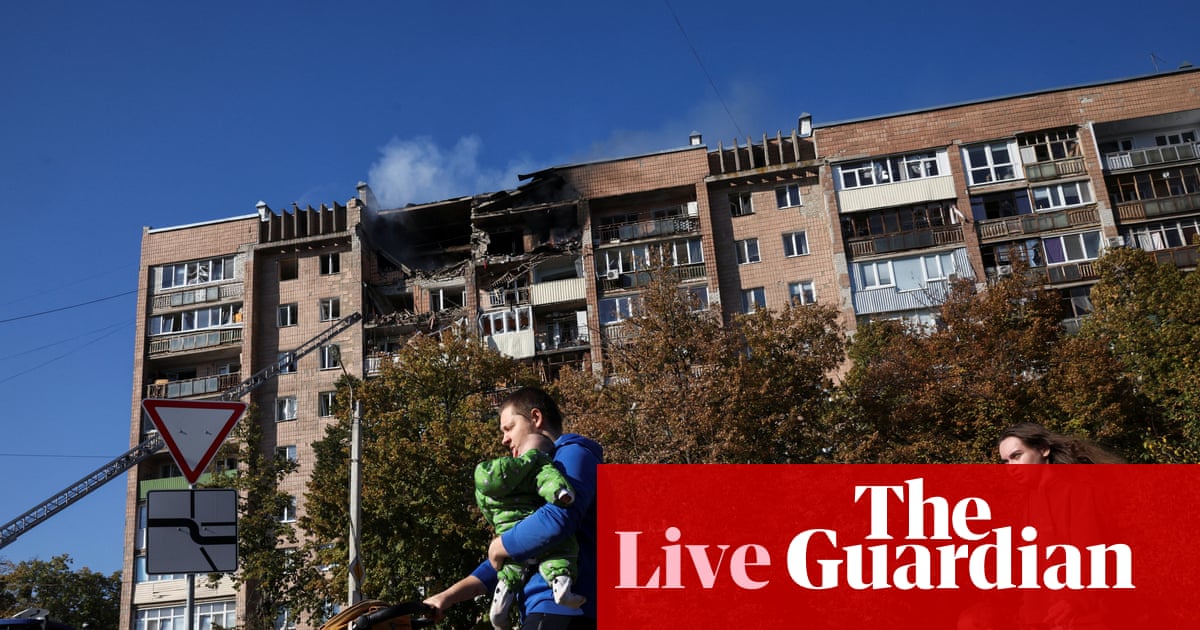
Kremlin rejects Zelenskyy’s idea of a 60-day ceasefire and refuses to comment on Trump’s ‘energy truce’
The Kremlin spokesperson, Dmitry Peskov, has said Russia rejects the idea of a temporary ceasefire, telling reporters that Moscow wanted a long-term peace deal instead.
“In the Kremlin, both President Putin and officials at other levels have repeatedly stated that we do not want a ceasefire,” said Peskov. “We want long-term peace and are prepared to do everything possible to achieve it.“
Peskov’s comments were a rejection of a 60-day ceasefire idea proposed by Ukrainian President Volodymyr Zelenskyy on Sunday to allow his country to hold presidential elections. Kyiv has accused Russia of violating temporary truces when ceasefires between the two sides have been agreed to in the past.
Peskov was asked to comment on Trump’s self-declared “energy ceasefire” between Russia and Ukraine and refused to be drawn on it, only saying:
double quotation markContacts continue. As soon as we have something to say on the matter, we will inform you.
Updated at 06.27 EDT
Key events
Zelenskyy says ‘increasingly clear’ Russia does not want energy ceasefire after strikes
Ukrainian president Volodymyr Zelenskyy said it was “increasingly clear” that Russia was unwilling to accept a US-proposed ceasefire on energy strikes, as Moscow hit six Ukrainian energy facilities on Monday.
“This is what happens when Russia sees the prospect of higher revenues for its war machine,” he wrote in a post on X.
Russia presents a long-term threat to Europe regardless of the outcome of the war in Ukraine, the head of Germany’s domestic intelligence agency said.
Warning that Moscow wanted to upend Europe’s international order, Sina Sellen, president of the BfV, said Russian-orchestrated attacks would “continue to come”.
“The hybrid threat is here, and it has long been decoupled from the situation in Ukraine,” he said at a Berlin conference organised by the BfV.
“For Russia, [the goal] is a fundamentally new map of Europe and of its role within Europe and in geopolitics.”
A 13-year-old girl was among three people killed in a Russian strike on a house near the frontline city of Kramatorsk in eastern Ukraine on Monday, the authorities said.
The head of the Donetsk regional military administration, Vadym Filashkin, said a house in the Cherkaske area was hit with cluster munitions, accusing Russia of “a deliberate attempt” to maximise civilian casualties.
German chancellor Friedrich Merz said that Russia would only negotiate “seriously” under pressure, days after president Donald Trump announced a temporary easing of US sanctions on Russian diesel.
“For Germany and for Europe, such a decision is out of the question,” said Merz, referring to the US-Russia diesel deal.
“Russia will only negotiate seriously under pressure and that is why we are maintaining our sanctions against Russia.”
Nato should signal its “red lines” to Russia over sabotage attacks in Europe, the alliance’s top military commander said.
“It’s important that allies continue to consult, think about how we might respond, and make sure that we message clearly and concisely to the Russians where our red lines are,” Nato commander Alexus Grynkewich said in Warsaw.
Ukrainian officials said Russian attacks killed six people in two Ukrainian cities yesterday.
In Kharkiv, Ukraine’s second-largest city, a strike on a grocery store killed three people and injured 20 others, including two children, the regional governor, Oleh Syniehubov, said.
Footage released by the Kharkiv prosecutor’s office captured the moment of the strike, showing debris flying through the air and fires breaking out as car alarms sounded.
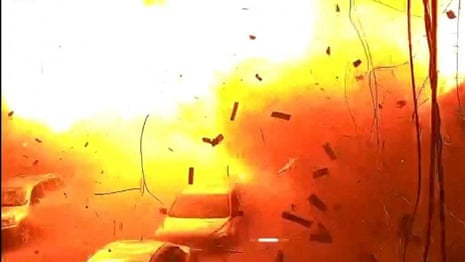 Huge explosion captured on CCTV after deadly strike hits grocery store in Kharkiv – videoShare
An “unprecedented” cyber-attack is behind the shutdown of refrigerator units in multiple French supermarkets, according to the chief executive of Cooperative U, one of the chains affected.
At least 150 Intermarche shops were targeted, along with almost 100 Cooperative U outlets, AFP reports. Paris prosecutors confirmed the attack, with media reporting that hackers were “managing to remotely trigger the forced defrosting of the refrigeration systems in numerous stores.”
Reuters is carrying some further quotes from Nato’s supreme allied commander for Europe, Gen Alexus Grynkewich, about how the alliance says it would deal with an attack on Nato territory. He told the audience at the Warsaw Security Forum:
If someone is foolish enough to attack us, we will fight. We will stop the attack and deny them the ability to achieve their objectives, whatever those might be. We will, in short, ensure any attack, against any ally, proves utterly futile.
Should the adversary choose to press the attack or commit his reserves, we will break the warfighting system engaged against us. This includes not just the attacking force itself, but anything and everything that supports, sustains, and controls that force.
The US general is speaking just days after president Donald Trump announced a deal to buy Russian diesel.
Updated at 08.19 EDT
Nato’s supreme allied commander for Europe, Gen Alexus Grynkewich has been outlining what he describes as the Nato “theory of victory”, in which he says Nato forces would block, then blunt, then break any aggressive move against the alliance.
While stressing that he did not see conflict as “inevitable”, he said at the Warsaw Security Forum it was a plan to “prepare us to execute our most sacred task – the defence of our people and our territory.”
Nato’s supreme allied commander for Europe, Gen Alexus Grynkewich, is speaking now at the Warsaw Security Forum. We will bring you any key lines that emerge.
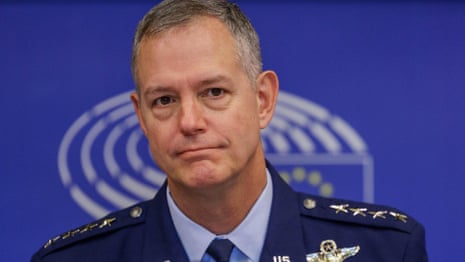 Nato’s top commander Grynkewich addresses Warsaw security forum – watch liveShare
Updated at 07.20 EDT
A little more from Kremlin spokesperson Dmitry Peskov here on the prospects of a limited truce agreement. He says that Russia would potentially offer a one-day truce if Ukraine were to hold elections. He said:
If they truly want to hold elections in Kyiv, then the president of Russia, the commander-in-chief, will be ready to give an order not to launch strikes on Ukraine on election day, specifically on election day.
ShareFrance’s high school students plan fresh protests
France’s high school students will stage new protests on Tuesday, the Agence France-Presse (AFP) news agency is reporting,
A government source told journalists last week that the cost for damage caused by the demonstrations, which have shaken an unpopular government trying to reduce a ballooning budget deficit, was already “at least 30 million euros”.
Widespread disillusionment has seen young people protest over recent weeks against what they say is underfunding and neglect of the education system, with the demonstrations marred by often violent clashes that have injured hundreds.
Trying to appease the student’s demands, the government announced last week that about 3,000 substitute teachers would be deployed in the coming days to replace absent staff at the 114 worst-affected high schools.
But the Union of High School students described the initial announcements as “crumbs” and maintain their demand for an extra €10m (£8.4m) to be invested in the country’s lycees, where students – most between 15 and 18 – complete their high school education.
On Friday, the government noted a drop in the number of blockades and meetings outside the country’s lycees. More than 96% were opening on Friday, the education ministry said, but now a new stage of the campaign for improved conditions could mark a turning point in the protests.
Protesters and high-school students take part in a demonstration outside the Lycee Toulouse Lautrec, in Toulouse on 12 OCtober 2026. Photograph: Ed Jones/AFP/Getty ImagesShare
Updated at 06.57 EDT