
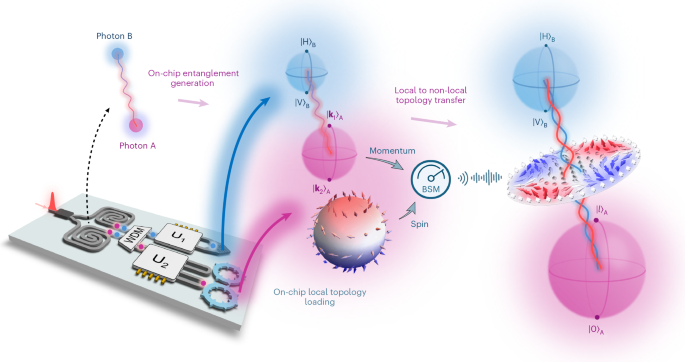
Figure 1 shows our on-chip scheme to prepare the skyrmion topology in the spin texture of a single photon \({|{{{\varphi }}}_{{\rm{sk}}}\rangle }_{{\rm{sp}}}=\frac{1}{\sqrt{2}}({|0,{\rm{L}}\rangle }_{{\rm{A}}}+{{|l},{\rm{R}}\rangle }_{{\rm{A}}})\) and transfer its skyrmion topology to an entangled state via the following mapping:
$${|{{{\varphi }}}_{{\rm{sk}}}\rangle }_{{\rm{sp}}}\to {|{{{\psi }}}_{{\rm{sk}}}\rangle }_{{\rm{ent}}}=\frac{1}{\sqrt{2}}\left({|0\rangle }_{{\rm{A}}}{|{\rm{H}}\rangle }_{{\rm{B}}}+{{|l}\rangle }_{{\rm{A}}}{|{\rm{V}}\rangle }_{{\rm{B}}}\right)$$
(1)
where subscripts A and B denote two correlated photons; \(0\) and \(l\) are two OAM topological charges; and \({\rm{L}},{\rm{R}},{\rm{H}}\) and \({\rm{V}}\) represent left-hand circular (spin-up), right-hand circular (spin-down), horizontal and vertical polarizations, respectively. Here the single-photon skyrmion state \({|{{{\varphi }}}_{{\rm{sk}}}{{\rangle }}}_{{\rm{sp}}}\) is generated using an integrated spin–orbit-locked microring resonator, which features two independent sets of angular grating inscribed at the inner and outer sidewalls with \({N}_{{\rm{in}}}\) and \({N}_{{\rm{out}}}\) scatterers, respectively. Specifically, photon A is coupled into a clockwise whispering gallery mode (WGM) inside the resonator with an azimuthal quantum number of \(M={N}_{{\rm{in}}}+1\). The WGM is subsequently extracted into the free-space Bessel mode by both sets of angular grating. Through the spin–orbit-locking mechanism and phase-matching conditions, the inner angular grating generates a spin-up polarized mode with an OAM charge of \(0=M-{N}_{{\rm{in}}}-1\), whereas the outer angular grating delivers a spin-down component with an OAM charge of \(l=M-{N}_{{\rm{out}}}+1\) (refs. 14,15,24,25,26). Their superposition forms a non-separable state of \({|{{{\varphi }}}_{{\rm{sk}}}{{\rangle }}}_{{\rm{sp}}}\). This state is generated with single-photon topology characterized by the skyrmion number \({N}_{\rm{sk}}\). Note that \({N}_{{\rm{in}}}\) and \({N}_{{\rm{out}}}\) here denote the intended numbers of equally spaced scatterer sites that define the angular grating periodicity. In the fabricated device, some outer sidewall scatterers are omitted locally in the bus-waveguide coupling region because of limited space; however, this local omission does not alter the grating periodicity and therefore does not change the emitted OAM order (Methods).
Fig. 1: Schematic of on-chip photonic quantum skyrmion preparation and topology transfer from single photons to entangled states.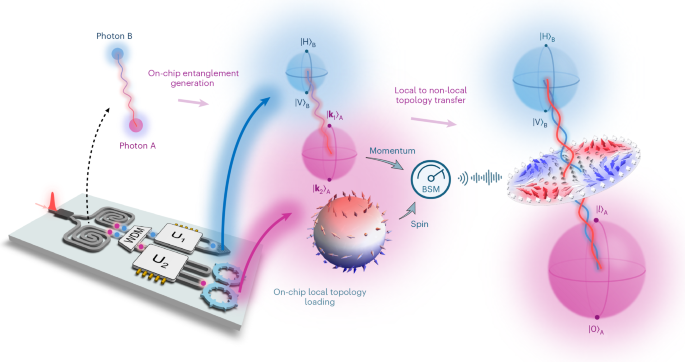
Left: an integrated photonic circuit is pumped by a femtosecond laser pulse (red Gaussian pulse), generating a path-entangled photon pair, photons A (magenta) and B (blue), through SFWM in two spiral waveguides. The photons are separated by a wavelength-division multiplexer (WDM) and manipulated by an MZI array implementing the unitary operations \({{\rm{U}}}_{1}\) and \({{\rm{U}}}_{2}\). Photon A is routed to a pair of spin–orbit-locked microring resonators (bottom right of the chip) for topology encoding, whereas photon B is directed to a two-dimensional grating coupler (top right of the chip). These operations prepare the photon pair in the entangled state \({|{{\chi }}\rangle }_{{\rm{AB}}}\). Centre: on-chip spin–orbit-locked microring resonators encode the local skyrmion state \({\left|{{{\varphi }}}_{{\rm{sk}}}\right\rangle }_{{\rm{sp}}}\) onto photon A, that is, single-photon topology preparation. The transparent spheres schematically represent the photonic state spaces of photons A and B, whereas the coloured vector field illustrates the locally prepared photonic skyrmion on photon A. Right: a spin-momentum BSM on photon A transfers the topology from the local single-photon skyrmion to a non-local entangled skyrmion shared by photons A and B. The reconstructed quantum Stokes field represents the resulting non-local skyrmion, whereas the transparent spheres illustrate the corresponding state spaces after topology transfer.
To generate entangled quantum skyrmions and achieve the topology transfer illustrated in equation (1), a bi-photon path entanglement state is initially generated: \({|{\varPsi }_{1}{{\rangle }}}_{{\rm{AB}}}=\frac{1}{\sqrt{2}}({|{{\rm{P}}}_{1}{{\rangle }}}_{{\rm{A}}}{|{{\rm{P}}}_{1}{{\rangle }}}_{{\rm{B}}}+{|{{\rm{P}}}_{2}{{\rangle }}}_{{\rm{A}}}{|{{\rm{P}}}_{2}{{\rangle }}}_{{\rm{B}}})\), where \({{\rm{P}}}_{1}\) and \({{\rm{P}}}_{2}\) represent two distinct on-chip paths. This process is facilitated by pumping two on-chip spiral waveguides with a femtosecond laser pulse at frequency \({\omega }_{{\rm{pump}}}\), which probabilistically drives spontaneous four-wave mixing (SFWM) to generate photon pairs at frequencies \({\omega }_{{\rm{A}}}\) and \({\omega }_{{\rm{B}}}\) (refs. 27,28,29,30). The nonlinear processes in the two spirals are coherently superposed, generating the state \({|{\varPsi }_{1}{{\rangle }}}_{{\rm{AB}}}\) on separating the two photons at different frequencies through the unbalanced MZIs28. Photon B is then directed through an MZI array implementing the unitary operation U1 into a two-dimensional grating coupler, which coherently converts \({|{{\rm{P}}}_{1}{{\rangle }}}_{{\rm{B}}}\) and \({|{{\rm{P}}}_{2}{{\rangle }}}_{{\rm{B}}}\) paths into free-space modes carrying \({\rm{H}}\) and \({\rm{V}}\) polarizations, respectively29,30. Simultaneously, photon A, propagating along the \({|{{\rm{P}}}_{1}{{\rangle }}}_{{\rm{A}}}\) and \({|{{\rm{P}}}_{2}{{\rangle }}}_{{\rm{A}}}\) paths, is routed via an MZI array implementing U2 into two identical microring resonators, where the single-photon topological state \({|{{{\varphi }}}_{{\rm{sk}}}{{\rangle }}}_{{\rm{sp}}}\) is coherently encoded onto the photon. On extraction from two distinct resonators and collection by an objective lens, photon A acquires two different momenta, \(\bf{k}_{\rm{1}}\) and \({\mathbf{k}}_{2}\). This process produces a tensor product state that intertwines the single-photon skyrmion with inherent entanglement between two photons:
$${|{{\varPsi }}_{2}{\rangle }}_{\mathrm{AB}}={|{{\varphi }}_{\mathrm{sk}}{\rangle }}_{\mathrm{sp}}\otimes \frac{1}{\sqrt{2}}\left({|{{\bf{k}}_{\rm{1}}}{\rangle }}_{{\rm{A}}}{|{\rm{H}}{\rangle }}_{{\rm{B}}}+{|{{\bf{k}}_{\rm{2}}}{\rangle }}_{{\rm{A}}}{|{\rm{V}}{\rangle }}_{{\rm{B}}}\right)={|{{\varphi }}_{\mathrm{sk}}{\rangle }}_{\mathrm{sp}}\otimes {|{\chi }{\rangle }}_{\mathrm{AB}}.$$
(2)
Here U1 and U2 are effectively set to identity transformations, but they are included in the schematic to highlight that the same integrated architecture can, in principle, realize arbitrary local unitary transformations for more general topological protocols.
Importantly, the chip-prepared state \({|{\varPsi }_{2}{{\rangle }}}_{{\rm{AB}}}\) constitutes an entangled skyrmion superposition state: the coupling between the single-photon skyrmion degree of freedom and the momentum–polarization entanglement yields a coherent superposition of entangled quantum skyrmion components, each tagged by the spin-momentum Bell states of photon A. This becomes explicit by rewriting equation (2) in the spin-momentum Bell basis of photon A:
$$\begin{array}{l}{|{\varPsi }_{2}{{\rangle }}}_{{\rm{AB}}}=\frac{1}{2}\left(\right.\!\!{|{\varPhi }^{+}{{\rangle }}}_{{\rm{A}}}{|{{{\psi }}}_{{\rm{sk}}}{{\rangle }}}_{{\rm{ent}}}+{|{\varPhi }^{-}{{\rangle }}}_{{\rm{A}}}{{{\sigma }}}_{{{z}},{\rm{B}}}{|{{{\psi }}}_{{\rm{sk}}}{{\rangle }}}_{{\rm{ent}}}\\\qquad\quad\;\,+{|{\varPsi }^{+}{{\rangle }}}_{{\rm{A}}}{{{\sigma }}}_{{{x}},{\rm{B}}}{|{{{\psi }}}_{{\rm{sk}}}{{\rangle }}}_{{\rm{ent}}}-{\rm{i}}{|{\varPsi }^{-}{{\rangle }}}_{{\rm{A}}}{{{\sigma }}}_{{{y}},{\rm{B}}}{|{{{\psi }}}_{{\rm{sk}}}{{\rangle }}}_{{\rm{ent}}}\!\!\left.\right)\end{array}$$
(3)
where \({|{\varPhi }^{\pm }\rangle }_{{\rm{A}}}=\frac{1}{\sqrt{2}}({|{\rm{L}},{{{\bf{k}}}_{\rm{1}}}\rangle }_{{\rm{A}}}\pm {|{\rm{R}},{{\bf{{k}}}_{\rm{2}}}\rangle }_{{\rm{A}}})\) and \({|{\varPsi }^{\pm }\rangle }_{{\rm{A}}}=\frac{1}{\sqrt{2}}({|{\rm{L}},{{\bf{{k}}}_{\rm{2}}}\rangle }_{{\rm{A}}}\pm {|{\rm{R}},{{{\bf{k}}}_{\rm{1}}}\rangle }_{{\rm{A}}})\) represent the four spin-momentum Bell basis states, and the operators \({{{\sigma }}}_{{x},{\rm{B}}}\), \({{{\sigma }}}_{{y},{\rm{B}}}\) and \({{{\sigma }}}_{{z},{\rm{B}}}\) denote the Pauli matrices acting on the polarization degree of freedom of photon B. In this scenario, analogous to the entanglement swapping process31,32, performing a spin-momentum Bell-state measurement (BSM; a joint two-qubit measurement projecting onto the Bell basis) on photon A heralds the corresponding entangled skyrmion component. With the appropriate Pauli operation conditioned on the BSM outcome, the protocol transfers the single-photon topology encoded in \({\left|{{{\varphi }}}_{{\rm{sk}}}\right\rangle }_{{\rm{sp}}}\) to the shared topology in \({|{{{\psi }}}_{{\rm{sk}}}\rangle }_{{\rm{ent}}}\), realizing the mapping function described in equation (1). The four terms in equation (3), therefore, do not represent four independently generated output states; rather, they are the four Bell-resolved components of a single chip-prepared coherent superposition, and each experimental run heralds one corresponding entangled skyrmion state according to the BSM outcome.
The photonic integrated circuit for encoding single-photon topology and distributing bi-photon entanglement is fabricated on a Si3N4-on-SiO2 platform with a 310-nm-thick Si3N4 layer (Supplementary Fig. 4 shows the fabrication flow and Fig. 2a shows an optical microscopy image of the device). The spiral waveguides are tailored with a width of 650 nm to optimize momentum matching in the SFWM process, thereby maximizing the efficiency of the correlated photon generation. Additionally, the microring resonators are designed with a width of 600 nm to enhance spin purity at the edge, facilitating spin–orbit locking. We first demonstrate the generation of single-photon topology through resonators with \({N}_{{\rm{in}}}={N}_{{\rm{out}}}=M-1\), resulting in a single-photon skyrmion state of \(\frac{1}{\sqrt{2}}({|0,{\rm{L}}\rangle }_{{\rm{A}}}+{|2,{\rm{R}}\rangle }_{{\rm{A}}})\) with a skyrmion number \({N}_{\rm{sk}}=2\). In experiments, the topology of the single-photon skyrmion is characterized by performing quantum state tomography33 on both spin and OAM of photon A extracted from the microring resonators. The reconstructed density matrix \({{{\rho }}}_{{\rm{sk}},{\rm{sp}}}={|{{{\varphi }}}_{{\rm{sk}}}\rangle }_{{\rm{sp}}}{{{\langle }}{{{\varphi }}}_{{\rm{sk}}}|}_{{\rm{sp}}}\) shows a fidelity of 86% ± 2% and the Stokes field distribution at the wavefront is subsequently derived from the expectation values of \({{{\rho }}}_{{\rm{sk}},{\rm{sp}}}\) (Extended Data Fig. 1a), yielding an experimentally retrieved single-photon skyrmion number \({N}_{\rm{sk}}=1.981\pm 0.002\), in agreement with theoretical expectations (Supplementary Sections 13 and 16). The bi-photon momentum–polarization entanglement \({|{{\chi }}\rangle }_{{\rm{AB}}}\) is characterized by performing quantum state tomography on the momentum of photon A, extracted from the microring resonators, and the polarization of photon B, captured from the two-dimensional grating coupler (Supplementary Section 14). The experimentally retrieved density matrix \({{{\rho }}}_{{{\chi }}}={|{{\chi }}\rangle }_{{\rm{AB}}}{{{\langle }}{{\chi }}|}_{{\rm{AB}}}\) exhibits a quantum fidelity of 91% ± 2% (Extended Data Fig. 1b). The topology transfer of the skyrmion structure is achieved by transitioning from the single-photon skyrmion on photon A to the correlation between entangled photons A and B. This is done by performing the spin-momentum BSM on photon A. A momentum-dependent spin-flip operation is designed to resolve the non-separability of the spin-momentum Bell states, facilitating efficient BSM with independent operations on spin and momentum (Supplementary Section 15). Consequently, the spin-momentum correlation of photon A is projected onto states \({|{\varPhi }^{\pm }\rangle }_{{\rm{A}}}\) and \({|{\varPsi }^{\pm }\rangle }_{{\rm{A}}}\), as described in equation (3), which generates the entangled skyrmion states \({|{{{\psi }}}_{{\rm{sk}}}\rangle }_{{\rm{ent}}}\), \({{{\sigma }}}_{{{z}},{\rm{B}}}{|{{{\psi }}}_{{\rm{sk}}}\rangle }_{{\rm{ent}}}\), \({{{\sigma }}}_{{{x}},{\rm{B}}}{|{{{\psi }}}_{{\rm{sk}}}\rangle }_{{\rm{ent}}}\) and \(-{\rm{i}}{{{\sigma }}}_{{y},{\rm{B}}}{|{{{\psi }}}_{{\rm{sk}}}\rangle }_{{\rm{ent}}}\), respectively. Quantum state tomography is then conducted on the tensor-product Hilbert space formed by the OAM of photon A and the polarization of photon B, yielding the four density matrices with an averaged fidelity of 89% ± 2% (Fig. 2b and Supplementary Section 15). The slightly higher mean fidelities of the entangled skyrmion states relative to the single-photon skyrmion state are probably attributable to differences in the tomographic conditions used at different stages of the protocol. The two-photon quantum Stokes parameter distributions are then reconstructed from these density matrices after applying the relevant Pauli operations, featuring entangled skyrmion numbers of 1.981 ± 0.001, 1.981 ± 0.001, 1.979 ± 0.001 and 1.9798 ± 0.0009. It is worth emphasizing that these entangled skyrmion numbers are extracted from quantum correlations between the OAM of photon A and the polarization of photon B, rather than from a classical optical texture. In these extracted entangled skyrmion numbers, the quoted uncertainties are reported using the standard rounding convention described in Supplementary Section 17. This convincingly validates our scheme of topology preparation and transfer through entanglement distribution.
Fig. 2: Experimental characterization of topology transfer.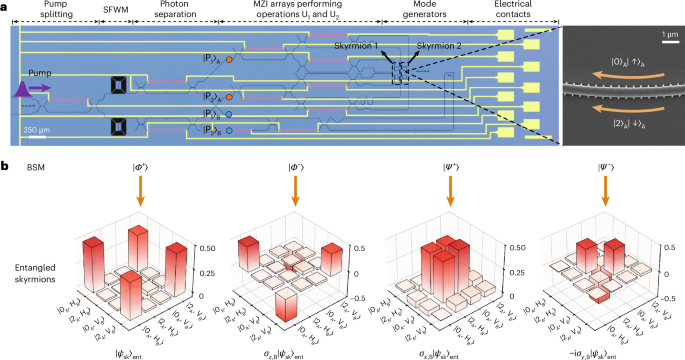
a, Optical microscopy image of the photonic integrated circuits used to implement the scheme shown in Fig. 1. A femtosecond pump pulse is split evenly to pump two spiral waveguides, generating the path-entangled photon pair \({|{\varPsi }_{1}\rangle }_{{\rm{AB}}}=\frac{1}{\sqrt{2}}({|{{\rm{P}}}_{1}\rangle }_{{\rm{A}}}{|{{\rm{P}}}_{1}\rangle }_{{\rm{B}}}+{|{{\rm{P}}}_{2}\rangle }_{{\rm{A}}}{|{{\rm{P}}}_{2}\rangle }_{{\rm{B}}})\) via SFWM. The photons are then separated by an unbalanced MZI, and two thermo-optic MZI arrays implementing transformations U2 and U1 (Fig. 1) route photon A into two identical microring skyrmion generators and photon B into a two-dimensional grating coupler, thereby creating the single-photon skyrmion and the entanglement state \({|{\varPsi }_{2}\rangle }_{{\rm{AB}}}={\left|{{{\varphi }}}_{{\rm{sk}}}\right\rangle }_{{\rm{sp}}}\bigotimes {\left|{{\chi }}\right\rangle }_{{\rm{AB}}}\). The black dotted box highlights the four spin–orbit-locked microring resonators used for topology encoding. The left two generate the skyrmion-1 state, whereas the right two generate the skyrmion-2 state. Results for the skyrmion-2 state are presented in the main text. Right: a scanning electron microscopy image of the skyrmion-2 microring resonator with angular gratings on its inner and outer sidewalls, generating \({\left|0,{\rm{L}}\right\rangle }_{{\rm{A}}}\) and \({\left|2,{\rm{R}}\right\rangle }_{{\rm{A}}}\) for clockwise WGMs. b, Retrieved density matrices for four entangled skyrmion states heralded by the corresponding spin-momentum BSM outcomes after topology transfer: \({\left|{{{\psi }}}_{{\rm{sk}}}\right\rangle }_{{\rm{ent}}}\), \({{{\sigma }}}_{\it{z},{\rm{B}}}{\left|{{{\psi }}}_{{\rm{sk}}}\right\rangle }_{{\rm{ent}}}\), \({{{\sigma }}}_{\it{x},{\rm{B}}}{\left|{{{\psi }}}_{{\rm{sk}}}\right\rangle }_{{\rm{ent}}}\) and \(-{\mathrm{i}}{\sigma}_{\it{y},{\rm{B}}}{|{{\psi }}_{\mathrm{sk}}\rangle }_{\mathrm{ent}}\). Each matrix corresponds to one of the four spin-momentum BSM outcomes (\({|{\varPhi }^{\pm }\rangle }_{{\rm{A}}}\) and \({|{\varPsi }^{\pm }\rangle }_{{\rm{A}}}\)), with quantum fidelities of 87% ± 3%, 88% ± 3%, 89% ± 2% and 89% ± 2% and entangled skyrmion numbers of 1.981 ± 0.001, 1.981 ± 0.001, 1.979 ± 0.001 and 1.9798 ± 0.0009, respectively. The uncertainties were estimated using 100 Monte Carlo realizations that consider Poissonian photon-counting statistics42 (Supplementary Section 17). The colour gradient follows the magnitude of each density-matrix element, enhances the three-dimensional visualization and does not encode an additional physical quantity.