

Introduction
Social Security’s cost-of-living adjustment (COLA) is vital because it ensures that the program’s more than 70 million beneficiaries maintain their purchasing power as prices rise. For over half a century, the Consumer Price Index for Urban Wage Earners and Clerical Workers (CPI-W) has been used to calculate the annual COLA. However, some proposals support switching to a different price index—the Chained CPI.1 Although the Chained CPI is designed to account for the ability of consumers to buy different goods when prices change, it is poorly suited to measuring the inflation experienced by Social Security beneficiaries. It would produce smaller annual COLAs over time compared to the CPI-W, and place an extra burden on people who can least afford any reductions to their benefits.
Key Takeaway: Cumulative impacts of benefit reductions over time from the Chained CPI are especially harmful.
This blog describes the effects of using the Chained CPI instead of the CPI-W for determining COLAs. When looking at the cumulative effect expressed in 2026 dollars over the 25-year period from 2001 through 2026, switching to the Chained CPI would have reduced benefits by:
$17,570 for the average male retired worker in 2001;$13,480 for the average female retired worker in 2001;$16,300 for the average male disabled worker in 2001;$12,200 for the average female disabled worker in 2001.
Calculating a COLA
The Social Security COLA equals the increase in average prices from the third quarter of the previous year to the third quarter of the current year. The percentage increase between these two periods is the COLA that takes effect with payments starting in January of the following year. For example, the percentage change from the third-quarter average CPI-W in 2024 to the third-quarter average CPI-W in 2025 is the COLA that took effect with payments beginning in January 2026.
Background on the Chained CPI
The Chained CPI, started in 2000, is an alternative price index that accounts for changes in consumer buying habits by assuming people will change what they buy when the relative prices of goods change. For example, if the price of fresh tuna increases, some people may respond by buying fresh salmon instead, thus reducing the impact of the tuna price increase.
The ability of individuals to modify what they purchase in response to price changes means the Chained CPI generally grows more slowly than the CPI-W and would lead to smaller COLAs than under the current formula. Because Social Security is the foundation of economic security for millions of Americans, any reduction in annual COLAs would have severe consequences—especially for long-term beneficiaries, including those who live to older ages and disabled beneficiaries—since the cumulative effect of smaller COLAs becomes larger over longer periods.
1. Switching to a Chained CPI would substantially lower benefits over time.
The Social Security Administration’s Actuarial Services office estimates that switching from the CPI-W to the Chained CPI would reduce the annual COLA by approximately 0.3 percentage point, on average (e.g. a 2.6 percent COLA derived using the CPI-W would be 2.3 percent if the Chained CPI were used instead).
A difference of three-tenths of a percentage point may appear small at first, but its effects compound over time. For example, a beneficiary claiming Social Security at age 62 would have benefits 3.7 percent lower at age 75 and 9.2 percent lower at age 95 than under current law. In short, using the Chained CPI is not simply a technical adjustment to an inflation formula; it is a permanent reduction in payments to beneficiaries that grows larger over time.
What if COLAs had been based on the Chained CPI instead of the CPI-W?
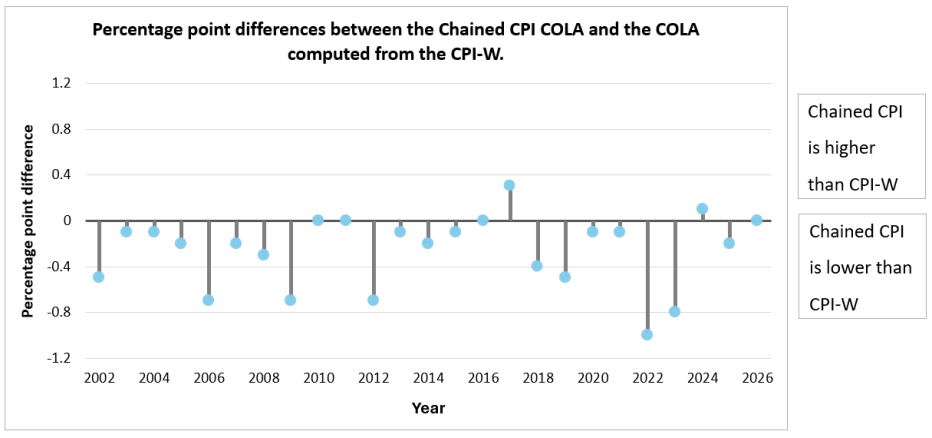
Figure 1 shows the percentage point differences over the last 25 years between what COLAs would have been using the Chained CPI and the COLAs derived from the current method using the CPI-W. Over this period, 19 out of 25 COLAs would have been lower using the Chained CPI instead of the CPI-W (including a full percentage point less in 2022); four COLAs would have been the same under either price index, and in just two of the 25 years the COLAs under the Chained CPI would have been higher.
Figure 1

(Note: Author’s estimates based on Bureau of Labor Statistics data)
Using the Chained CPI significantly reduces benefits for the average worker
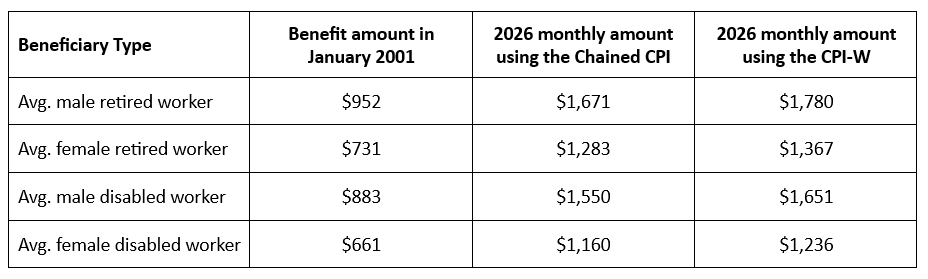
To make the implications of using the Chained CPI more concrete, consider a simple example involving four different beneficiaries – retired male workers, retired female workers, disabled male workers, and disabled female workers. Assume they began receiving benefits in January 2001, with their monthly benefits equaling the average benefit in each of these categories. The last two columns in Table 1 show what inflation-adjusted benefits would equal in 2026 using the Chained CPI compared to the current CPI-W.
Table 1
(Note: Author’s estimates based on Bureau of Labor Statistics and Social Security Administration data. This analysis shows simulated 2026 monthly benefits for people who began collecting average benefits in 2001)
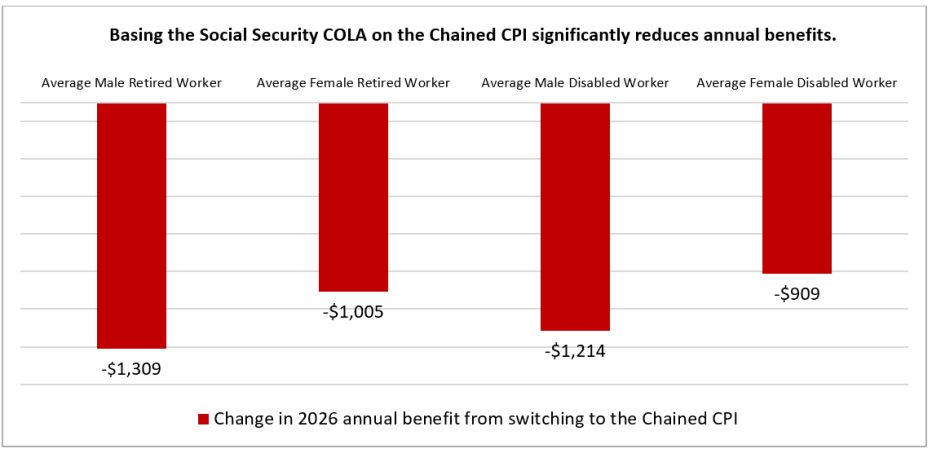
The monthly differences range from about $84 to $109 for average retired workers, and $76 to $101 for disabled workers. Over the course of a year the impact is much greater; Figure 2 shows the annual reduction in 2026 benefits from using the Chained CPI instead of the CPI-W.
Figure 2
(Note: author’s calculations based on data from the Social Security Administration and the US Census Bureau)
2. Social Security beneficiaries are considerably older than the overall U.S. population, and their spending patterns are not well captured with the Chained CPI.
The target population for the Chained CPI is urban consumers, and the principal argument for its use is that it better captures how consumers can substitute toward less expensive products when prices rise. However, Social Security beneficiaries are considerably older than the average U.S. consumer—the average age for all Social Security beneficiaries is 70; among retired workers, who make up 76 percent of all Social Security beneficiaries, the average age is 74.2
Social Security beneficiaries may have more difficulty than the general population at substituting many of the goods and services they rely on—notably prescription drugs, medical services, utilities, and housing when these costs increase. As a result, the chained CPI may not accurately measure the price increases faced by Social Security beneficiaries because older people devote a greater share of their spending to health care and other goods and services whose prices can rise rapidly and are difficult to substitute for.
Recognizing this issue, in 1987 Congress asked the Bureau of Labor Statistics to develop a price index for older Americans, which resulted in the creation of the Consumer Price Index for Americans 62 years of age and older. Known as the CPI-E, this experimental index has increased about 0.15 percentage points faster per year than the traditional CPI since 1982, largely because older Americans spend a greater share of their budgets on medical care. If anything, this suggests that Social Security’s COLA would have to be higher to reflect the expenses of older beneficiaries, not lower by using an index that produces even smaller increases.3
Conclusion
Switching from the CPI-W to the Chained CPI is not a harmless technical adjustment; it is a deliberate policy choice that would permanently erode the financial security of America’s retirees. By design, its slower inflation indexing creates a compounding penalty that cuts deepest among those least able to afford it – older beneficiaries and the long-term disabled who are less able to respond to price changes, especially for health care. There are reasons to believe that the Chained CPI actually understates the inflation Social Security beneficiaries face. Policymakers should reject any attempt to use the Chained CPI for annual COLA adjustments.
[1] See Provision A3 in: https://www.ssa.gov/oact/solvency/provisions/cola.html
[2] https://www.ssa.gov/policy/docs/statcomps/supplement/2026/5a.html#table5.a1
[3] Some have argued that use of the CPI-W should continue as a reasonable middle ground between the Chained CPI and the CPI-E. https://crr.bc.edu/social-securitys-cola-lets-not-mess-with-the-index/