
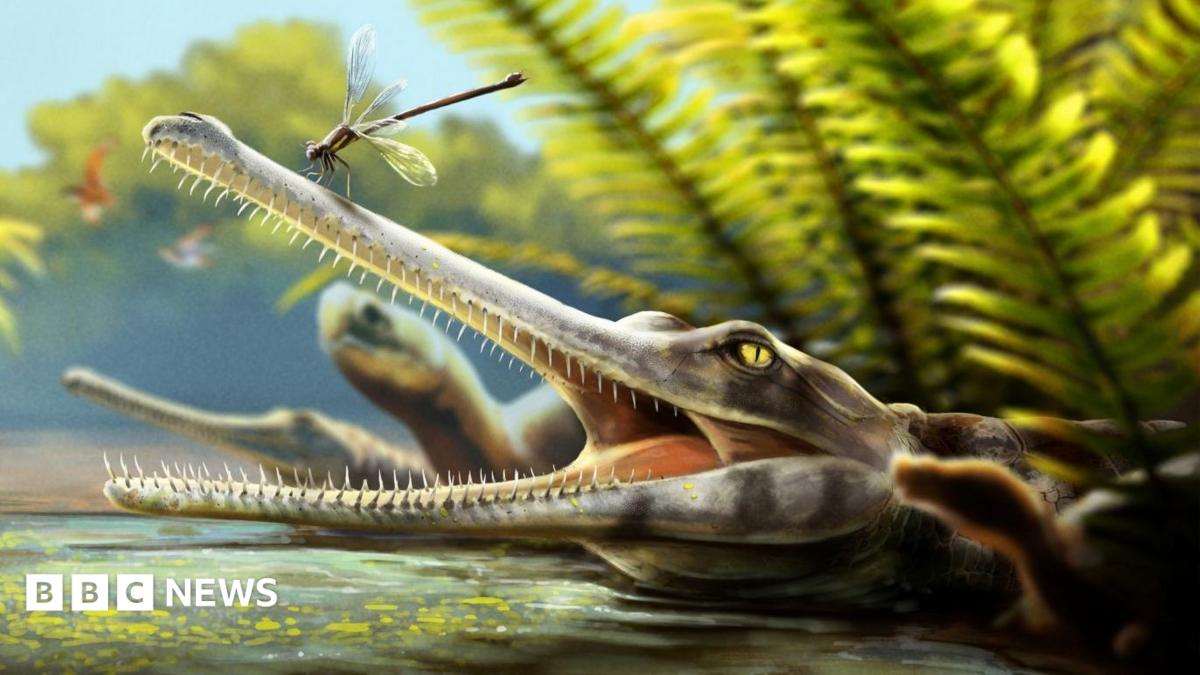
A previously undiscovered relative of the crocodile that lived about 170 million years ago has been identified by scientists.
A team from the University of Portsmouth and Hassan II University of Casablanca found fossils of the ancient reptile in Morocco’s Atlas Mountains.
The animal – which has been named ctenosuchus tenuidens – had a distinct long and narrow snout filled with needle-like teeth, unlike any of its known relatives.
Researchers say the teeth suggest it hunted smaller, softer prey, making it unique among long-snouted crocodiles.
“If it caught a big fish, and the fish wriggled, those delicate teeth would get smashed,” said Hamzah Imran from the University of Portsmouth, the lead author of the research.
“We think the animal was probably eating soft prey like shrimp, worms and tiny fish, so nothing that would break its teeth.
“These feeding habits make this particular species very different to other long-snouted crocodiles, so it really is quite an exciting discovery.”
It is the animal’s unusual comb-like teeth that led to its name. In Ancient Greek, “cteno” means comb, “suchus” means crocodile and “tenuidens” means thin teeth.