
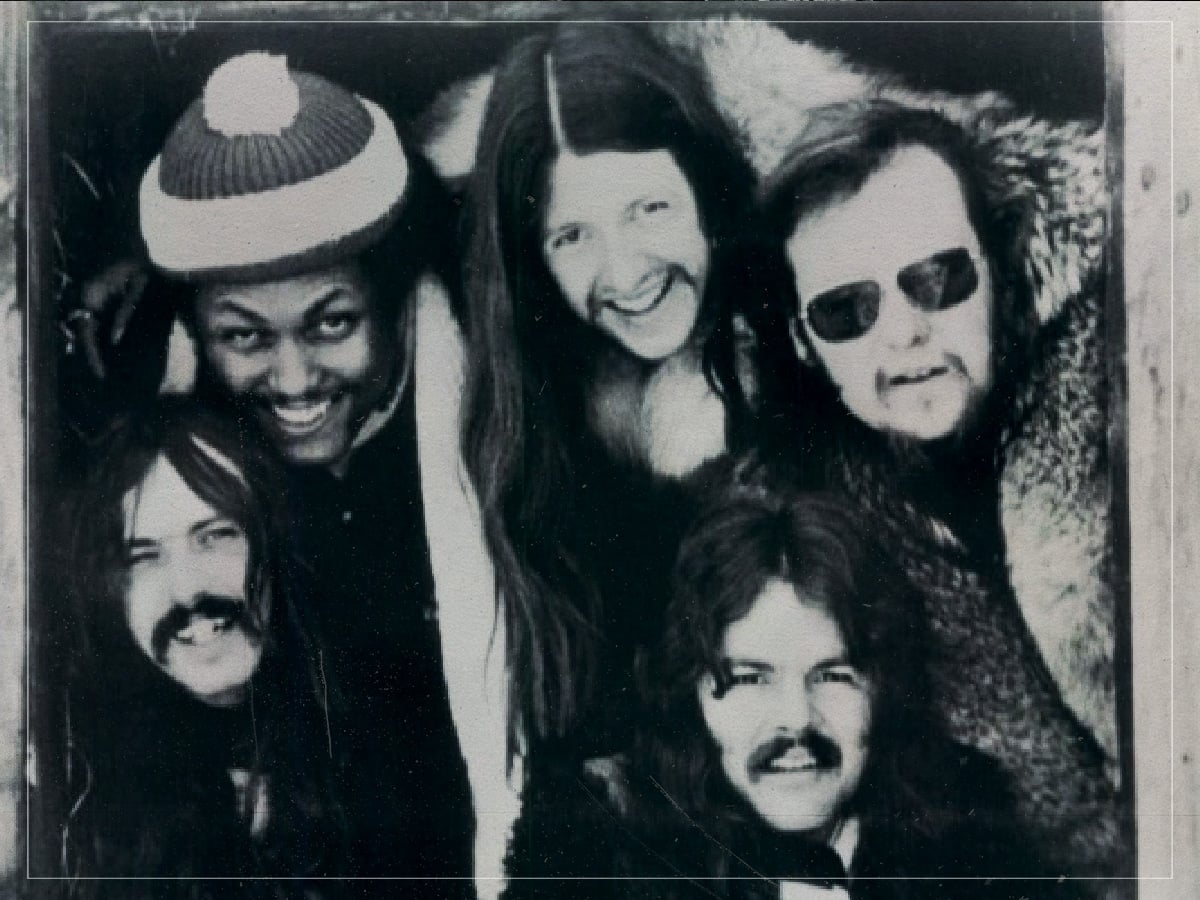
Credit: Far Out / IFA
Wed 14 October 2026 2:00, UK
A lot of young people go through an Alan Watts phase when they’re trying to make sense of the world, as the essays and speeches of the mid-century British-American philosopher, infused with elements from Eastern religion and proto-hippie ideas, make a terrific complement to a night of dorm-room dope smoking.
Watts is arguably as popular today as he was in the 1960s, but when Doobie Brothers singer-guitarist Tom Johnston became an admirer during his college years in San Jose, California, he didn’t have to listen to old clips on YouTube; he could hear Watts’ latest mind-expanding observations from the horse’s mouth, live on the radio, on Bay Area stations like KPFA and KSAN.
“I was listening to Alan Watts in school a lot,” Johnston told Guitar Player in 2024, noting that some of those soliloquies on the radio were influencing his early songwriting, along with the harsh political realities of the early 1970s in America.
He added, “This was during the Vietnam era… I was still involved with San Jose State [University], and there were a lot of SDS [Students for a Democratic Society] riots over there. I got drafted and had to go to two different draft centres, Fresno and Oakland, so I was familiar with everything and against the war and all that stuff, so it just filtered into the lyrics.”
Specifically, Johnston remembers all these factors coming together as he worked on the song that would become the Doobie Brothers’ first hit, ‘Listen to the Music’, the lead single off their 1972 sophomore album Toulouse Street. “That’s actually one of the few songs I just sat down and wrote and had everything, words and music, at the same time,” he recalled.
“Usually the music’s first and the words later… I thought people would get along a lot better if they used music to communicate rather than political rhetoric. I was trying to give it a utopian view, I guess.”
Over 50 years later, Johnston still claims that ‘Listen to the Music’ was the only song he ever wrote that he knew, instantly, it was a single, a potential hit. That confidence carried into the studio, where he and his bandmates, along with producer Ted Templeman, laid down the track without changing much of anything from the original demo.
Further reading: From The Vault
That decision was certainly justified when the song was released in July ‘72, powered by those sterling harmonies in the chorus, and raced out to a peak position of number 11 on the US Billboard chart, the first Doobies song to make a dent. Johnston remains proud of the song, but the inspiration that brought it into being is a more complicated subject in retrospect, as the worldview of a 23-year-old is always going to be a tad different from that of a 78-year-old.
“The idea was that music would lift man up to a higher plane,” he told Songfacts in 2009. “And that world leaders, if they were able to sit down on some big grassy knoll where the sun was shining and hear music, such as the type I was playing, would figure out that everybody had more in common than they had not in common…”
“Basically, that music would make everything better. And of course, I’ve since kind of realised it doesn’t work that way.”
Tom Johnston
Then again, Johnston’s old hero Alan Watts would probably say that he was on the right track the whole time. Maybe music wasn’t going to turn the world’s authoritarian leaders into empathetic angels, but living one’s life in a musical way was a pretty good idea.
“We thought of life by analogy with a journey, a pilgrimage,” he said in one of his famous talks, “which had a serious purpose at the end, and the thing was to get to that end, success or whatever it is, maybe heaven after you’re dead. But we missed the point the whole way along.
Concluding, “It was a musical thing, and you were supposed to sing or to dance while the music was being played.”
