
A major oil well blowout in the African country of Niger has been releasing methane into the atmosphere over the past 18 days at such an enormous rate that its climate impact so far could be equivalent to cancelling out approximately 40% of the entire reduction in Ireland’s greenhouse gas emissions achieved last year.
The extraordinary scale of the leak has been revealed by Europe’s Copernicus Atmosphere Monitoring Service (CAMS), which has been tracking large methane plumes over the desert in eastern Niger.
Satellite measurements have detected emissions exceeding 40 tonnes of methane per hour from a single oil field facility, with the incident continuing for almost three weeks.
To put that figure into an Irish context, the leak is releasing methane at a rate equivalent to the combined emissions of approximately 2.8 million Irish dairy cows – almost twice Ireland’s entire dairy herd.
Methane is a particularly powerful greenhouse gas, with a global warming potential approximately 28 times greater than carbon dioxide over a 100-year period.
On that basis, the Niger leak is releasing more than 1,100 tonnes of CO₂ equivalent every hour.
That is comparable to the combined emissions of approximately 3.9 million typical Irish petrol or diesel cars, using their annual emissions averaged across every hour of the year.
It is considerably more than the entire number of private cars on Irish roads.
But it is the cumulative impact of the incident that makes the figures particularly striking.
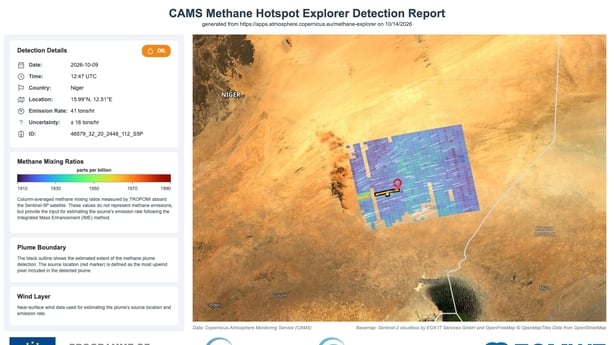
Europe’s Copernicus Atmosphere Monitoring Service has been tracking the methane plumes in eastern Niger (Photo: Copernicus)
The leak began on 25 September and was still ongoing when Copernicus carried out its latest analysis on 13 October.
If emissions continued at a constant rate of 40 tonnes per hour throughout those 18 days, more than 17,000 tonnes of methane would have escaped into the atmosphere.
That would amount to almost half a million tonnes of CO2 equivalent, or about the same as 40% of the reduction in Ireland’s annual emissions.
Total emissions yet to be verified
According to the Environmental Protection Agency, Ireland’s greenhouse gas emissions fell by approximately 1.2 million tonnes of CO2 equivalent in 2025.
That reduction was achieved through changes across the economy, including greater use of renewable electricity, reduced fossil fuel consumption, and emissions reductions in several sectors.
Achieving these reductions is an enormous national undertaking.
Billions of euro are being invested in renewable energy, electricity infrastructure, public transport, home retrofitting, and other measures to move the country away from fossil fuels.
Households and businesses are being required to make significant changes, while carbon taxes, higher fuel costs and changes to transport infrastructure are among the sometimes-unpopular consequences of the transition.
Yet, if the Niger leak maintained the emission rate detected by European satellites, then in just 18 days it would have effectively cancelled out the global warming benefit of 40% of the reduction in greenhouse gas emissions achieved through an entire year of climate action in Ireland.
It is an extraordinary illustration of how a single industrial accident can produce greenhouse gas emissions on a scale comparable to the hard-won annual reductions of an entire country.
However, Copernicus has not yet established whether emissions remained at this rate continuously throughout the incident, and the cumulative quantity released has yet to be verified.
‘Environmental emergency of exceptional severity’
The emissions are coming from the Goumeri W-8 oil well in the Agadem oil fields in eastern Niger.
The well is operated by a subsidiary of China’s state-owned China National Petroleum Corporation (CNPC).
On 25 September, it suffered a major blowout, causing crude oil and gas to erupt uncontrollably more than ten metres into the air.
Two workers were hospitalised, the drilling platform was severely damaged, and two neighbouring wells were potentially compromised.
The Nigerien government described the incident as an environmental emergency of exceptional severity.
The Environmental Protection Agency said Ireland’s greenhouse gas emissions fell by approximately 1.2 million tonnes of CO2 equivalent in 2025
Specialist teams have been working around the clock to contain the spreading crude oil and bring the well back under control.
Earth embankments, trenches and collection basins have been constructed to prevent the oil spreading further, while gas concentrations are being monitored because of the risk of fire or explosion.
An independent investigation has been launched to establish the cause of the blowout and determine responsibility, with Algerian technical experts also consulted.
Environmental organisations have raised concerns about potential damage to grazing land, livestock, soils and scarce water resources.
70% of methane emissions from fossil fuel operations could be avoided
Copernicus says its Methane Hotspot Explorer has identified a series of exceptionally large methane plumes originating from the affected facility.
Higher-resolution observations from its Sentinel-2 satellite have helped pinpoint the source, while additional imagery has been requested from the commercial satellite operator GHGSat.
Richard Engelen, Deputy Director of CAMS, said the detection demonstrated how routine satellite monitoring could rapidly identify unexpected methane releases and their impact.
The incident also highlights a much wider international problem involving methane escaping from oil and gas facilities, pipelines, and other fossil fuel infrastructure.
Reducing methane emissions is regarded as one of the fastest ways of slowing global warming in the coming decades.
According to the International Energy Agency’s Global Methane Tracker 2026, approximately 70% of methane emissions from fossil fuel operations could be avoided using existing technology.
That includes around three-quarters of emissions from oil and gas production.
The agency estimates that more than 35 million tonnes of methane could be prevented annually at no net cost, because the commercial value of the recovered gas would outweigh the cost of capturing it.
Yet, it says there is still no indication that global methane emissions from fossil fuel operations are declining.
The Niger incident is a particularly stark illustration of why tackling these emissions matters.
While countries such as Ireland are investing billions of euro and asking households, farmers and businesses to make significant changes to reduce their greenhouse gas emissions, enormous quantities of methane continue to escape from fossil fuel infrastructure elsewhere in the world.
Satellite technology is making these releases increasingly difficult to overlook.
But detecting them is only part of the challenge.
Ensuring that major leaks are stopped as quickly as possible, and that operators are held accountable for preventing avoidable releases, will be equally important if international efforts to slow global warming are to succeed.