
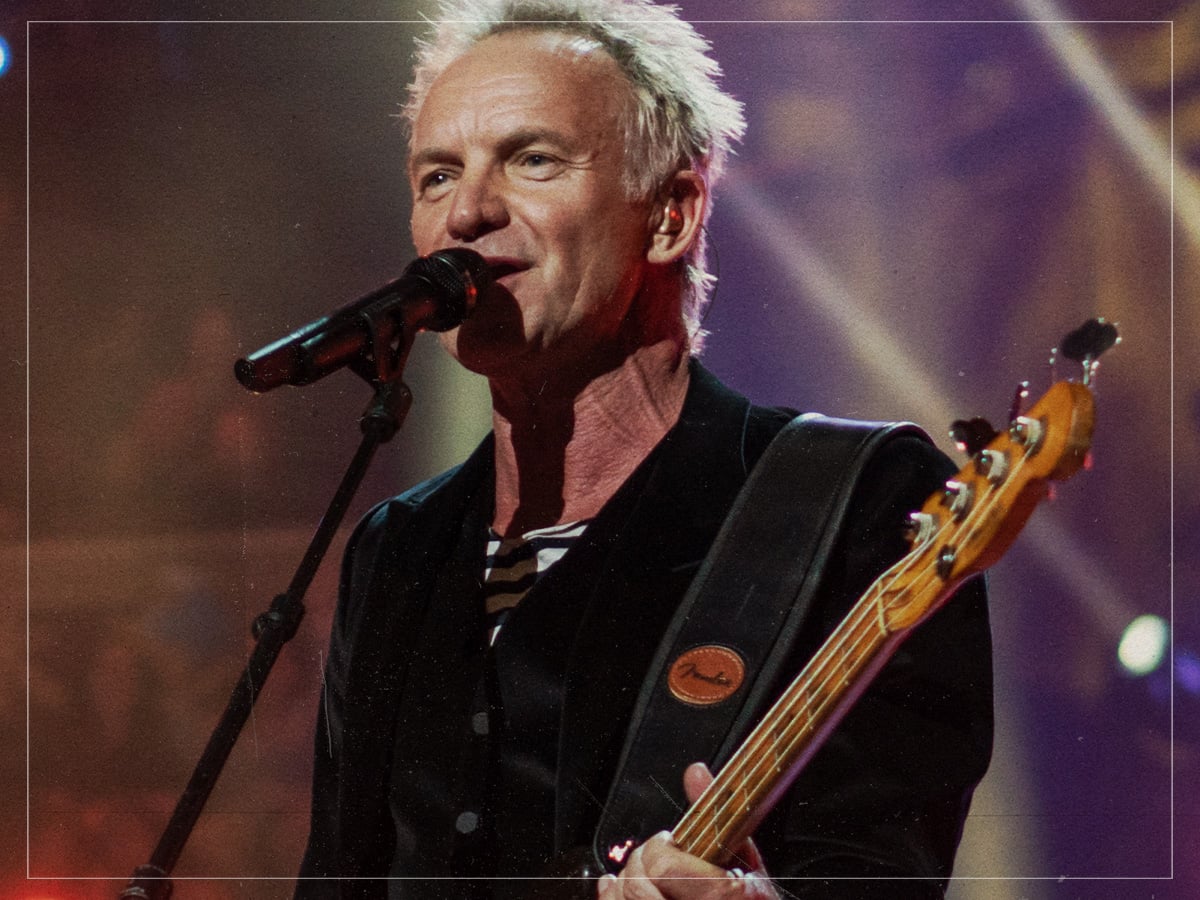
Credit: Far Out / Raph Pour-Hashemi
Sat 17 October 2026 6:00, UK
It may sound rather pretentious, but regardless of whether you understand the lyrics, music is often regarded as a language unto itself, with the rhythm and sound carrying the ability to unite people across cultures.
It goes without saying that many of Sting’s songs have arguably transcended language barriers, including ‘Fields of Gold’, ‘Englishman in New York’ and numerous tracks by The Police. Despite this, there remains one song in his catalogue which seems to have truly shifted his perception in this regard, and that’s ‘Desert Rose’, which first appeared on his sixth solo studio album, Brand New Day, in 1999, before being released as a single in January 2000.
Written during a period in which the ex-Police frontman had developed a deep interest in North African raï music, the track was inspired by his experiences attending performances and meeting musicians in Paris.
“We’d go to the clubs, and I’d meet the musicians and singers. ‘Desert Rose’ was inspired by that sound and feeling,” Sting recalled.
In 1998, he had listened to an album by Algerian singer Cheb Mami, which subsequently prompted him to see the singer perform at Bercy alongside Khaled, Rachid Taha and Steve Hillage. The experience had quite an impression on Sting, who soon began developing the music that would become ‘Desert Rose’. Wanting to incorporate Arabic vocals into the track, Sting approached Mami and asked him to improvise over the melody, and the latter developed his own lyrics without knowing what Sting had written in English.
When the pair reconvened, Sting was curious to know what Mami had been singing about, and although their lyrics were not identical, remarkably, both musicians had independently arrived at the same subject, as Sting recalled, “While I did not tell him what the song was about, he ended up singing in Arabic about the exact same feeling. It was that feeling of longing, a feeling of desire.”
For Sting, the song’s imagery of rain and gardens in the desert represented several forms of longing, whether romantic, physical or spiritual, and he later described the collaboration as an interesting experiment. However, not everybody was convinced that this experiment would work commercially, as upon release, American radio programmers were initially hesitant to play ‘Desert Rose’, while a representative from A&M Records reportedly encouraged Sting to remove its Arabic introduction for fear of alienating listeners.
Further reading: From The Vault
He refused, and the song subsequently received an unexpected boost when its music video, which featured a Jaguar S-Type, was incorporated into an advertising campaign for the car manufacturer. The exposure helped introduce ‘Desert Rose’ to a much wider audience, with the single eventually reaching number 17 on the US Billboard Hot 100.
Looking back, Sting admitted that he was both happy and surprised by its success, for there were hardly any Western pop hits opening with Arabic vocals at the time. What some had regarded as a commercial risk had ultimately become one of the song’s defining characteristics, but perhaps the most remarkable thing about ‘Desert Rose’ had occurred long before anybody heard it on the radio.
Sting and Mami had written about the same emotion without being able to understand each other’s words, so for all the talk of music being a universal language, the pair accidentally demonstrated that there might actually be something to the idea.
