
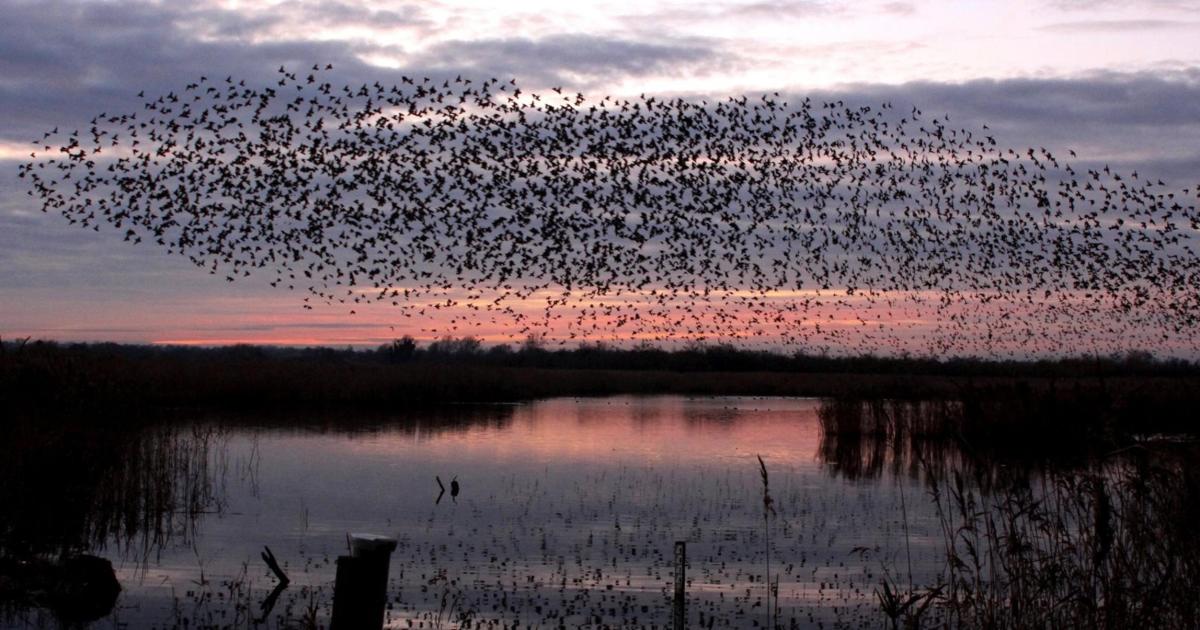
Judging by social media posts, searching for starling murmurations has become an increasingly popular autumn and winter activity, particularly when thousands of birds are involved.
The mesmerising swirls of pre-roost starlings have been popularised by wildlife TV programmes such as Winterwatch, used by businesses as a visual reference for teamwork, and, in recent years, incorporated by a string of different companies into advertisements for their products.
The starling, and its instinctive cooperation to avoid predation, has become a cultural metaphor for working together for a common cause.
Newly fledged starling chick (Image: Margaret Holland)
For me, it is a little like the feeling one has when an obscure artist or musician you have followed and admired for years suddenly becomes popular: “Yeah, well, I discovered them years ago, before they were famous.”
Behind the sports field of my old secondary school stood dense clumps of hawthorn.
In mid-winter, just as the school day ended, several thousand starlings would gather to roost in the relative safety of the thick, prickly scrub.
But as the afternoon quickly darkened and waves of starlings continued to arrive, the twisting mass made it impossible to estimate their true number.
Occasionally, I would delay my walk home to watch them in their unbelievable shape-shifting twists and whirls.
Alone in the chill air and fading light, the experience has remained profoundly memorable.
But familiarity, they say, breeds contempt.
I closely associate the starling with the house sparrow, as they were by far the most common birds of my urban youth.
Putting scraps out in the garden meant that few other birds got a look-in.
The starlings would bully other birds, even the feral pigeons; they constantly squabbled and fought among themselves.
Singing male starling (Image: Julian Thomas)
I found them bad-mannered, unruly and rather loutish, both in appearance and behaviour.
Hoping for blackbirds, blue tits, and robins, I’d have preferred they weren’t there.
But in nature, as with life, one must be careful what one wishes for.
According to the RSPB, the UK’s breeding starling population declined by 80% between 1970 and 2024.
In autumn, starlings migrate here and boost the numbers of our own birds.
However, similar population declines on the continent, combined with milder European winters, mean that fewer now travel to the UK.
Starling murmurations now rarely reach into a million birds, as many once did.
In modern times, the starling has always had a close association with us.
They found our built environment perfect for nesting opportunities; the only other requirement being a nearby lawn or park, rich in earthworms and leatherjackets.
Even in our great cities the starling could thrive.
The relatively liberal diet of the adult birds allowed them to benefit from our wastefulness, and like feral pigeons and house sparrows, this led to our disregard, even contempt.
The Central London murmurations, and resulting roosts, of the 1930s and 40s were astounding, with estimates of over two million birds during the particularly hard winter of 1946/47.
Starlings spent the night under bridges, and on the city’s most iconic buildings, including Whitehall and Westminster Abby.
In 1949 a flock roosting on the hands of Big Ben, stopped the clock!
Despite the authorities being driven mad by the thick layers of droppings, a Londoner’s evening journey home must have been made a little more thrilling by the sight of such spell-binding murmurations.
As recently as the 1980s, I recall seeing, and hearing, starlings roosting in the plane trees around Leicester Square.
Starling leaving nest (Image: David Savory)
The starlings are gone now, as are the house sparrows that once hopped between the tourists’ feet.
Here in Norfolk, large starling roosts could be met with consternation too, particularly by those whose livelihood depends on harvesting reed for thatch.
A favoured, and more natural site for a starling roost, is deep within a reedbed.
They feel safe clinging to reed stems over water, although these quickly bend and break under the weight, moving the starlings onto the next bed of reed the following evening.
Flattened and soggy reed is no good for harvesting, although with starling numbers so low, this is an infrequent problem now.
Reedbed roosts always attracted the attention of raptors, and I have been lucky enough to see hen harrier, merlin, marsh harrier, and peregrine, all at the same roost, each attempting to snatch dinner out of the air.
Occasionally bittern will hunt at night among reedbed-roosting starlings.
A welcome change from a fish supper perhaps!
Of course, predation is another good reason to keep moving a roost site.
I’m not sure when it happened, but the starling has become one of my favourite British birds.
I have two starling nest-boxes and each one is used, with both pairs often raising two broods.
In spring, both male and female starlings have bright metallic coats of purple and green.
When their glossy feathers catch the light, they shimmer a spectrum of colour – like oil on water.
Both parents work hard to raise their chicks, with the male occasionally breaking off feeding duties to deliver his “song” from the chimney top.
With much wing beating, it is a weird electric-sounding series of clicks and whistles.
They are amazing mimics too, and can copy other birds, car alarms, and phones ringing.
Last spring, I kept hearing a wigeon calling somewhere in my garden – as a winter duck in the UK, this seemed highly unlikely.
One of my starlings must have spent the winter on a Norfolk Broad’s marsh!
They are resolute parents, spending the whole spring constantly probing my lawn for worms, leatherjackets, and other insects; in and out of the nest box – a flying tag-match with their partner.
When the young finally appear, they are a uniform chocolate colour and lack the glisten of an adult.
They are relentless in their pursuit, and constant in their demand for food, from their over-worked parents.
Unfortunately, this year’s scorching summer, and rock-hard ground, prevented them attempting a second brood.
This homage to the common starling, or chimney-snipes as my dad used to call them, was prompted by a recent walk.
In the first fade of light, a group of local starlings had lined up along a rooftop and on the TV aerial.
They gave the impression of exchanging information with one another, just nattering about their day.
Their conversation was the usual jumble of strange clacks, snaps, and shrills, as starling conversations often are.
It left me with a feeling of nostalgia, and saddened for their plight, for the chattering of starlings will always be, for me, the evocative sound of the dimming light on a late autumn’s afternoon.
The starling is now classified in the UK as a “Red List Species” under the Birds of Conservation Concern.
The decline of the starling has left me a little ashamed of my previous attitude towards them, and it is a grim reminder that we must not take nature for granted, even when it appears to be widespread and abundant.