
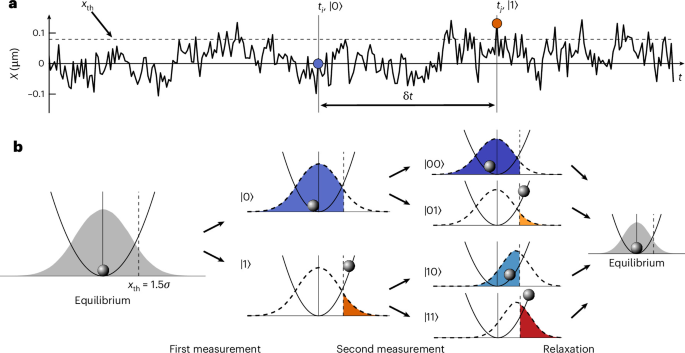
Maxwell’s famous Gedankenexperiment illustrates that information about the microscopic fluctuations of an equilibrium system can be converted into work extracted from a heat bath. The hypothetical demon thereby reveals a fundamental connection between information and energy conversion at small scales. This insight is formalized in information thermodynamics, which unifies work, entropy production and information within a consistent non-equilibrium theory1,2,3,4,5,6,7.
A cornerstone of information thermodynamics is a generalization of the second law of thermodynamics, first derived by Sagawa and Ueda, which bounds the average net work W that can be extracted from a system during a measurement-based feedback protocol8,9:
$$W\le -\Delta F+{k}_{{\rm{B}}}T\,I(Z:M).$$
(1)
Here ΔF is the free energy difference between the initial and final equilibrium states associated with the extraction protocol, kB is the Boltzmann constant and T is the temperature of a weakly coupled heat bath5,10. The mutual information I(Z : M) quantifies the average information gained about the microscopic system state Z from a measurement with possible outcomes M ∈ ΩM. The state Z represents the true physical state of the system, which fully determines its energetics and dynamics but is only partially accessible in practice. A measurement provides incomplete information about Z, reflecting finite resolution, noise, coarse-graining or unobservable degrees of freedom. Equation (1) shows that information acquired through measurement constitutes a thermodynamic resource, enabling further work extraction on average.
Experimental realizations and theoretical studies of Szilard engines, tests of the Landauer bound11,12,13,14,15,16 and verifications of fluctuation theorems have provided direct evidence of information-to-work conversion17,18,19,20,21. Most studies assume Markovian, that is memoryless, environments, where exchanged information is irreversibly lost. Often, however, this assumption breaks down: disordered materials, (bio)polymer solutions, periodically driven many-body systems, critical and active media but also open quantum mechanical systems typically exhibit pronounced temporal correlations that render the dynamics non-Markovian22,23,24,25,26,27,28. Microscopically, such non-Markovian effects originate from hidden environmental degrees of freedom (hDoFs) that retain information about past system–environment interactions and thereby influence subsequent dynamics and energetic exchanges. Only recently have theoretical studies started to formalize this perspective in the context of information engines operating with temporal correlations and information backflow29,30. Complementary experimental works have explored specific consequences, such as delayed feedback control and energy recuperation in viscoelastic environments31,32.
In general, the presence of hDoFs pose a central challenge for theoretical frameworks, as they complicate both the interpretation of entropy production and the applicability of standard information-thermodynamic bounds33,34,35,36,37. From the perspective of a Maxwell demon or feedback controller being restricted regarding its observables, the system, therefore, seems opaque, that is, only partially accessible. Moreover, environmental memory encodes information about the history of the system and, thus, constitutes a thermodynamic resource. This naturally raises the question of whether and to what extent such concealed memory can be harnessed for work extraction.
Previous theoretical work has suggested that this is, in principle, possible when the operations of the demon are precisely timed with respect to the system–bath dynamics36. We experimentally realized such a mechanism using time-resolved position measurements of an optically trapped Brownian particle in a viscoelastic fluid. Rather than relying on microscopic control or detailed knowledge of the environment, our approach uses delayed measurement pairs to access hDoFs operationally and in a model-independent way. This enables information stored in environmental memory to be retrieved and converted into useful work. More broadly, our results establish information backflow as an experimentally accessible resource for enhancing the performance of information engines in non-Markovian environments.
To elucidate the role of memory in work extraction, it is instructive to revisit equation (1). If the state of the system Z is taken to comprise an observable degree of freedom X together with all environmental hDoFs Y, the dynamics becomes Markovian in the extended state space Z = {X, Y}, and equation (1) formally applies with the mutual information I((X, Y) : M). Throughout, we assume isothermal conditions and restrict to protocols with ΔF = 0 (which is the case for any cyclic machine), allowing us to focus exclusively on information-driven work extraction.
It can be generally shown (Methods) that I((X, Y) : M) = I(X : M), implying that a single measurement cannot access thermodynamically useful information about environmental memory. Consequently, equation (1) remains unchanged compared with the Markovian case, despite the presence of hDoFs.
Further insight is obtained by considering work extraction conditioned on a specific measurement outcome M = m of an observable variable x ∈ X. The measurement transforms the equilibrium distribution ρeq(x) to the conditional distribution ρm(x) = ρ(x ∣ m), and the extractable work obeys5,38,39:
$${W}_{m}\le {k}_{{\rm{B}}}T\,{\mathcal{I}}_{m}(Z),$$
(2)
with the relative entropy or Kullback–Leibler (KL) divergence \({{\mathcal{I}}}_{m}(Z)={D}_{{\rm{KL}}}[{\rho }_{m}(z)| | {\rho }_{{\rm{eq}}}(z)]\). Averaging this bound over m, with Pm the probability of measurement outcome m, recovers equation (1), as the mean relative entropy is the mutual information \({\sum }_{{\Omega }_{M}}{P}_{m}{{\mathscr{ \mathcal I }}}_{m}(Z)=I(Z:M)\). The outcome-resolved bound in equation (2) immediately shows why hDoFs cannot be exploited through a single-time measurement: owing to conditional independence (M ⊥ Y ∣ X), one has DKL[ρm(x, y) ∣∣ ρeq(x, y)] = DKL[ρm(x) ∣∣ ρeq(x)]. This accords with physical intuition: memory manifests through temporal correlations, which are inaccessible to a single snapshot measurement. Exploiting memory, therefore, requires measurements at several times.
Repeated measurements are generally beneficial in the presence of measurement uncertainty (for example, measurement error or binning), as they increase the available information about the system state. Consequently, even in Markovian systems, repeated measurements can enhance the amount of extractable work (equation (1))3,6. For protocols consisting of a measurement followed by feedback, however, the total extractable work from an initially equilibrium system is fundamentally bounded by the excess free energy in the post-measurement state relative to equilibrium1. In systems with memory, environmental hDoFs can contain further excess free energy and lead to information backflow from the environment to the system, thereby, in principle, allowing work extraction beyond the Markovian limit (Methods; specifically, equations (14) and (15) show how both bounds, equations (1) and (2), are changed, respectively). To experimentally access these memory effects, we focus on a minimal measurement protocol capable of probing non-Markovian dynamics: two consecutive binary measurements (left and right). As we demonstrate, this minimal set-up already suffices to retrieve information from memory and convert it into useful work.
As an experimentally accessible and well-controlled model system exhibiting environmental hDoFs, we studied a colloidal silica particle of diameter 2.7 μm suspended in a viscoelastic micellar solution composed of an equimolar 8-mM mixture of cetylpyridinium chloride monohydrate (99%) and sodium salicylate (99.5%) (Methods). At room temperature, the surfactants formed a dynamical micellar network with a single structural relaxation time τr (refs. 40,41). For our concentrations, we had τr ≈ 6 s (Supplementary Note 2). As a result, a colloidal particle suspended in this solution exhibited pronounced non-Markovian behaviour42,43. Because the micellar network dynamics was not directly observable in our experiments, the state of the micellar network is considered as a hDoF storing information about past particle–bath interactions. The colloid was confined by optical tweezers in a harmonic potential \(V(x)=\frac{1}{2}\kappa {(x-\lambda )}^{2}\), with x the particle position, λ the trap centre and κ the trap stiffness. Particle trajectories were recorded at a rate 100 s−1 and spatial resolution of ±5 nm (Fig. 1a).
Fig. 1: Two-measurement protocol and state-conditioned particle distributions.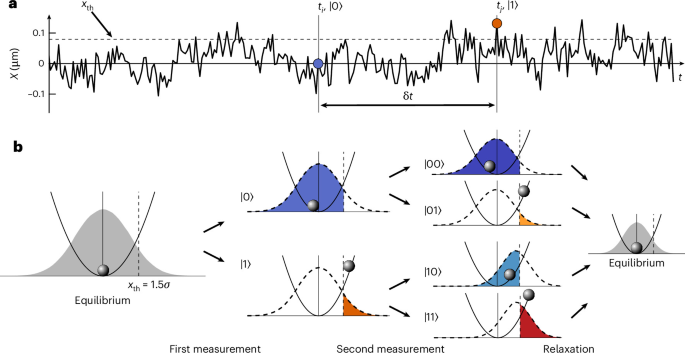
a, Measurement protocol illustrated using an experimental (subsampled for clarity) particle trajectory x(t) (black) corresponding to the state \(\left\vert 01\right\rangle\). At t = ti and tj = ti + δt, the particle position is compared with a fixed threshold xth. Positions below and above the threshold are indicated by the blue and orange symbols and define the states \(\left\vert 0\right\rangle\) and \(\left\vert 1\right\rangle\), respectively. b, Left: equilibrium position distribution ρeq(x) (grey) in the harmonic potential V(x) (solid black). The vertical dashed line marks the threshold xth. Middle: the first measurement truncates the equilibrium distribution (black dashed line) and prepares the conditional states \({\rho }_{\left\vert 0\right\rangle }(x,0)\) (blue) and \({\rho }_{\left\vert 1\right\rangle }(x,0)\) (orange). Right: a second measurement at tj = ti + δt prepares a further refined conditional ensemble. The \({\rho }_{\left\vert 0\right\rangle }(x,\delta t)\) distribution (dashed line) is then split into \({\rho }_{\left\vert 00\right\rangle }(x,0)\) (blue) and \({\rho }_{\left\vert 01\right\rangle }(x,0)\) (light orange). The \({\rho }_{\left\vert 1\right\rangle }(x,\delta t)\) (dashed line) distribution splits into \({\rho }_{\left\vert 10\right\rangle }(x,0)\) (teal) and \({\rho }_{\left\vert 11\right\rangle }(x,0)\) (red). All distributions subsequently relax back to equilibrium (grey). The solid spheres correspond to the mean particle position of the corresponding probability distributions.
The particle position was sampled under equilibrium conditions, as seen by the stationary distribution shown in Fig. 1b. At each measurement time t = ti, the position was compared with a threshold xth, assigning the state \(m=\left\vert 0\right\rangle\) for X < xth and \(m=\left\vert 1\right\rangle\) otherwise. The temporal decay of each such single-measurement outcome was characterized by the corresponding conditional distribution \({\rho }_{\left\vert i\right\rangle }(x,t)\) (Fig. 1b). Note that a positional measurement does not alter the microscopic state of a classical system, rather it prepares a different statistical ensemble conditioned by the measurement outcome. Selecting a given outcome (for example, X > xth) truncated the equilibrium Boltzmann distribution and created a genuine non-equilibrium state (Fig. 1b).
To access information about the full system, including hDoFs, we, therefore, performed a second measurement at tj = ti + δt. This defined a conditional state \(\left\vert ij\right\rangle\) with possible outcomes \(m\in \{\left\vert 00\right\rangle ,\left\vert 01\right\rangle ,\left\vert 10\right\rangle ,\left\vert 11\right\rangle \}\), characterized by conditional distributions \({\rho }_{\left\vert ij\right\rangle }(x,t)\) (Fig. 1b). This double-measurement selectively correlated the observed particle configuration with specific thermal excitations of hDoFs, which subsequently relax on their intrinsic timescale τr. The coupled particle–network relaxation was indirectly reflected in the time evolution of the average potential energy of the particle:
$${\overline{V}}_{m}(t)=\int \,{\rm{d}}x\,{\rho }_{m}(x,t)\,V(x).$$
(3)
Figure 2a shows the state-conditioned relaxation curves \({\bar{V}}_{\left\vert ij\right\rangle }(t)\) for δt = 1 s, each obtained from 300 s of trajectory data and averaged over 103 realizations. The strong dependence on the initial state \(\left\vert i\right\rangle\) for a fixed final state \(\left\vert j\right\rangle\) demonstrates that double measurements are sensitive to environmental memory. Most notably, the non-monotonic behaviour of the \(\left\vert 10\right\rangle\) state provides direct experimental evidence of energy transfer from hDoFs to the particle. By contrast, for large delays δt = 200 s, the relaxation curves no longer depend on the initial state \(\left\vert i\right\rangle\) but only on the final state \(\left\vert j\right\rangle\). This indicates that the hDoFs have equilibrated and no longer retain memory of the earlier state (Fig. 2b). Consequently, the relaxation became monotonic and approached the average equilibrium potential energy (0.5kBT), from both below and above. Memory effects are also expected to vanish in the limit δt → 0. This is confirmed by the inset of Fig. 2b, which shows the relaxation behaviour \({\bar{V}}_{\left\vert j\right\rangle }(t)\) after a single measurement (corresponding to δt = 0 s). As expected, these curves are nearly identical to the state-conditioned relaxations with identical final state \(\left\vert j\right\rangle\) for δt = 200 s.
Fig. 2: Memory-dependent relaxation: state-conditioned relaxation of the averaged particle potential energy.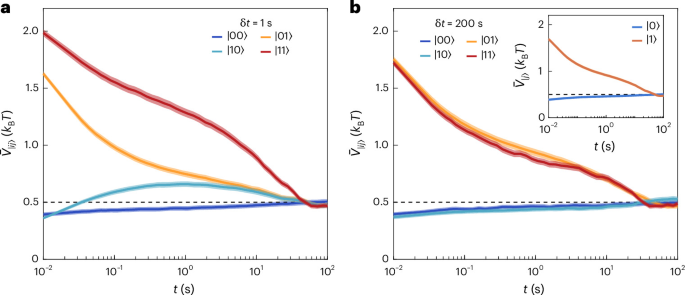
a, State-conditioned relaxation curves \({\bar{V}}_{\left\vert ij\right\rangle }(t)\) following a two-measurement protocol at δt = 1 s, showing pronounced differences between states with identical final outcome j but different initial states i. b, For δt = 200 s ≫ τr, the relaxation curves collapse for fixed j, demonstrating that the dynamics becomes independent of the initial state \(\left\vert i\right\rangle\) due to the equilibration of the hDoFs. Inset: relaxation following a single measurement (δt = 0 s), closely matching the large-δt limit, as memory effects vanish in both cases. All curves relax towards the equilibrium value 0.5 kBT. The shaded bands correspond to the standard error of the mean (s.e.m.) calculated using a bootstrapping procedure (Methods).
To provide a simple physical interpretation, we also considered a minimal micromechanical model (Supplementary Note 4), in which the hDoF of the non-Markovian environment is represented by a fictitious bath particle elastically coupled to the experimentally observed colloidal particle32,43,44. The resulting relaxation curves are in good agreement with the experimental data and, in particular, also reproduce the characteristic energy backflow of the \(\left\vert 10\right\rangle\) state (Supplementary Fig. 3a).
To experimentally quantify the extra information gained from a time-delayed second measurement, we compared the conditional distributions \({\rho }_{\left\vert ij\right\rangle }(x,t)\) and \({\rho }_{\left\vert j\right\rangle }(x,t)\) for t ≥ 0. Both ensembles ended up in the same final state \(\left\vert j\right\rangle\), but \({\rho }_{\left\vert ij\right\rangle }(x,t)\) additionally retained information about the earlier outcome \(\left\vert i\right\rangle\). Because these distributions already differed at t = 0, any direct comparison would mix effects due to different initial conditions with genuine memory contributions. We, therefore, constructed a new, history-blind, control distribution \({\tilde{\rho }}_{\left\vert ij\right\rangle }(x,t)\) by randomly subsampling trajectories from the single-measurement ensemble \({\rho }_{\left\vert j\right\rangle }(x,t)\) at t = 0, such that the empirical distribution of particle positions at t = 0 matched that of the corresponding two-measurement state (Supplementary Note 3). By construction, this ensured that
$${\tilde{\rho }}_{\left\vert ij\right\rangle }(x,0)={\rho }_{\left\vert ij\right\rangle }(x,0).$$
(4)
For a memoryless system, \({\tilde{\rho }}_{\left\vert ij\right\rangle }(x,t)={\rho }_{\left\vert ij\right\rangle }(x,t),\) for all x and all t ≥ 0. Starting from such control ensembles, we then compared the averaged temporal evolution of observables obtained from single- and two-measurement outcomes, thereby isolating the contribution arising from information stored in hDoFs, which we refer to as information backflow. Any difference between the two ensembles also directly reflects information gained from the second, time-delayed measurement.
We characterized the time-dependent information content using the KL divergence with respect to the equilibrium distribution, \({{\mathcal{I}}}_{\left\vert ij\right\rangle }(t)={D}_{{\rm{KL}}}[{\rho }_{\left\vert ij\right\rangle }(x,t)| | {\rho }_{{\rm{eq}}}(x)]\). Applying the same construction to the control distribution yielded the corresponding control information \({\tilde{{\mathcal{I}}}}_{\left\vert ij\right\rangle }(t)\). This quantity would bound the extractable work, if the system was Markovian, or, equivalently, if the system was non-Markovian but only a single measurement was done (equation (2)). By construction, the two ensembles have identical initial information, \({\tilde{{\mathcal{I}}}}_{\left\vert ij\right\rangle }(0)={{\mathcal{I}}}_{\left\vert ij\right\rangle }(0)\).
In a Markovian system, the instantaneous state fully determines the future evolution, implying identical information decay for both ensembles, so that \({\tilde{{\mathcal{I}}}}_{\left\vert ij\right\rangle }(t)={{\mathcal{I}}}_{\left\vert ij\right\rangle }(t)\) for all t (Supplementary Fig. 6a). The difference between \({\tilde{{\mathcal{I}}}}_{\left\vert ij\right\rangle }(t)\) and \({{\mathcal{I}}}_{\left\vert ij\right\rangle }(t)\) observed at δt ≈ 1 s (Fig. 3a,b), therefore, provides direct evidence for a backflow of information about the observable x stored in hDoFs of the micellar network, which is revealed only through the evolution of the system after the second, time-delayed measurement.
Fig. 3: Information backflow: information decay and non-Markovian order parameter.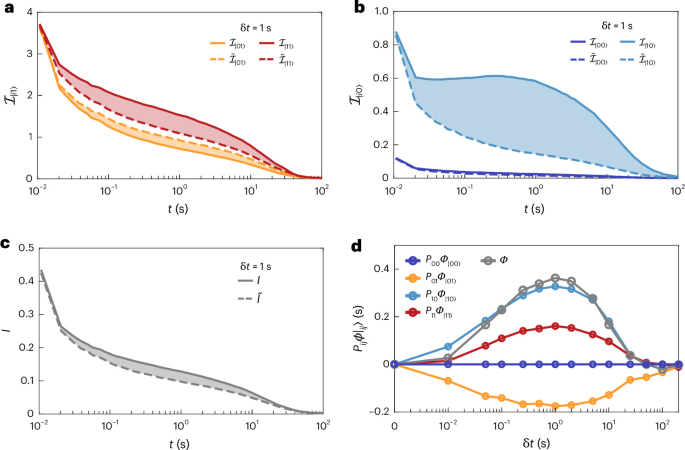
a, Time evolution of the KL divergence \({{\mathcal{I}}}_{\left\vert ij\right\rangle }(t)\) (solid lines) and \({\tilde{{\mathcal{I}}}}_{\left\vert ij\right\rangle }(t)\) (dashed lines) for δt = 1 s, conditioned on the second measurement outcome j = 1. The shaded regions denote enhanced persistence (accelerated decay) of information relative to the adjusted state. Notably, for the state \(\left\vert 01\right\rangle\), the difference \({{\mathcal{I}}}_{\left\vert 01\right\rangle }(t)-{\tilde{{\mathcal{I}}}}_{\left\vert 01\right\rangle }(t)\) is negative, corresponding to an accelerated decay of information. b, Same as a, but for states conditioned on j = 0. c, State-averaged information I(t) and \(\widetilde{I(t)}\), obtained by weighting individual contributions with their empirical probabilities Pij. The shaded region highlights the net excess information retained at δt = 1 s. d, Integrated order parameters weighted by their relative probabilities \({{\rm{P}}}_{ij}{\Phi }_{\left\vert ij\right\rangle }(\delta t)\) for individual measurement-conditioned states together with the state-averaged quantity Φ(δt), which show a pronounced maximum at δt ≈ 1 s.
To obtain the average time-resolved information at time t after a double measurement, we weighted each state \(\left\vert ij\right\rangle\) by its probability Pij:
$$I(t)=\mathop{\sum}\limits_{ij}{{\rm{P}}}_{ij}{{\mathcal{I}}}_{\left\vert ij\right\rangle }(t).$$
(5)
As shown in Fig. 3c, for δt = 1 s, I(t) decayed more slowly than the corresponding measure \(\tilde{I}(t)\) despite identical initial values, demonstrating a history-dependent contribution beyond the instantaneous state. Inspired by ref. 45, we captured this excess contribution using the integrated order parameter:
$$\Phi (\delta t)=\mathop{\sum}\limits_{ij}{{\rm{P}}}_{ij}\int_{0}^{\infty }\left[{{\mathcal{I}}}_{\vert ij\rangle }(t)-{\tilde{{\mathcal{I}}}}_{\vert ij\rangle }(t)\right]\,dt,$$
(6)
which quantifies the net information stored in hDoFs that influences the subsequent dynamics of the system. A value Φ(δt) ≈ 0 indicates memoryless (Markovian) behaviour, for which the relaxation is fully determined by the instantaneous particle state (Supplementary Fig. 6b). By contrast, Φ(δt) ≠ 0 indicates the influence of hDoFs, whose internal states affect the relaxation speed towards equilibrium. This interpretation also holds at the level of individual measurement-conditioned states and is reflected in the sign of \({{\mathcal{I}}}_{\left\vert ij\right\rangle }(t)-{\tilde{{\mathcal{I}}}}_{\left\vert ij\right\rangle }(t)\) (Fig. 3a–c). By varying the measurement interval δt, we thus mapped the temporal window over which memory affects the particle. Importantly, a non-zero contribution to Φ(δt) corresponds to a delayed decay of information and coincides with regimes where energy is transiently transferred from hDoFs back to the particle, establishing a direct link between information backflow and the energy backflow from the non-Markovian environment. Figure 3d shows the state-resolved contributions \({{\rm{P}}}_{ij}{\Phi }_{\left\vert ij\right\rangle }(\delta t)={{\rm{P}}}_{ij}\int_{0}^{t}\left[{{\mathcal{I}}}_{\left\vert ij\right\rangle }(t)-{\tilde{{\mathcal{I}}}}_{\left\vert ij\right\rangle }(t)\right]\,dt\). Despite pronounced differences in their shapes, the extreme values of all curves (except Φ|00〉) occurred almost at the same delay time δt ≈ 1 s, which was set by the timescales of the decay of hDoFs and the particle relaxation in the optical trap. Numerical simulations of the non-Markovian model reproduced this behaviour, yielding an order parameter Φ(δt) in good agreement with the experimental results (Supplementary Fig. 3b). As shown below, a similar state-resolved structure of \({\Phi }_{\left\vert ij\right\rangle }(\delta t)\) is reflected in the corresponding contributions to the extracted work, highlighting Φ as a predictive indicator for the efficiency of extracting work from hDoFs.
To test experimentally whether information retrieved from hDoFs can be converted into work, we compared with the fundamental information-theoretic bound in equation (2). We begin by rewriting this relation in terms of the decrease in the non-equilibrium free energy5:
$${W}_{m}\le {k}_{{\rm{B}}}T\,{\mathcal{I}}_{m}(Z)={\mathcal{F}}_{\mathrm{neq}}[{\rho }_{m}(z),V]-{F}_{\mathrm{eq}},$$
(7)
where Feq is the free energy of the final equilibrium configuration and \({{\mathscr{ \mathcal F }}}_{\mathrm{neq}}[\varrho ;U]={\langle U\rangle }_{\varrho }-{\sum }_{x}{k}_{{\rm{B}}}T\,\varrho (x)ln\varrho (x)\) denotes the non-equilibrium free energy for a state ϱ under external potential U (ref. 1).
We now consider the experimental protocol used throughout this work, consisting solely of rigid translational shifts of the external potential by an amount Λ over a duration tf: VΛ = V(x − Λ). Under these conditions, equation (2) simplifies considerably: for Markovian systems, the entropic contribution to the free energy difference in equation (7) vanishes, allowing the information-theoretic bound to be replaced by the tighter energetic bound:
$${W}_{m}\le {\underbrace{{\langle V(0)\rangle }_{m}-\mathop{\min }\limits_{\Lambda }[{\langle {V}^{\Lambda }(0)\rangle }_{m}]}}_{=:{W}_{m}^{* }}\le {\overline{V}}_{m}(0),$$
(8)
where \({\bar{V}}_{m}(0)={\langle V(0)\rangle }_{m}\) is the mean potential energy of the post-measurement state of x (equation (3)) before relaxation takes place. For convenience, we denote the corresponding energetic bound by \({W}_{m}^{* }\). By contrast, in systems with memory, the extractable work is not bounded by equation (8), as hDoFs can store further excess free energy generated by thermal excitations, which becomes accessible during feedback.
In our experiment, we considered a particle confined in a single-well harmonic potential with stiffness κ, which serves as a minimal and well-controlled reference setting. Here equation (8) simplifies to (Methods):
$${W}_{m}^{* }=V\left({\langle X\rangle }_{m}\right)=\frac{\kappa}{2}{\langle X\rangle }_{m}^{2}.$$
(9)
Thus, the extractable work in the Markovian reference system is bounded by the potential energy of the average, post-measurement state.
We conducted the following protocol. After the second measurement, at time t = 0, the optical trap was translated at constant velocity \(\dot{\lambda }\) over a duration tf = 3 s (Supplementary Note 6). The fluctuating work performed during the extraction process is given by
$$w=-{\int }_{0}^{{t}_{{\rm{f}}}}\frac{\partial V(x)}{\partial \lambda }\,\dot{\lambda }\,{\rm{d}}t,$$
(10)
where positive values correspond to work extracted from the system. Figure 4b shows the average extracted work after measurement outcomes m, which we denote Wm(tf). We normalize Wm(tf) by the energetic bound \({W}_{m}^{* }\) for the Markovian reference system from equation (9). The maximum conversion efficiency \({\eta }_{\left\vert 11\right\rangle }^{* }(\delta t)\), indicated by markers in Fig. 4a, exhibits a pronounced dependence on the measurement interval δt. The maximum is obtained for δt ≈ 1 s (see inset). Notably, this non-monotonic behaviour closely resembles the trend of the order parameter Φ from Fig. 3d, which shows a maximum around a similar value of δt, indicating maximal information backflow for δt ≈ 1 s. This demonstrates that information retrieved from the second, time-delayed measurement enhances work extraction, a feature that is absent from Markovian environments (Supplementary Fig. 4a).
Fig. 4: Work extraction from hDoFs through two-measurement protocols.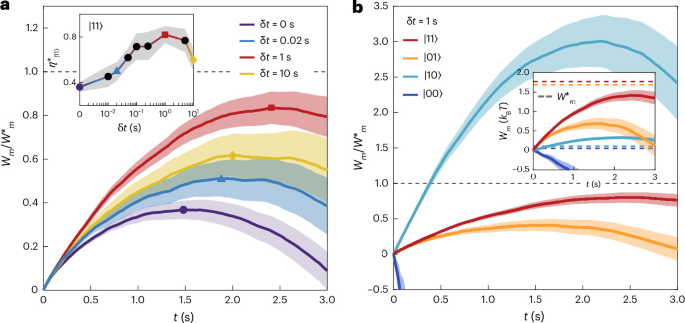
a, Averaged normalized work \({W}_{m}(t)/{W}_{m}^{* }\) along finite-time extraction protocols, extracted from a \(\left\vert 11\right\rangle\) state and for increasing δt (purple to yellow). The work is normalized by the theoretical optimum for the corresponding Markovian system, \({W}_{m}^{* }\) (equation (9)). Markers denote the maximal normalized work for each interval, \({\eta }_{\left\vert 11\right\rangle }^{* }\), which peaks at δt = 1 s (see inset) but remains below unity. b, Averaged normalized work \({W}_{m}/{W}_{m}^{* }\) extracted for a fixed value δt = 1 s and states \(\left\vert 11\right\rangle\) (red), \(\left\vert 01\right\rangle\) (light orange), \(\left\vert 10\right\rangle\) (teal) and \(\left\vert 00\right\rangle\) (blue). For \(\left\vert 10\right\rangle\), the maximum extracted work clearly exceeds \({W}_{m}^{* }\), demonstrating the extraction of energy stored within hDoFs. Although the ratio of work that can be extracted from the hDoFs is highest in state \(\left\vert 10\right\rangle\), the absolute amount of extractable work is highest in \(\left\vert 11\right\rangle\) (inset). The averages have been obtained from ~100 extraction protocols, and the shaded areas correspond to the s.e.m. obtained from bootstrapping (Methods).
In addition to correctly identifying an optimal timescale δt between measurements, the non-Markovian order parameter Φ also predicts which states are most favourable for extracting energy from the hDoFs. Among all configurations, \(\left\vert 10\right\rangle\) yields the largest Φ, reflecting maximal information backflow and the associated recovery of non-equilibrium free energy after the double measurement (Fig. 3d). Consistently, this state produces the highest work output from memory, as captured by the normalized work \({W}_{m}/{W}_{m}^{* }\) (Fig. 4b). The extracted work reaches values up to three times \({W}_{\left\vert 10\right\rangle }^{* }\), substantially exceeding what would be achievable from an equivalent measurement in a Markovian environment. This behaviour indicates that energy extraction in the \(\left\vert 10\right\rangle\) state is dominated by the hDoFs, with only a minor contribution from the observable potential energy. The condition \({W}_{m}/{W}_{m}^{* } > 1\), therefore, provides direct evidence that free energy stored in hDoFs can be converted into work using information obtained solely from the tracer particle. Overall, the ordering of work extraction is captured well by Φ.
When considering the absolute amount of extracted work Wm (Fig. 4b, inset), which combines contributions from the memory as well as the bare potential energy of x of the initial state, a different ordering of the states emerges. This can be partially attributed to the largely different values of \({\langle V(0)\rangle }_{\left\vert ij\right\rangle }\). State \(\left\vert 11\right\rangle\) allows the highest absolute value of work to be extracted, owing to a substantial contribution from the observable potential energy \({\langle V(0)\rangle }_{\left\vert 11\right\rangle }\). Although \(\left\vert 01\right\rangle\) seems similar at first glance, as \({\langle V(0)\rangle }_{\left\vert 01\right\rangle }\approx {\langle V(0)\rangle }_{\left\vert 11\right\rangle }\), the work extracted is considerably smaller. Moreover, \({W}_{\left\vert 01\right\rangle }\) reaches its maximum earlier, consistent with \({\Phi }_{\left\vert 01\right\rangle } < 0\), which indicates that the hDoFs accelerate the relaxation dynamics in this case. Finally, no work can be extracted from the \(\left\vert 00\right\rangle\) state, for which \({W}_{\left\vert 00\right\rangle }\) remains systematically negative. Numerical simulations reproduced this behaviour and are in good agreement with the experimental results (Supplementary Fig. 4b).
In this work, we have demonstrated work extraction beyond the Markovian limit, focusing on the minimum measurement scheme to access memory—two binary measurements—and an extraction protocol restricted to rigid potential shifts. By using more flexible and optimized extraction protocols or by increasing the number of measurements or their spatial resolution to increase the accessible information, the extractable work could further be enhanced; the fundamental limit set for work extraction is set by the total excess free energy of the (thermally excited) system state at the onset of control (equation (7)).
Our results highlight a general route for identifying and exploiting hDoFs as a thermodynamic resource in systems with intrinsic memory. In this context, time-delayed or repeated measurements provide an operational handle that can be used to infer statistical information about the state of hDoFs from partial observations, without requiring any explicit or direct access to their microscopic dynamics. This enables memory-aware control strategies, such as adaptive feedback protocols that tailor control actions to the inferred bath state and allow accelerated relaxation towards equilibrium in time-correlated environments where conventional Markovian shortcuts fail46.
Beyond control, double measurements also suggest an operational criterion for memory erasure by signalling when all information-bearing hidden modes have relaxed and the dynamics becomes history independent. Beyond classical systems, the storage and backflow of information in unobserved environmental modes are a central theme in the theory of open quantum systems, where non-Markovianity has been widely discussed27,28. Our findings thus point towards a unifying perspective in which hDoFs—whether classical or quantum—can be systematically characterized and exploited for information-based control, equilibration and energy conversion in time-correlated environments.