
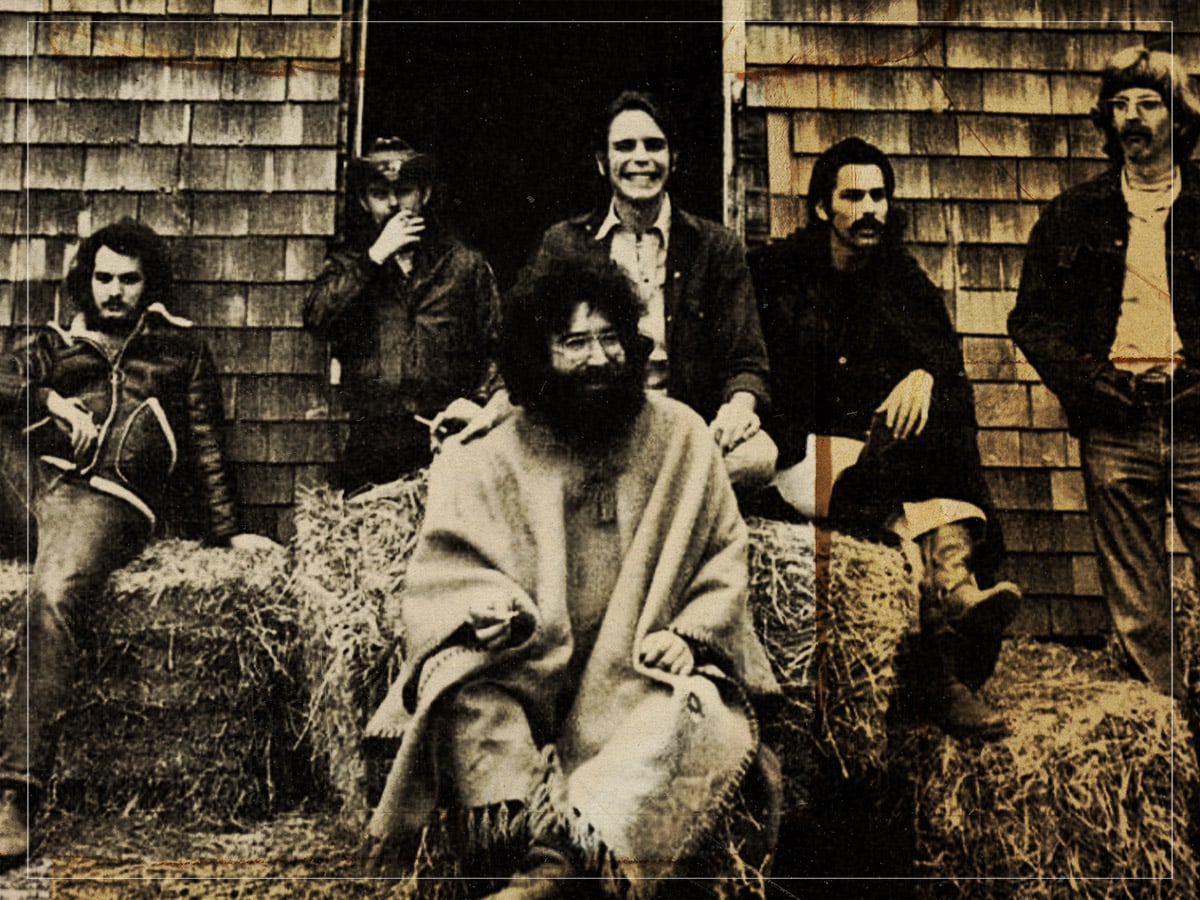
Credit: Far Out / Herb Greene / Public Domain
Sat 17 October 2026 23:30, UK
“In late ’65, strange posters began to appear on telephone poles and in bookstores around the South Bay,” Grateful Dead bassist Phil Lesh recalled in his 2005 memoir Searching for the Sound. The poster read: “Can you pass the acid test?”
Lesh was 25 years old and only a few months into his membership in a San Francisco area band called The Warlocks, but he and his mates weren’t wet behind the ears when it came to psychedelic drugs. They had already done a fair bit of dabbling in mind expansion in those early days before the Haight-Ashbury blew up as a sort of Mecca for drug culture. This poster or flyer, which they were seeing everywhere, however, did seem like an invitation to step up their game to the next level.
“A tall, narrow, off-yellow strip of paper,” as Lesh described it, “Promised attendance by the Beats! Neal Cassady! Freaks! The Merry Pranksters! And by implication, had one eyes to see and ears to hear, something perhaps more intangible. Since we were constantly ready to drop a little acid at a moment’s notice, I wangled invitations for the band to the first Test through my good friend Page Browning.”
After that friendly bit of networking, a new version of the poster appeared, with The Warlocks’ name now added to it, giving the impression they might be the headline musical act at the event. In reality, the members of the band, which would soon rename themselves the Grateful Dead, didn’t even bother bringing their instruments. Pre-planning anything didn’t really make sense when the whole point was to trip communally and see what happened.
The first Acid Test certainly seems like a newsworthy moment in retrospect, considering the people involved and the wider movement it helped spawn, but it was actually a fairly humble affair; a house party, really, held in the home of organiser Ken Babbs in Soquel, California, near Santa Cruz.
As one of the leaders of the so-called ‘Merry Pranksters’ group, alongside writers Ken Kesey (author of One Flew Over the Cuckoo’s Nest) and Neal Cassady, Babbs would later recall in a 2022 interview that the whole thing started as more of a “Halloween party” rather than a big cultural happening (the party was on November 27th, so his memory might be foggy on that front): “We were out in the yard, we’re communing with the moon, holding hands, and levitating off the ground. And then we hear this music. We realised it was coming from the house, and we went in, and these guys were all playing our instruments. They ended up playing all night.”
Just about any recounting of the first Acid Test probably needs to be taken with a grain of salt, considering everyone involved was there for the expressed purpose of loosening their brains out of their skulls. Phil Lesh remembered that he and the other Warlocks definitely did borrow the instruments that the Pranksters had sitting in the house, but he didn’t recall jamming all night. Instead, when Ken Kesey handed him an electric guitar, he “couldn’t make any sense out of it,” according to his memoir, “The night sky was ever so much more fascinating”.
Further reading: From The Vault
In a 1988 interview on the subject with journalist Joe Smith, Jerry Garcia confirmed that while the Warlocks messed around with playing a tune or two, “there was no real performance of any kind involved. Everybody there was as much performer as audience”.
However, if anybody in attendance had decided to become a fan of the Warlocks going forward, they might have had a hard time tracking them down, as just days after the lysergic gathering, Garcia became aware of the existence of another band called The Warlocks, so he sought a new name from an old dictionary in Lesh’s house. Thus was born the Grateful Dead.
By 1966, the Dead were deeply involved in the far more organised and well-attended multimedia affairs that the Acid Tests evolved into. Unlike most rock bands in the mid-60s, the goal wasn’t to be the next Beatles, or to ascend to stardom and sell records. It was, for a while anyway, to figure out a higher plane of existence, or maybe more importantly, to enjoy themselves.
“When we fell in with the Acid Tests, we started having the most fun we’d had, ever,” Garcia said, noting that the prime six months of that period had a major impact on how the band developed and established its loose, guiding principles.
“It was just incredible.”
