
Ukraine did not receive a warning from the US about an impending Russian missile attack on Sunday evening, Volodymyr Zelenskyy has said, reviving concerns that Washington is withholding intelligence to bully Kyiv into capitulating to Moscow.
Yuri Ihnat, a spokesperson for the Ukrainian air force, said on television on Monday morning that Ukraine had not received a warning before a Russian missile barrage hit power plants in Kyiv at about 11pm. Earlier, a Ukrainian government official had told the Guardian the US had not warned the capital about the impending missile strike.
Ukraine did receive a warning before a subsequent strike, at 3am, Ihnat added.
“Once again, Russia launched a ballistic missile attack in multiple waves throughout the night, and once again, there was no warning from our partners,” Zelenskyy wrote in a social media post on Monday morning.
“When the supply of missiles for Ukrainian air defence is blocked, and Russia receives sanctions relief or delays, it is, unfortunately, a denial of reality on the part of our partners,” the president added.
Zelenskyy is grappling with recent US moves benefiting the Russian president, Vladimir Putin.
On Friday, Donald Trump waived a sweeping package of sanctions on Russia, telling Congress the pause on the legislation, named after the late senator Lindsey Graham and passed by both chambers, was in the national interest. Ukraine has also complained of slowed deliveries of PAC-3 air defence missiles from the US.
The US president wrote on Truth Social on Sunday: “My decision on Russia is a very simple one. I am in the process of negotiating peace in the war between Russia and Ukraine, and don’t want to do anything that will drive, foolishly, Russia away from the bargaining table.
“Zelenskyy doesn’t care, and frankly, with all of the money that Europe is famously giving him … he doesn’t want to end this war, and probably never did.”
Trump also told reporters on Monday that he would consider a trilateral meeting with Russia and China. He said: “We would have it to talk about nuclear weapons and denuclearisation. If President Xi wants to have it, I’d have it.”
For years, the US has warned Ukraine before Russia launched ballistic missiles, giving authorities several minutes to sound alarms and allow civilians to reach shelters before the strikes hit. However, Ukraine has said it was not warned on at least three days in the past week before missiles were launched, amid a public quarrel between Zelenskyy and Trump.
Speaking in the early hours of Monday on a trip to Samarkand, Uzbekistan, the US secretary of state, Marco Rubio, said: “If it happened last night, I don’t know exactly. I know a few nights ago there was a software problem involving their early warning system.”
US officials have not previously mentioned a software glitch in the early warning system. In at least one case, Ukrainian officials had been told that bad weather over southern Russia had obscured preparations for the missile launch. Rubio said the military’s European Command was looking into the strikes.
The US has maintained plausible deniability as services and programmes provided to support Ukraine have suddenly begun to fail. The Trump administration has denied that it throttled services in Ukraine for Starlink, the satellite internet service run by Elon Musk that is used both on offensive drones and anti-air weapons by Ukraine.
Ukraine has also said US weapons delivered through the PURL scheme, where Europe purchases US weapons then delivers them to Ukraine, have been delayed. The Trump administration reportedly threatened Kyiv with a slowdown in crucial weapons deliveries unless it stopped striking Russian oil refineries.
On Sunday, Ukraine launched more than 1,000 drones at Russia in one of its largest aerial attacks of the war, setting fire to an oil export terminal and a depot in St Petersburg.
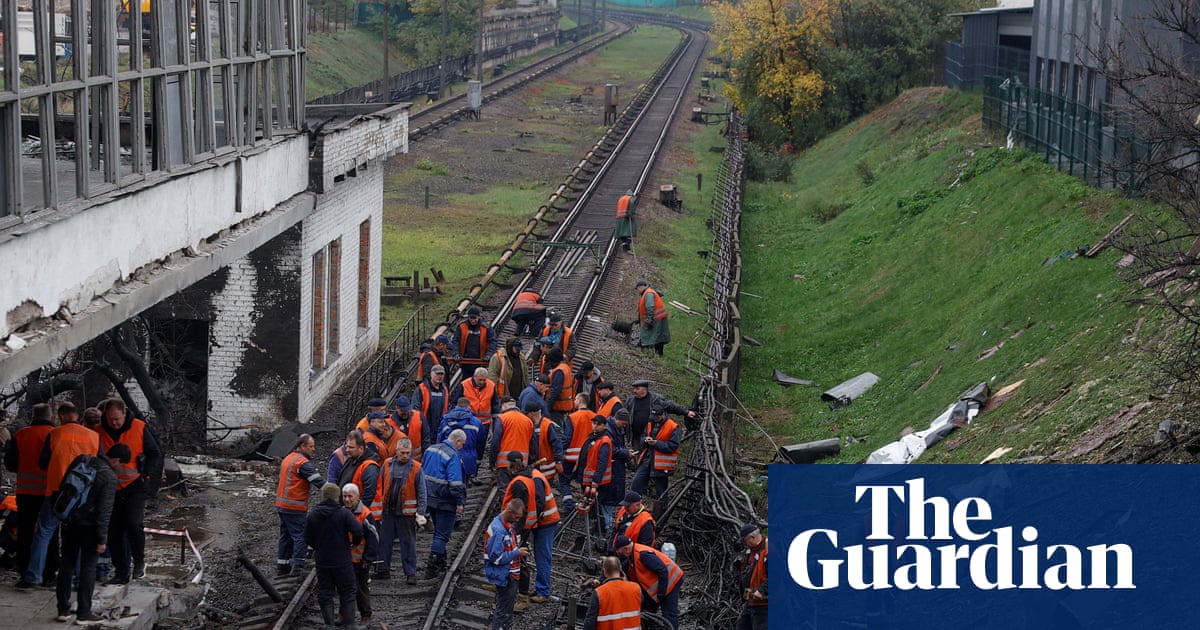
The Russian barrage on Sunday evening hit 28 substations and other critical energy facilities, depriving more than 500,000 people of electricity, heat and running water, Zelenskyy said on social media. Russia has sought to disrupt daily life in Ukraine by attacking trains, shopping centres, fuel stations and supermarkets, among other sites.
Russia fired 16 ballistic missiles at Kyiv and the surrounding region, Zelenskyy said, and officials in the capital reported that a 21-year-old woman had been killed.
Later drone strikes on a public park in the north-eastern Kharkiv region killed six people, including young children. The regional governor, Oleg Synegubov, said on Telegram that three of the dead in the attack on Nova Vodolaha were children, including one in a pushchair. Seven children were among the 14 wounded. Police posted pictures showing damaged playground equipment.
Synegubov condemned “another terrorist act by the Russian Federation”, saying “the enemy strikes a recreational park in the middle of the day, knowing that there is no military infrastructure there at all”.
Pope Leo XIV spoke by phone with Zelenskyy on Monday to discuss the embattled city of Oleshky in Ukraine’s Kherson region, according to a Vatican statement. He told the Ukrainian president that he had asked Putin for a humanitarian ceasefire during a call with the Russian leader on Friday.
Residents of Oleshky face a worsening humanitarian crisis, with shortages of food and medication, as they are caught in the crossfire between Russian and Ukrainian troops. The Vatican said that Leo had expressed deep concern about conditions in the city and sought a ceasefire to permit aid deliveries and evacuations.
The call to Zelenskyy came two days after Leo, 71, was discharged from a hospital in Rome where he underwent a lung cancer operation on Tuesday.
The Kremlin said on Friday it had explained to Leo what it called “the Kyiv regime’s responsibility for the difficult humanitarian situation”.