
A Victorian painting of an Edinburgh landmark, up for sale for the first time in 175 years, may only exist because of a piece of gentlemanly “skullduggery”.
The 1851 masterpiece by David Roberts – lauded by art historians as the foremost British painter of architecture – depicts the Donaldson Hospital in West Coates and is expected to fetch up to £150,000 at auction.
The painting has not even been exhibited since it was shown at the Barbican in London almost 40 years ago and will go on sale for the first time on Thursday this week.
Research unearthed by auctioneers Bonhams from the Barbican, however, suggests that the painting may be linked to an elaborate plot to win a famed Edinburgh architect the job to design the building.
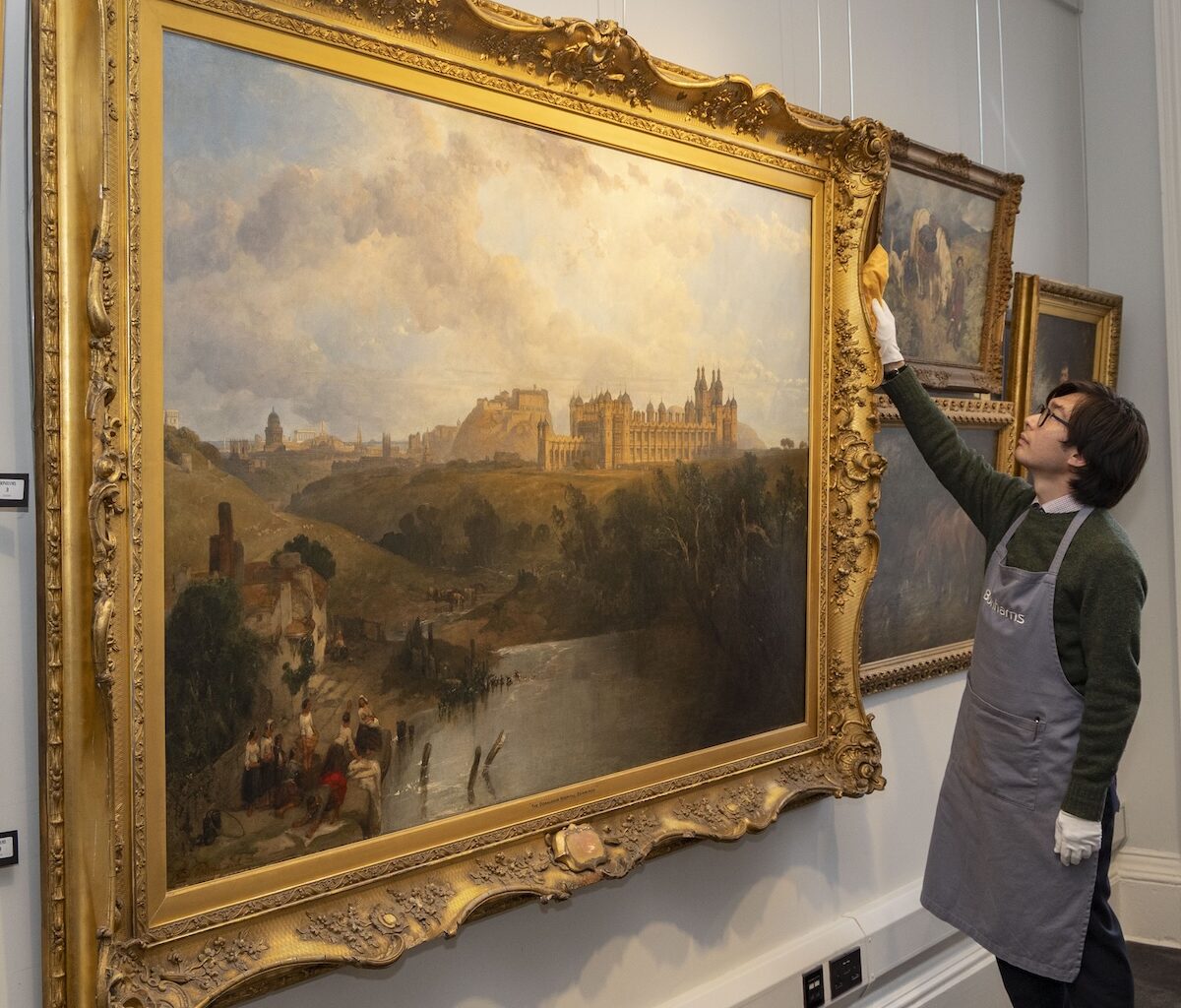
 View of Donaldson’s Hospital from the North West (1851) by David Roberts, oil on canvas, 128 x 190.5cm (50 3/8 x 75in) © Alan Simpson
The building, which now serves as luxury flats, was first commissioned in the Will of Edinburgh publisher James Donaldson, who asked for a hospital to be built in his name after his death in 1830.
While the competition process to decide upon the architect was open, Playfair is thought to have sought the assistance of the painter whose “magic pencil” could “enhance” his designs and boost his chances.
A mutual friend of the pair wrote to Roberts in March 1838 to inform him that Playfair was in the running to design the hospital.
He added: “He is most anxious to be successful in this competition, and is aware that there is no artist living whose magic pencil could so enhance the effect of his drawing and thereby give him an additional chance of success.
“He has applied to me to ask if you would have the goodness to colour lightly two perspective drawings for him.
“They will be accurately drawn in outline and all that you would require to do would be to give an effect.”
He clarified that Playfair would “cheerfully” pay whatever charge Roberts placed on the paintings but requested that Playfair’s name be attached to the paintings.
At the time, such “ghosting” was not unheard of, but architects were at pains to ensure the practice was not documented.
 May Matthews, Managing Director of Bonhams Scotland (left), described Roberts’ vision of Edinburgh as “monumental” © Alan Simpson
The Barbican – in their book accompanying the 1986-87 exhibition – described this intervention as a piece of “skullduggery”, but the plot paid off and Playfair won the commission.
The building was opened in 1850 as a school – which later specialised in educating deaf children – rather than a medical hospital (under 19th-century Scottish usage, “hospital” referred to a charitable school).
Queen Victoria is reputed to have remarked, upon opening the building, that it was more impressive than many of her own palaces.
After the building was constructed, Playfair paid Roberts a generous £200 (the equivalent of around £36,000 today) to paint the finished Jacobethan edifice – perhaps as a thank you for his assistance.
Roberts enlivened the school with washerwomen on the banks of the Water of Leith in the foreground and a herd of cattle at the water’s edge, separating the figures from the distant view.
Playfair’s building is contrasted by distant hills, suffused with sunlight breaking through a cloudy sky.
The juxtaposition of architectural grandeur with an idealised vision of rural life was central to Roberts’ work.
Some artistic licence, however, appears to have been taken in the arrangement of the Edinburgh skyline.
 Roberts may have embellished the view of Edinburgh landmarks in the background somewhat © Alan Simpson
Although the general viewpoint is from the northwest of the city, with Donaldson’s Hospital at its centre, beyond the building can be seen Edinburgh Castle, Arthur’s Seat, Calton Hill and even North Berwick Law.
Several other prominent buildings designed by Playfair also appear, including the Royal Scottish Academy and the National Monument of Scotland on Calton Hill.
Valued at £100,000-£150,000, the work will go on sale at Bonhams in Edinburgh at 12 noon on 22 October 2026, along with works by Sir John Lavery and Anne Redpath.
May Matthews, Managing Director of Bonhams Scotland, said: “Together, the three works offer different windows onto Scottish cultural history: Roberts’s monumental vision of Edinburgh architecture; Redpath’s vibrant interpretation of Gran Canaria; and Lavery’s portrait of a pioneering Scottish woman, emerging from the extraordinary artistic and social world of Victorian Glasgow.
“With their compelling provenance, strong Scottish connections and, in each case, a history largely unseen by the public, the three paintings are notable highlights of the forthcoming Bonhams Scottish Art Sale.
“Their first appearance at auction is expected to generate significant interest from collectors seeking works with both artistic importance and a fascinating sense of history.”
Founded in 1793, Bonhams is one of the world’s leading auction houses, with flagship salerooms in London, New York, Paris and Hong Kong.
Related