
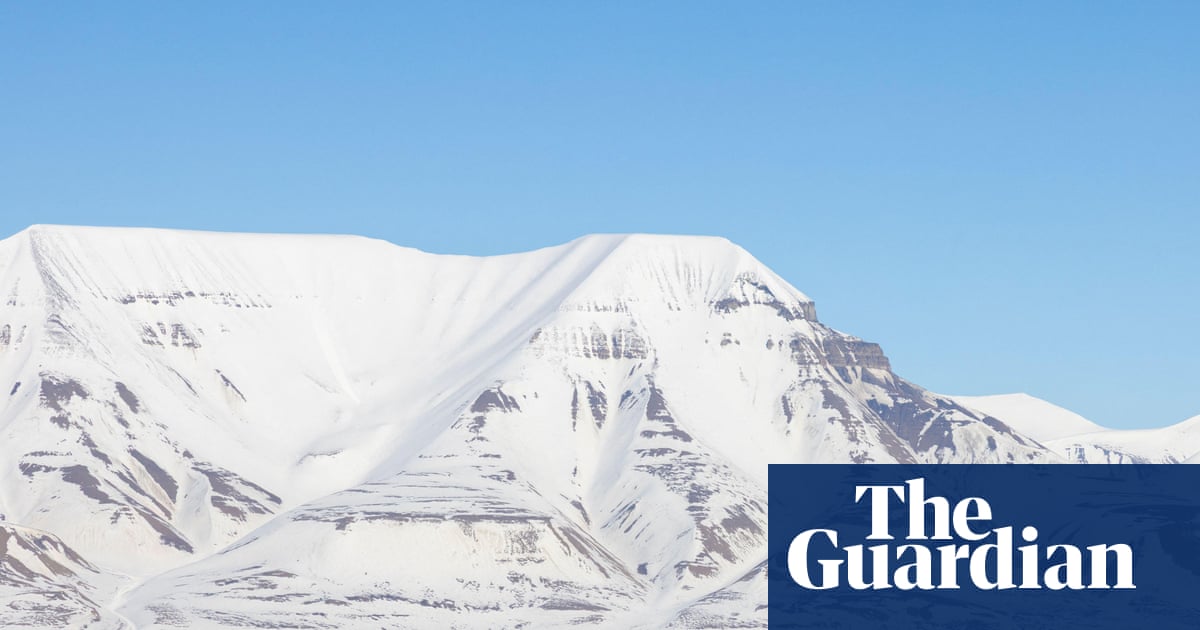
On a rugged mountain plateau of snow-dusted rocks, in the remote archipelago of Svalbard, a glaciologist, Andy Hodson, points out the “ears” of ice, white against the rock, that gave Foxfonna glacier its name, after the arctic fox.
The small glacier, on a mountain 8 miles (15km) outside the Norwegian village of Longyearbyen, is a popular summer hike for tourists who come here seeking the Arctic experience.
But in Svalbard, where glaciers cover 57% of the land and temperatures are rising up to seven times faster than the global average, making it one of the fastest-warming places on Earth, Foxfonna is changing rapidly.
“It is slowly dying,” says Hodson, a professor at the University Centre in Svalbard (UNIS). The telltale signs include a concave profile: Foxfonna is no longer accumulating snow. Precipitation here is increasingly falling as rain. Its thinning rate is between 1 and 4 metres a year, making it unrecognisable from when Hodson was last here a few years ago.
Out in the fjords, on the other side of the coastal village, the large glacial fronts extending into the sea that are characteristic of the islands are melting at an even faster rate: over the past two years, 10 have retreated entirely on to land.
In 2024, “things went crazy”, Hodson says, after record-high summer temperatures led to a big ice loss, of 1%, across the archipelago. It is affected by Arctic amplification – a feedback loop in which sea-ice retreat and atmospheric warming make each other worse.
Andy Hodson points to Foxfonna’s concave profile, a sign that the glacier no longer accumulates snow. Photograph: K McVeigh/Guardian
“Pretty much the whole island is losing ice now,” says Hodson.
Longyearbyen, a scatter of brightly coloured houses, research institutes and tourist hotels at the bottom of a steep valley, lies at a latitude of 78 degrees north, the last stop in the high Arctic before the north pole. An important outpost of Arctic science, it attracts explorers, adventurers and nature lovers.
The village’s 2,600 inhabitants are used to extremes: winter temperatures can drop as low as -20C (-4F) and, from late October to early March, the sun does not rise, plunging the valley into more than 100 days of darkness.
Marjolaine Verret takes water samples. Photograph: Tonje Emilie Stenstad/The Guardian
But they are now facing new and unsettling challenges – things that many point out should serve as a warning for other Arctic regions. Not only is snow melting faster but now the permafrost – ground that once remained frozen all year – is thawing.
This is having unexpected but significant consequences. People have recently been warned not to drink from their taps due to heavy metals contained in the bedrock leaching into the village’s water supply. Instead, they now have to fill up containers from a central tank of filtered water in the village’s supermarket, while the municipality investigates and works out what to do in the long term.
The thaw has also caused landslides, damaged foundations and cracked walls, rendering some homes uninhabitable and threatening the long-term stability of other buildings. As a consequence, there are no longer enough homes for the number of people who need them.
The authorities in Longyearbyen have been forced to learn lessons, acclimatise and try to adapt to the changing conditions.
Search crews with shovels worked to free people from buried houses in Longyearbyen after an avalanche in 2015. Photograph: EPA
On the rooftop of the Svalbard Science Centre, which featured in the opening scenes of Vigil, the recent BBC thriller set in Svalbard, Gunhild B Sætren points out the scene of the most devastating avalanche in the archipelago’s history. The avalanche, in December 2015, buried nine people, killing one man and an infant in their homes in the shadow of Mount Sukkertoppen.
“It was terrible,” says Sætren, a professor of safety psychology, who manages the Unis Arctic Safety Centre (ASC), established after the tragedy to focus on hazard management and climate adaptation. “Climate change is impacting us in very many ways. The greatest risk is avalanches. The area used to be an Arctic desert, but now there is more rain.”
‘The melt is starting earlier,’ says tour guide Matilda Weihs. Photograph: K McVeigh/Guardian
The tragedy, which was followed by another, non-fatal avalanche that damaged two houses in 2017, happened as the result of warming strong easterly winds and drifting snow. At the time, the avalanche danger from Sukkertoppen was known about, but no avalanche warning system was in place.
Since then, snow fences to reduce drift and a wall of avalanche traps have been installed on the mountain and some houses pulled down, including Sætren’s own. The centre now provides weekly snow observations for the municipality’s avalanche warning system.
Sætren also works on a programme with other high Arctic remote settlements in Iceland and Greenland, to look at common problems, such as evacuation procedures for avalanches. A new tour guide approval system, introduced by the governor of Svalbard to better assess climate and other risks, is expected to be in force by 2027.
Arctic geology is complex and changing fast, with tour operators saying the changes are curtailing certain activities. At the Husky cafe, Matilda Weihs, 30, a guide for Svalbard Wildlife Expeditions who was trained by the ASC, says that this year they had to move the snowmobiles seven miles out of the village to find enough snow cover for tours.
Longyearbyen in Svalbard, pictured a few days before the return of the sun on 8 February this year. Photograph: Oriane Laromiguiere/AFP/GettyLongyearbyen is the largest populated area on Svalbard. Photograph: Nigel Killeen/Getty Images
“We are losing snow earlier and the melt is starting earlier,” says Weihs. “There are big changes in the fjords. You need to stay away from glacier fronts due to the danger of glaciers calving into the sea.”
The loss of drinking water has been a huge shock to people, says Terje Aunevik, mayor of Longyearbyen and a former husky musher. “In Norway, where we have always taken for granted that we can drink the water from the tap, it’s challenging to start thinking that we need to carry our water. People get angry, wondering ‘why don’t we have control over it?’”
It has forced a rethink about how to tackle the problem longer term, says Aunevik.
“Now we are using a lot of resources to clean our tap water, when we use maybe 1-2% of that for drinking. That’s crazy energy use. We could have two different water-supply systems into our households, one for drinking and one for grey water.”
Aunevik says the challenges of thawing permafrost are also forcing a rethink of the way the village is built.
The construction of new homes to tackle the housing crisis was held up while the village grappled with a transition to a new energy system (a former mining camp, it previously used waste hot water from the mines for heating). And then, in 2025, scientists discovered the heavy metals were contaminating the water supply.
Students checking the depth of permafrost. Photograph: Tonje Emilie Stenstad/The Guardian
“I sometimes say that we are in the beginning of building a completely new town,” Aunevik says. “We need to change everything.
“There is a saying that wood does not rot in the Arctic, but now it does. It challenges how we construct our buildings.”
Ingvild Sæbu Vatn, a partner at the Longyearbyen architecture firm LPO Arkitekter, says one solution to the problem of melting permafrost affecting wooden foundations has been to drill into the bedrock. Another settlement in Svalbard, Ny-Ålesund, tried this, but Sæbu Vatn says some buildings began to be pushed up by the movement in the ground.
“They thought, ‘we’ll put the foundations in the bedrock and then we’ll be fine’ but they were wrong,” says Sæbu Vatn, who adds that this needs to be done with care. “If you put foundations in bedrock but you don’t do it properly, the buildings will still jack up. We need to look again at how we are building foundations.”
Those working on solutions have also not ruled out the extraordinary. “One solution being explored [to stabilise building foundations] is to freeze the ground by blowing cold air under the buildings in winter,” says Sæbu Vatn.
She says that while Longyearbyen is undoubtedly struggling, her hope is that in finding a way to survive they can offer hope to other Arctic regions, such as those with Inuit populations in Greenland and Canada.
“The big resource that Longyearbyen has is its population,” she says. “People are adventurous and resourceful, and a lot of companies are very innovative. Maybe we can build knowledge from this strange little place that is rapidly warming. That would be a nice goal.”