
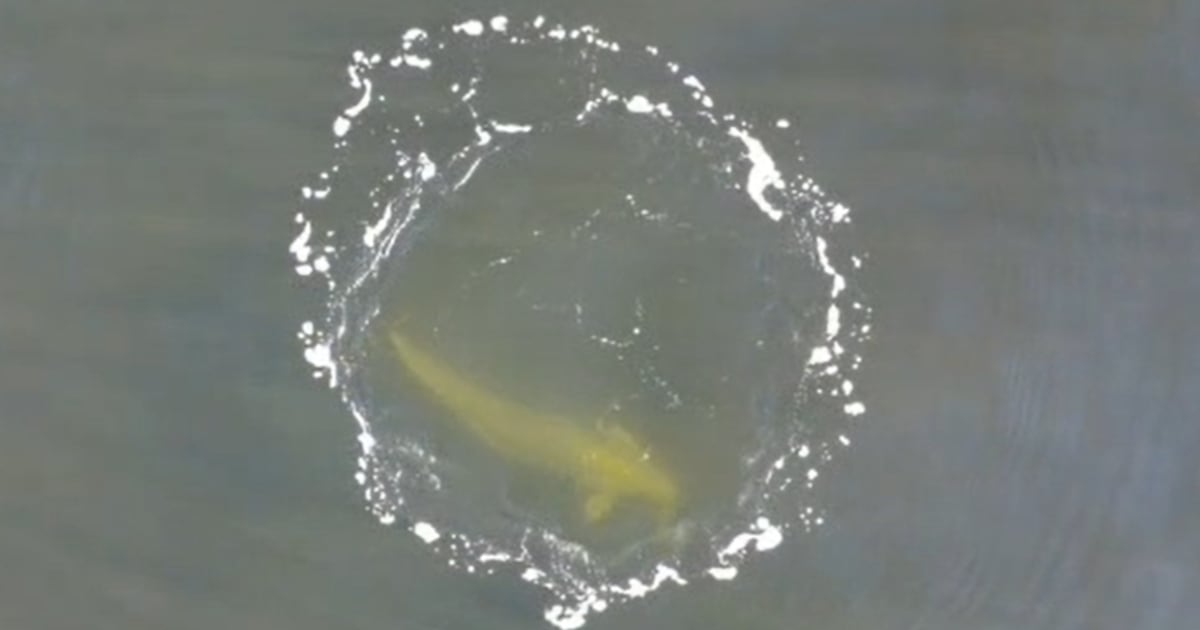
A beluga whale, a species that normally lives in the freezing waters of the Arctic and sub-Arctic, was spotted in Donegal Bay on Saturday.
Pádraig Whooley, sightings officer with the Irish Whale and Dolphin Group (IWDG), said “our latitudes are not the natural home for beluga whales”.
On October 17th, Sebastian Szumlański was at Fintra in Donegal Bay, where he recorded drone footage of the whale that was later shared with the IWDG.
There have been at least four previous reported sightings of Beluga whales around the Irish coast, with the first known dating back to 1948 off Clare Island in Co Mayo.
The video from Donegal Bay was the IWDG’s second ever validated record; the first was off Dunseverick, Co Antrim, in 2015.
However, Whooley said the whale’s presence did not mean it was “trying to make Ireland its home”. He said the beluga was an adult, which was known because the whales were “born quite dark and they pale with age”.
He said the whale spotted in Donegal Bay was “absolutely brilliant white”.
Adult belugas can reach up to 5m in length. Whooley said the one spotted looked to be 4m-4½m long.
He said many such whales had scars from polar-bear attacks.
“It is mad to think that now we have a species of whale in Irish waters that is the food of polar bears,” he said. “It is just a little bit of a trend that we’re beginning to see that we are writing more and more of these articles about these Arctic animals that are turning up in Irish waters.
Though “still very infrequent”, Whooley said there were a lot of sightings of the bowhead whale, the walrus, the narwhal and the belugas.
“Sightings of these animals are, you know, becoming more frequent. We’re seeing them more frequently … the interval gap is narrowing,” he said.
“There are big changes out there … we’re losing some species that perhaps used to be more common. We’re also starting to see more species that we almost never saw before.
“It’s very dynamic out there. Things are changing and it’s the rapid rate with which things are changing.”
Beluga whales belong to the same family as narwhals. In 2025, a juvenile, female narwhal became stranded on Sweet Nellies Beach, north of Greencastle on the Inishowen Peninsula in Co Donegal.
Whooley said the beluga whale sighting was “coinciding with really bad weather”, citing Storm Austen.
“The big storm won’t make any difference to the whale but it’ll impact our ability to actually observe the animal and to try and monitor it from the shoreline.”
Whooley said the nearest population of Arctic belugas was probably Svarlbard, a northern Norwegian territory – all marine species “are on the move”.
“The trend is that everything is pushing farther and farther north because everything is looking for cooler water because most fish have a preference for cool water,” he said.
“So when the fish are tracking north and I’m talking about, you know, species like mackerel and herring and stuff like that, that are really important for whales, as they’re tracking north, the predators are following after them.
“But what do you do when you live on the top of the world? You can’t go north. There is no north. When you live in the North Pole already, there is nowhere left for you to go.
“The only place for you to go, if your habitat breaks down, is to drop south and that is why we are starting to see more of these Arctic species in warmer waters because there is literally nowhere left for them to go and that is a problem of their geography.”
[ What changes in butterfly populations tell us about climate change in IrelandOpens in new window ]
Whooley asked members of the public who had seen any species of whale or dolphin to report their sightings to the IWDG here.