
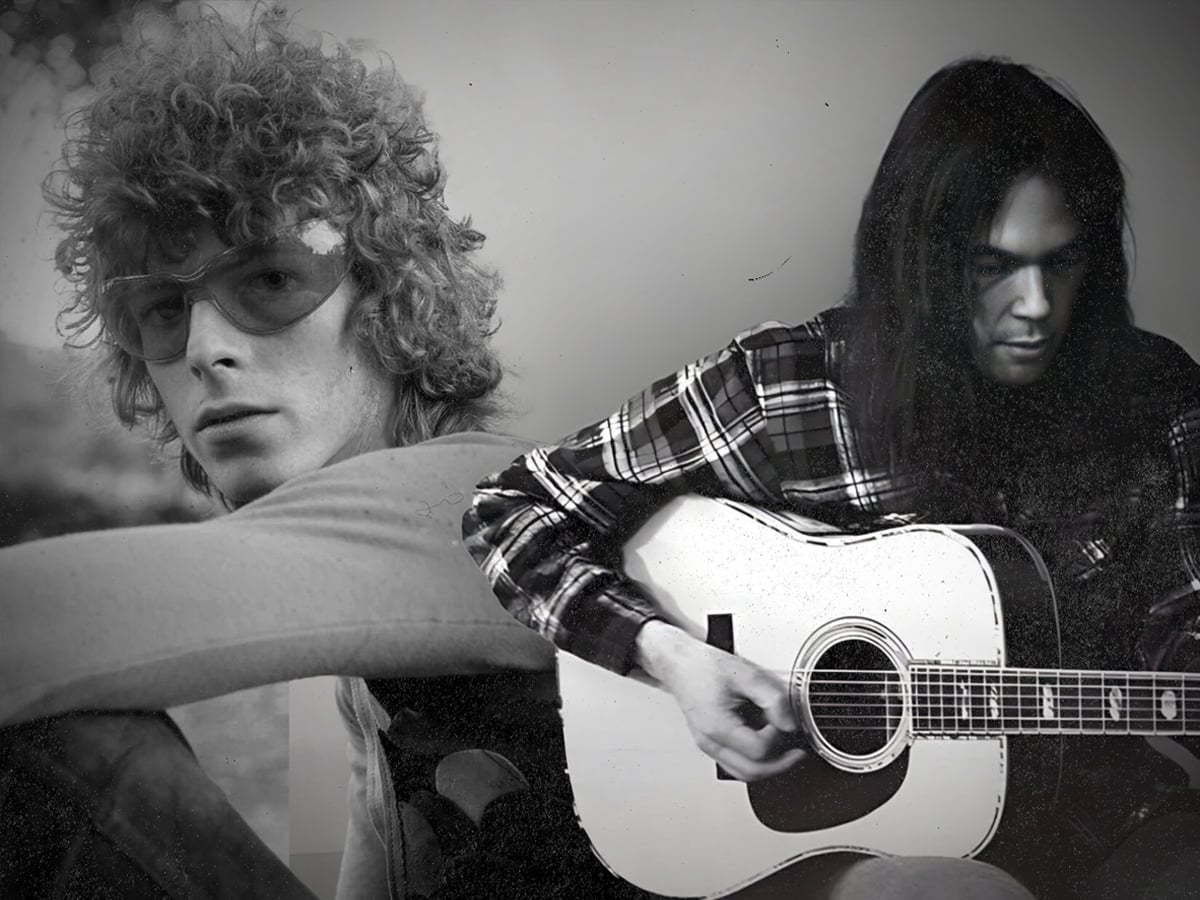
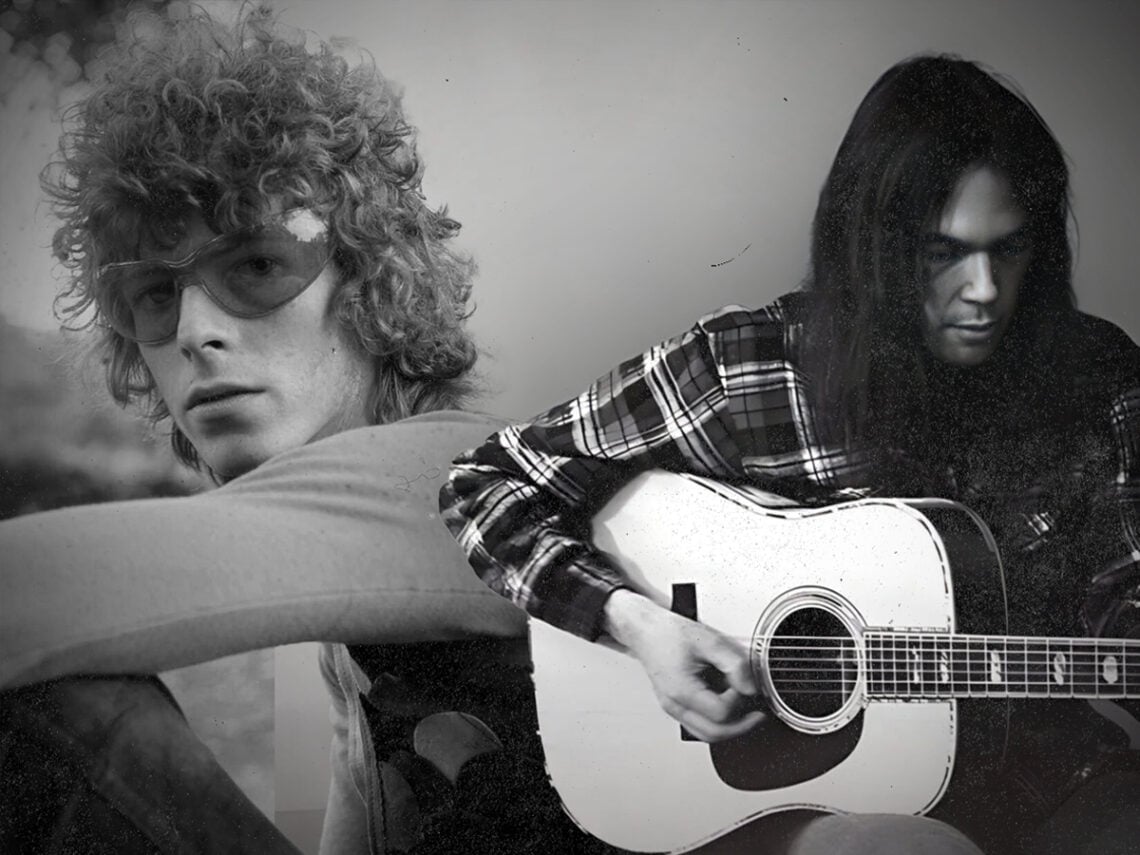
Credit: Far Out / Alamy / Neil Young
October 22nd, 2026 · 6:30pm BST
For a musician who spent his life transforming personal experiences into extraordinary songs, the birth of his first child was never going to pass without inspiring something special. On May 30th, 1971, David Bowie and his then-wife Angie welcomed their son Zowie, who would later become the filmmaker Duncan Jones. To celebrate becoming a father, Bowie did what came most naturally to him: he picked up his guitar and wrote a song.
Just three days after his son’s birth, Bowie performed the song during a live BBC session. “I’d been listening to a Neil Young album, and they phoned through and said that my wife had a baby on Sunday morning, and I wrote this one about the baby,” he told the audience. The song that followed was ‘Kooks’.
On ‘Kooks’, which was included on the album he released later that year, Hunky Dory, Bowie sounds almost giddy with joy. “Will you stay in our lover’s story?” he chirps, as if he is telling his newborn son a fairytale.
With its simple melodic structure, merry trumpeting, and jaunty piano, the song is charmingly twee, sonically evoking a childhood wonderland. The string arrangements underscore a sense of parental affection and foreshadow the melancholy of a child growing up and leaving the nest.
“Soon you’ll grow, so take a chance,” he sings.
It is likely the album that influenced Bowie was Young’s tender 1970 masterpiece, After the Gold Rush. Musically, ‘Kooks’ has the most in common with the album’s fifth track, ‘Till the Morning Comes’; both are sweet and upbeat, both feature horns, jangling keys, and comforting melodic repetition. There are some lyrical similarities between ‘Kooks’ and the song ‘I Believe in You’. On the chorus of ‘Kooks’, Bowie sings the line, “If you stay, you won’t be sorry. ‘Cause we believe in you”.
‘Kooks’ portrays an endearing but idealistic vision of parenthood. Bowie describes himself and his wife as a couple of romantic weirdos and sings of buying his son a “funny old crib”, a pair of shoes, and a trumpet. He promises to throw Duncan’s homework in the fire, and tells him not to pick fights, because he doesn’t believe himself capable of “punching other people’s dads”. He is, however, aware that he is not the most conventional father: “If you stay with us, you’re going to be pretty kooky too.”
Further reading: From The Vault
In an interview with Rolling Stone in 1976, Bowie explained, “[Fatherhood] pleased my ego a lot. I think Zowie’s a survivor. He’s very definitely an independent person of his own choosing, it seems. And I find it very easy to think of him not as mine or Angie’s, but as [Kahlil] Gibran has said, ‘a little plant’. I don’t feel very paternal about him.”
Hunky Dory co-producer Ken Scott later told Uncut, “‘Kooks’ is the love of Duncan that he never really showed when Duncan was growing up… It says it all. It’s how he felt at the moment of birth.”
Indeed, the fact that Bowie was performing live at the BBC less than a week after his son was born perhaps hinted that he wouldn’t be the most present father. Mountains of cocaine and a fascination with Nazi paraphernalia are probably not all that conducive to a healthy childhood.
That being said, father and son clearly forged and managed to maintain a strong relationship as they grew older. Duncan was the best man at his father’s second wedding in 1992, to the model Iman. He even referenced the song ‘Kooks’ on Twitter / X in 2018: “Unfortunately, those lyrics were fantastical. I had to do my homework every bloody time.”
