
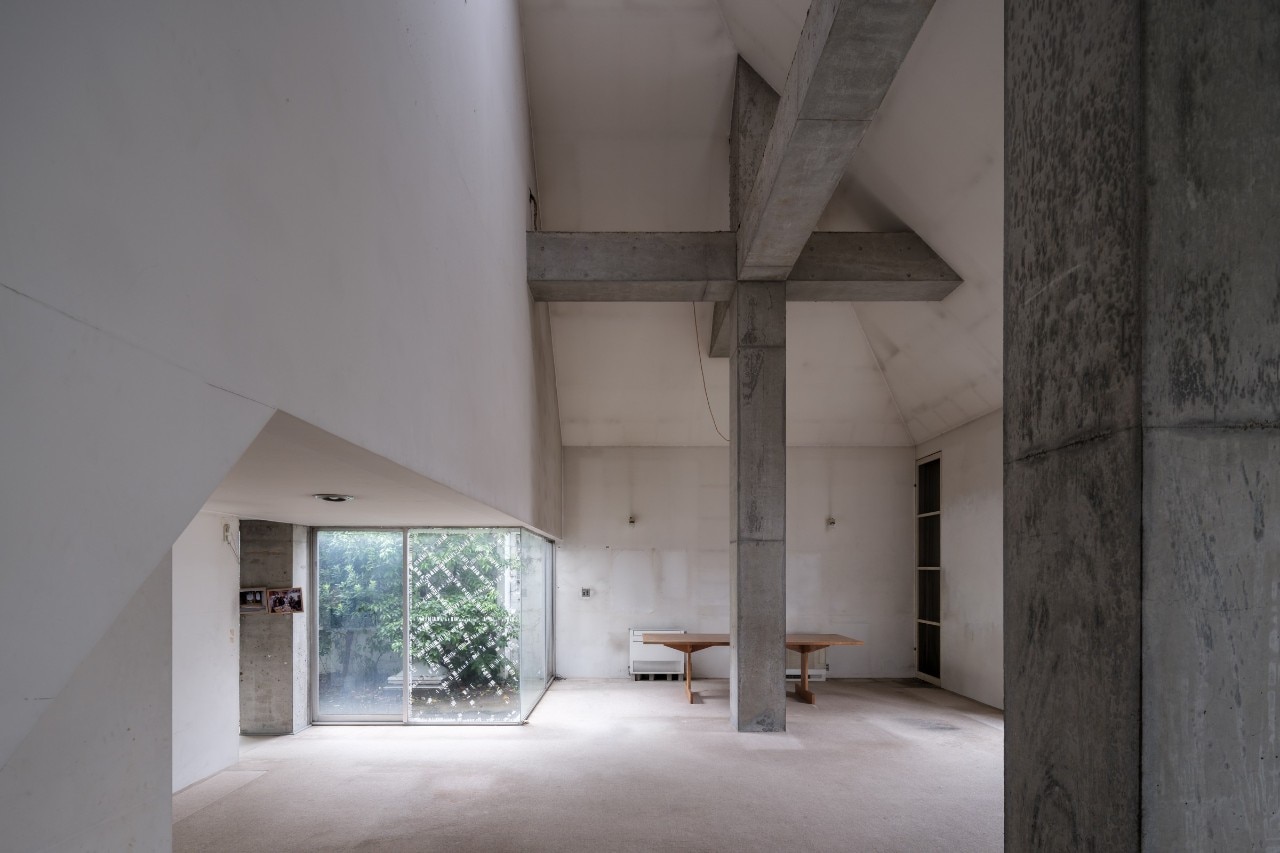
In the early 1970s, there comes a change of direction: the orderly arrangements of his early period give way to more complex and irregular configurations, putting into question the foundations of modernism, which Shinohara considered by then incapable of interpreting the complexity of the contemporary city. This marks the era of what Shinohara described as a “savage” architecture: term that describes not only the roughness of the exposed materials but, above all, the desire to move beyond the conventions of balance and compositional harmony, embracing contrasts, discontinuities and irregularities as constitutive conditions of modernity (Tanikawa House, 1974).
In the 1980s, this research reached its most radical expression. In the essay “Chaos and Machine”, published in “The Japan Architect” in 1988, Shinohara introduced the concept of “Modern-next”, proposing a way to move beyond modernist rigour through technology and the adaptive, interchangeable logic of the machine – the only tools capable of dealing with the chaos of the present. Centennial Hall (1987) in Tokyo is an emblematic example of this approach: a metal semi-cylinder embedded within prismatic volumes evokes an aircraft, making it difficult to interpret the building as a unified whole and reflecting, through its architectural form, the complexity of the urban context.