
“But he turned up with this folder and there were 35- odd,” Meade recalls.
“He said, ‘They might be rubbish. I can do them again.’”
Meade shakes his head. “I just skipped along the road thinking, ‘Wow, I can’t wait to see them.’ It blew my mind.
“It was a great honour, even better than seeing the book for the first time.”
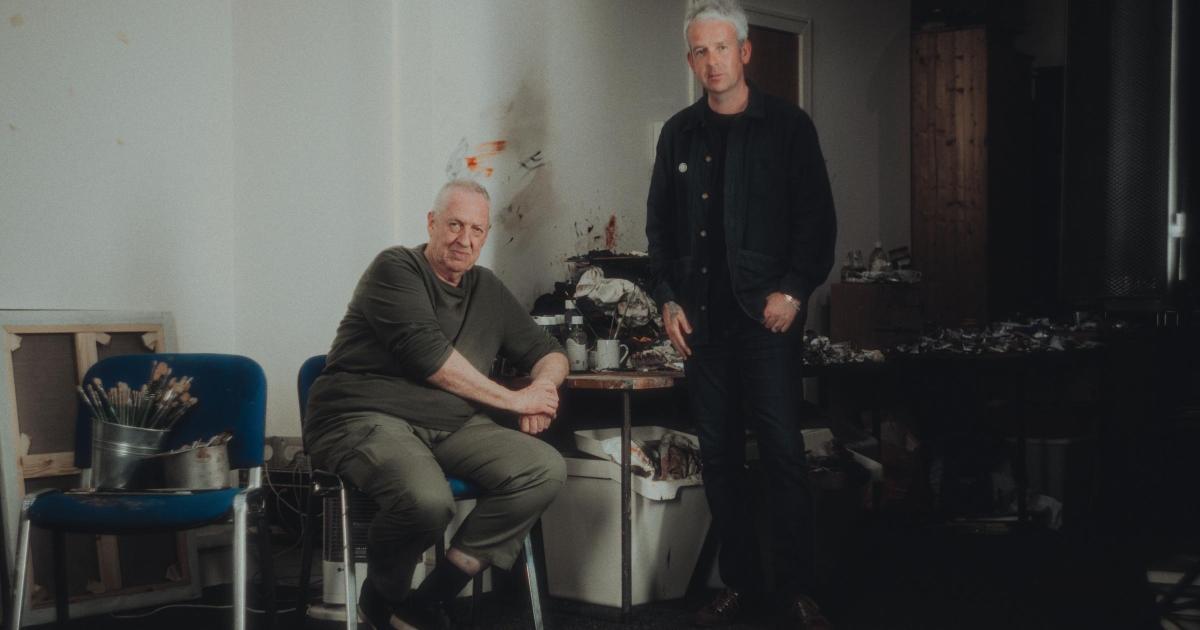
It is Wednesday afternoon in Glasgow and Peter Howson is in his studio painting when Meade and I arrive. A crucifixion. It looks very Howson.
Glowering, dark, full of suffering and pain. Jesus, Meade points out, looks a bit like Primal Scream frontman Bobby Gillespie, much to Howson’s amusement.
Meade has brought doughnuts. A sweet tooth is one of the things the two men have in common these days, I’m told. Howson works away for 10 minutes before coming to join us to talk about poetry and art and music and the end of the world.
We start with the poetry. Some seven months after Howson gave Meade that folder the poems and illustrations have been gathered together and printed under the title Paper Illness.
Meade, it is very clear, is thrilled by Howson’s illustrations. “I think they work so well with the poems. They’re really adding to them.”
Raymond Meade and artist Peter Howson with the new poetry collection Paper Illness (Image: Julie Broadfoot)
There’s a scratchy pen portrait of a man on the cover wearing an eye patch. “It’s based on him,” Howson confirms, looking over at Meade.
“When I was at school I had this eye patch,” Meade explains. Oh, was there a photo? “I f****** hope not,” he says, laughing. “I said to Peter I used to have this eye patch and it was horrible. It was a surgical thing. I wanted to look like a pirate. So, he’s made me look like a pirate.”
Do they make an odd couple? Howson, now in his late sixties, is one of contemporary art’s big beasts. Widely regarded as one of the great contemporary figurative painters, he was Britain’s official war artist in Bosnia in 1993 where he was appalled by what he saw. In Kosovo a gun was held to his head.
No surprise then that his paintings are full of despair and horror. But also the odd celebrity (he’s painted Madonna and David Bowie in the past).
Meade, at 44, is a generation younger. Growing up a fan of Oasis and The La’s, he formed the band The Ronelles in 2004 before becoming a solo artist and working with the likes of Justin Currie, Glenn Matlock, and author Iain Banks. He even played with Shane McGowan one night in the late 2000s. He joined Ocean Colour Scene early in 2015, but in 2021 he was diagnosed with multiple sclerosis. Even so, he continues to tour with the band.
The two men have known each other for years – they’re a little fuzzy on exactly how long, but maybe over a decade. Long enough for Howson’s daughter Lucie to be the one who taught Meade how to play chess. And now they’ve finally worked together.
“I had always wanted to do something with Peter,” Meade admits. “To be honest I thought he would say no.”
Howson is surprised. “You thought I would say no?”
“Yeah, I didn’t want to bother you. But I just thought there was good imagery in it,” he says of his poems.
Some of the illustrations featured within the book which is available now (Image: Peter Howson)
“And I was interested from the artistic side of things in how he would interpret it,” he adds, turning back to me. “So when I passed the poems over to him there were no notes.
“I think he asked for a couple of pointers on a couple of them.”
And why did Howson want to get involved? “Well, I would never say no to Raymond. I see him as a soul mate.”
Howson’s black and white drawings for Paper Illness are, given the scale and brute force of many of his paintings, surprisingly delicate, I suggest.
“Yeah, the drawings are delicate aren’t they,” Howson concedes, “much more delicate than the paintings, though I can do sensitive paintings sometimes. I think I’m known for doing big, brash things.
“I felt totally inspired doing them. I just chose certain poems to begin with that appealed to me straight away. And I decided to do tons of drawings.
“The imagery is great. Some poetry you probably couldn’t illustrate, but these ones you could. There’s a sadness in them that I like as well. I think that he has done me a favour really. He probably thinks I’ve done him a favour illustrating them.”
Meade nods and adds, “Just a bit.”
The illustrations are responses to the poems. “I love poetry. I don’t understand it sometimes,” Howson explains, but Meade’s poems he found charming. “They’re lovely and short and contemplative, fragile, sometimes angry …
Paper Illness is a collection of poetry by Raymond Meade, best known as the bass player of rock band Ocean Colour Scene (Image: Julie Broadfoot)
“I think in this mad world we’re living in poetry is such a beautiful thing to do. It doesn’t serve any purpose apart from enriching lives, I think.
“I felt great when I read them anyway. I loved them and I’ve been encouraging him to do more, but I don’t know if he ever will.
“They weren’t easy to illustrate. I don’t think poetry is easy to illustrate, but I did my best.”
Meade has been writing all his life. But at the start of the year – with Ocean Colour Scene on a break from touring for a few months – he set aside some time to see what he actually had.
“And before I knew it I definitely had the bones of something to put out.”
The encouragement of Scottish author Jenni Fagan helped him get over any imposter syndrome. “She has been so helpful. I just think she’s the best writer in Scotland at the moment.
“I’m coming to this as a musician and I know people are going to say, ‘Oh, the guy from Ocean Colour Scene is trying to be a poet.’
“And she said, ‘You just need to put that out of your head. Just be a poet.’ And that was powerful.”
Paper Illness is a collection of 52 short poems – and 10 Howson illustrations – that touch on everything from Brendan Behan and the Aberfan disaster to the deeply personal. Meade even addresses his multiple sclerosis diagnosis.
Ocean Colour Scene fans may well smile ruefully at the line, “I miss when MS stood for Moseley Shoals” in the poem Notes On Multiple Sclerosis, a reference to the band’s 1996 album.
“When I get a text about a setlist – especially this year because it’s the 30th anniversary of Moseley Shoals – it just comes up ‘MS’. It was in my head a lot,” Meade notes with a smile.
As for the diagnosis, “the first year was difficult. I got back to playing pretty quickly, but I’ve only recently found out how to manage it.
“My neurologist, he’s brilliant. There is so much information at the start but he said a thing that really stuck. This is true for everyone, not just MS people. Think of your day. You wake up with an allocation of energy tokens. Just be careful how you spend them.
“When I’m on the road with the band we tour a lot. We’re just back from Spain a couple of weeks ago. I’m really strict about having a nap in the afternoon to be ready for the show. Straight to bed. No madness. We come off stage at 11 o’clock. I’m in my bunk at 11.30pm.”
Howson has a question about that, given the reputation of rock stars. “Can you sleep with all the racket going on?”
This Howson is entitled Yorkhill (Image: Peter Howson)
“Yeah, they’re getting old,” Meade says of his fellow band members with a smile.
“You’re not like a normal rock star,” Howson suggests.
“ I’m a session musician,” Meade says plainly.
“There’s something very stable about you and I think that’s got a lot to do with your wife,” Howson suggests. “She’s your rock.”
Meade admits he lost friends in the wake of his diagnosis. “Yeah. There’s a stigma and I certainly found that I knew in the moment of the diagnosis that my body wasn’t going to be the same and it hasn’t been. But what I hadn’t bargained for was just losing touch with people. I’ve definitely acknowledged it.
“I’m past the anger with it. If that’s how people are, that’s how people are. You can’t make people want to be in touch with you. But the people who matter to me, they are great – whether it’s Peter or the guys in Ocean Colour Scene. There was a lot of black humour around. They thought I could get medicinal cannabis and we could get a parking pass. It was really funny and what I needed at the time.”
Howson picks up the baton. “If you can write poetry about it, I think it’s a therapeutic thing. The same with my paintings. If I didn’t paint I’d go mad. I don’t know what your mental state is,” he says, turning to Meade, “but mine’s unstable quite a lot of the time.”
In the book, on the page opposite the aforementioned Notes on Multiple Sclerosis, there’s another deeply personal poem, Notes on Sobriety. Howson has been open in the past about the fact that he entered AA to deal with his alcoholism and drug addiction.
“The sobriety thing for me was a choice, not a necessity,” Meade points out. “I never had any problem with alcohol. I just realised that life might be a little easier without it. A week turned into a month then a year and here I am 16 and a half years sober.
“I’ve never been to AA, although I do know a lot of people who attend,” he adds. “Peter and I were introduced by someone from AA, but it wasn’t at a meeting.”
Howson recalls another encounter. “I used to see Raymond a lot in the West End. I used to walk my dogs and I was with my daughter.” He does recall meeting Meade in Peckham’s in Hyndland. I think you stood behind me at one point.”
Meade nods. “That was the moment I made up my mind to …”
“Talk to me.” Howson finishes his sentence. “I was really chuffed about that.”
Growing up in Scotland it would have been impossible, Meade suggests, for him not to be aware of Howson. “Peter’s work is omnipresent. I knew it before I knew him.”
And now they’re working together.
Meade, Howson suggests, has been a tonic for him. “In my early days I used to hang out with a lot of people that weren’t good for me. He is good for me.”
What did the two of them bond over?
“We’re both interested in the Holocaust,” Howson says simply. “We talk about that a lot. I think we are both interested in …”
He tries to find the right words. The extremities of human experience, I suggest.
“Well, yeah. I’m particularly interested in disasters and famine and death and all that. The older I get the more I think the world is in a very dangerous position.”
Howson’s paintings have often been concerned with the horrors of the world. He has always been willing to gaze at the worst aspects of humanity. His artist’s eye is as unflinching as Goya’s.
Read more
Meade, meanwhile, was moved to work on a project entitled The Railway People about the Holocaust after visiting Auschwitz. He wrote a poem and a song which saw him work with Holocaust survivor Eva Mozes Kor. The resulting documentary, narrated by Michael Sheen, won an award and Meade and Kor remained friends until her death in 2019.
In a world where Nigel Farage is having to deny Reform would order troops to use lethal force against migrants crossing the channel, are they both fearful for where we find ourselves in 2026?
“Well,” Howson suggests, “the problem these days is you can be a completely sane, normal good person and social media will turn you into a monster and that’s what’s happening. People are constantly being radicalised. Britain has changed.
“People think I was pro-right wing because I used to paint all these thugs with Union Jacks. Completely wrong. But the rise of the right wing is massive. The whole world is in danger at the moment from AI … And Trump as well.”
“Over here everyone is really caustic at the moment,” Meade adds, “really quite aggressive about it and quite narrow-minded. People sitting on a dinghy for however many days and the dangers involved in that … If it’s just as simple as ‘shoot boats, they can’t come here …’ I don’t want to be a part of that.
“I think Brexit caused all this. I loved being part of Europe.”
He pauses, then jumps to another train of thought.
“I’ve got friends who have teenage kids now and they hold up f****** idiots like the Tate brothers or Jake Paul as their heroes.
“When I was growing up my heroes were Lee Mavers, Noel Gallagher, probably Peter to an extent. People that didn’t want to be famous. They were just really good at what they did. You look at this now. Everything’s disposable. I despise the culture we’re subjected to. It goes beyond vanity. It’s worrying and you couple that with AI …”
He stops, shakes his head. “I just try to live in a little bubble of my own, don’t do any harm to anyone.”
It’s worth saying that there is both light and shade in Meade’s poetry. And maybe, I suggest, there is redemption in Howson’s paintings?
“Oh, there will be,” Howson agrees, “but only after everything’s destroyed. That’s my religious thing. I can’t get away from it. I’m into Apocalypse. It’s not that I encourage it, but when I see it happening I can feel it and I think, ‘I’m frightened, but I’ve got to be strong.’
“At the moment I’m having to reassess my whole life in art businesswise because there’s a massive dip in the art market. I see myself as a bit of a survivor because I’ve been doing this for a long time. There was a golden period in the 1980s. 1990s less so.
“It took an uplift until about the last six, seven years.”
The art market aside, he’s also dealing with the passing of time and ageing. “I can’t function quite as well. I couldn’t travel on my own anymore. I don’t have the confidence to do that anymore.”
The Tendencies (Image: Peter Howson)
Time catches up with all of us. Howson is now 68. “I should start working out. I had pneumonia last year and it slowed me down quite a lot. I had to give up cigarettes. All my vices are disappearing. Maybe I took an overdose of Nytol the other night to get to sleep.”
How many hours a day does he work?
“Not as many as I’d like to. I’ve got a different routine these days. I used to get up at 3.30, 4 o’clock in the morning and work right through to about 10 o’clock at night sometimes. I did have breaks.
“I call my daughter twice a day, I call my mum and dad twice a day. My dad’s 97, my mum’s 90, and so I keep in touch with them. They’ve still got a wee house.
“My daughter, I’m on the phone to her for an hour and a half every day. She comes up quite regularly.
“I’m not in here that much now,” he adds, looking around at his studio which is full of books and newspapers and CDs and paint on all the furniture. “My routine is different. I’m only here until 2 o’clock, 2.30pm. That’s why when I’m in here I’m working like mad.
“And then I go home and Lorraine, my partner, I don’t know how she puts up with me. I really just go back and work. I normally put on the TV and it’s behind me so I don’t actually get to see it. But the only thing I can work to is old people’s television like Talking Pictures and ITV3, with Poirot and Miss Marple. I don’t know how many times I’ve seen Midsomer Murders and Miss Marple and Poirot.”
“I like a bit of Morse,” Meade agrees.
“Morse is fantastic. So, I’m drawing away. Lorraine just brings me cups of tea. She’s a herbal fanatic so it’s always herbal tea. Never anything stronger. And I get my dinner. I get my beans on toast and my soup. Sometimes it’s a bit more adventurous.”
As for Meade, will there be more poems? “I would like to think so. I don’t think that I have a choice. It just poured out. I don’t like the word cathartic, but, in some ways, it’s been just that.
When I gave Peter the poems I said, ‘Don’t judge me on this. It’s all woe is me.’ And he said, ‘Woe is me is amazing. Woe is me is the best form of art that there is..’”
“Pour out your soul,” Howson adds approvingly. It’s what Howson has been doing all his artistic life, after all.
Paper Illness is published by Mackerel Editions. For more details visit mackereleditions.com