
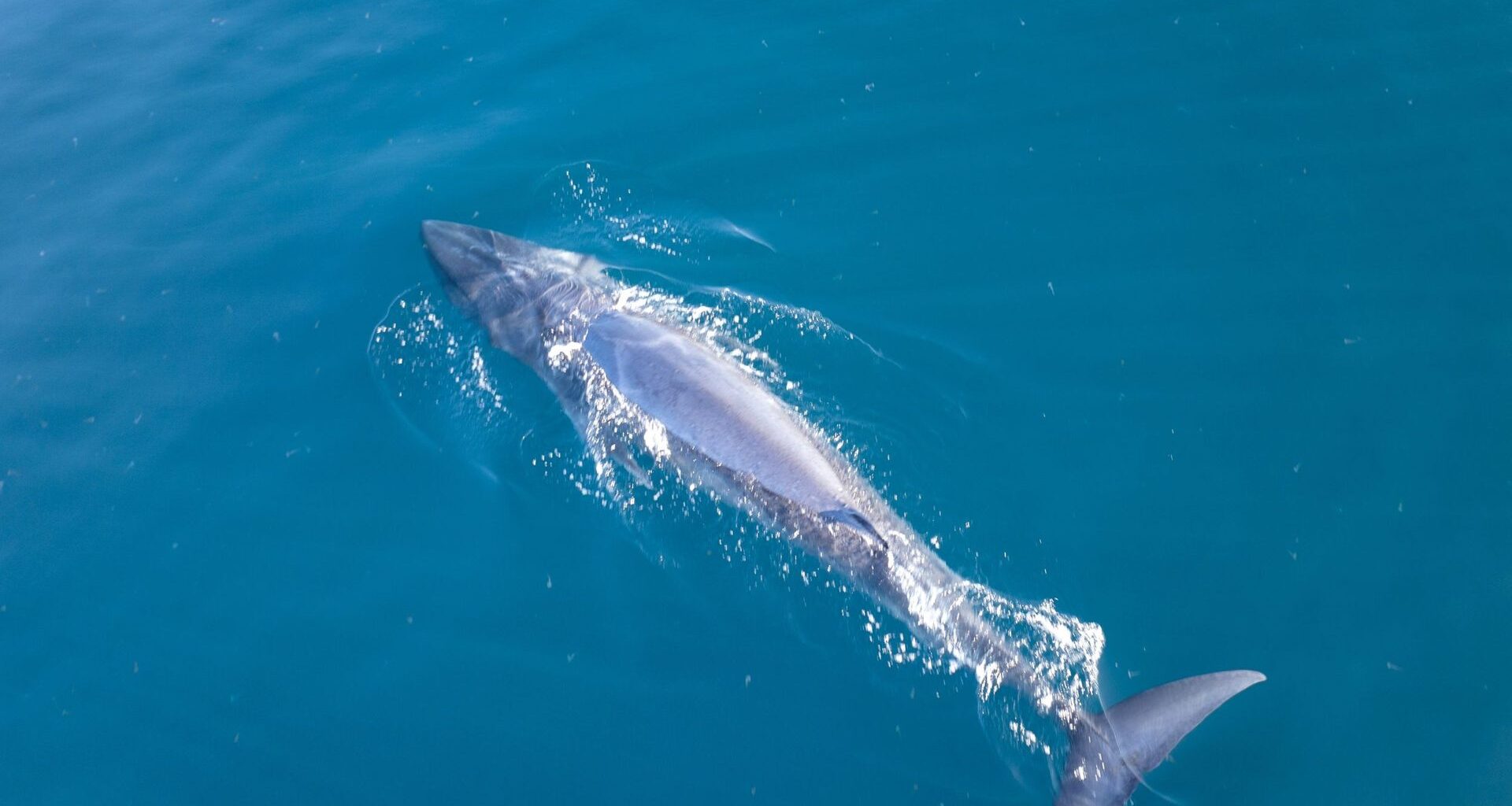
Scientists are using underwater songs to uncover where elusive Omura’s whales live, what they may eat, and how they survive year-round in tropical waters.
Spending the whole year in warm seas sounds like a comfortable arrangement. For a whale, though, warm water is only part of the deal: there also has to be enough to eat.
Many whales travel between cold feeding grounds and warmer breeding waters, drawing on stored fat while they travel and breed. Omura’s whale skips that routine and stays in the tropics.
Off Australia, researchers have never documented what this elusive whale eats. Now, they have found a possible food clue by listening to its songs.
The team detected whale songs most often in warmer waters, particularly where microscopic algae had flourished about a month earlier.
That delay could help explain how a large animal finds meals in the same seas throughout the year, without making the long trip to colder feeding grounds.
Finding whales through song
Scientists only recognized Omura’s whale as a separate species in 2003, having previously mistaken it for a small form of its relative, Bryde’s whale.
Most of what researchers know about its life still comes from a population off northwest Madagascar.
Spotting one off Australia remains unusual, but its song gives researchers another way to find it.
The whale repeats a two-part call lasting about 15 seconds, with some sounds lower than the deepest note on a piano.
Ciara Browne, a PhD student at Curtin University in Perth, led the team that searched recordings from 35 sites, collected between 2005 and 2023.
They reused sound files from other projects, letting software flag possible calls before checking every detection by hand.
“Omura’s whales are notoriously difficult to study because visual sightings are rare, so listening for their calls provides an important way of understanding where they occur,” Browne said.
From algae to dinner
The algae themselves are not the meal the researchers have in mind. They may start a chain in which small animals eat the algae, then become food for whales.
To look for that connection, the team used satellite measurements of chlorophyll, the green pigment in algae.
Those readings give scientists a rough idea of how much algae is growing, but readings from the day of a recording showed no clear connection to whale calls.
Looking back 30 days changed the picture. Higher algae levels a month earlier went with a greater chance of hearing whales, suggesting that food takes time to work its way through the ocean’s food web.
Small algae-eating animals may need those weeks to become more plentiful, and researchers have seen a similar sequence off Madagascar.
There, algae blooms have preceded swarms of krill, the shrimp-like animals that attract feeding Omura’s whales.
Where the whales sing
The recordings picked up calls in every month, with the busiest stretch running from September through May.
Calls became least common during the Southern Hemisphere’s winter, from June through August.
The team’s models showed a greater chance of hearing whales once surface water warmed beyond about 81.5°F (27.5°C). January through March offered the best odds.
Winter recordings placed more calling whales farther north, toward the equator.
Recorders in the Joseph Bonaparte Gulf and off the Kimberley coast heard calls throughout the year, perhaps because those northern waters stay warm through winter.
A separate model also pointed offshore, with the best odds of hearing whales about 124 miles (200 kilometers) from the coast.
The pattern suggested that Australia’s continental shelf and its outer edge could be important whale habitats.
Meals without migration
The shelf gives researchers a broad area to search for feeding whales, but plenty of details remain unclear.
Depth, distance from shore, and distance from reefs overlap, so the researchers could not tell which feature best explained the pattern.
Wind supplied another possible clue, although its connection to calls was weaker.
Strong winds can push surface water aside and allow nutrient-rich water to rise from below, helping create conditions that concentrate krill and small fish.
Near Scott Reef, researchers tracking the direction of songs found that some whales stayed in one place for long periods.
They may have been feeding while singing, although the songs alone cannot confirm that.
Together, the clues fit the possibility that Omura’s whales keep eating throughout the year instead of depending mainly on one feeding season.
They probably still carry fat reserves, but regular meals could help sustain their tropical lives.
Sharing a noisy home
These whales live in waters that people use for shipping, commercial fishing, and offshore oil and gas operations.
Because they remain in the region throughout the year, they may face more sustained exposure to underwater noise than migrating whales.
That noise can interfere with communication and change animal behavior. It also makes whales harder for researchers to hear: near shipping lanes, the recorders picked up calls over shorter distances than in quieter deep water.
Knowing where whales spend their time gives people who plan offshore activity a better chance of considering them before making decisions.
Study co-author Christine Erbe directs Curtin’s Centre for Marine Science and Technology.
“This knowledge can help inform marine planning and improve our understanding of potential impacts from activities such as shipping, offshore industry and other sources of underwater noise,” Erbe said.
The mysteries that remain
A recording tells researchers that a whale called within listening range, but it cannot reveal how many whales live there or what they ate.
Songs are the only vocalizations documented so far for Omura’s whales, and if only males sing, as in other baleen whales, the results may largely miss females and calves.
The listening network also left gaps because researchers originally placed the equipment for other projects.
Different sites recorded in different years, and the analysis assumes the whales’ range stayed fairly stable across those 18 years.
Sound-recording tags could capture calls beyond song, while genetic samples could help establish whether the singers are all male.
Scientists still lack enough information to judge the species’ extinction risk, which explains its Data Deficient listing on the International Union for Conservation of Nature‘s Red List.
As warming changes ocean temperatures and food supplies, these recordings give researchers a starting point for understanding where the whales’ habitat may shift.
The study is published in the journal Marine Mammal Science.
—–
Like what you read? Subscribe to our newsletter for engaging articles, exclusive content, and the latest updates.
Check us out on EarthSnap, a free app brought to you by Eric Ralls and Earth.com.
—–