
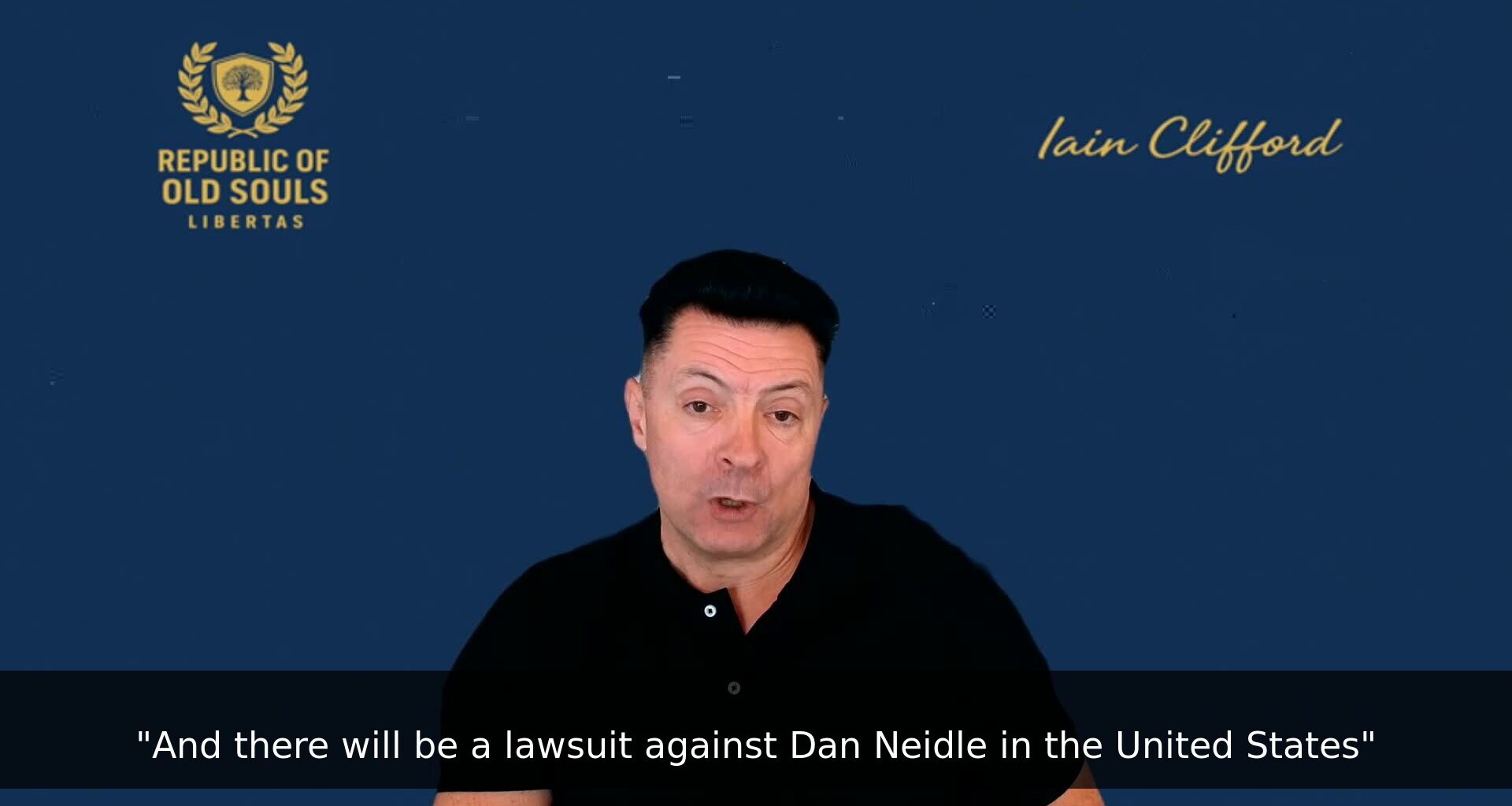
I’m being sued for $795m in a US federal court in Wyoming, under a law designed to take down the Mafia. The man suing me is a fugitive British fraudster called Iain Clifford Stamp, who says I caused him to lose $120m by exposing his tax fraud scheme.
This is a strange story, even by the standards of Tax Policy Associates.
Stamp used to sell British homeowners a way to magically eliminate their mortgages. It didn’t work, and the High Court said his scheme had “every appearance of deceit, of abuse and contempt of Court”. The FCA froze his assets, and when he ignored the order, a judge sentenced him to 12 months in prison for contempt. Stamp fled to Northern Cyprus.
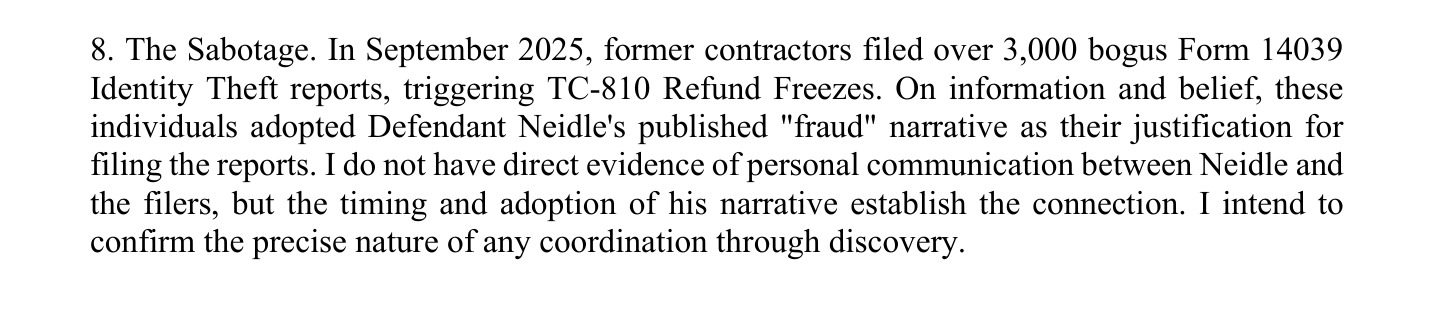
He’s now selling British people US tax refunds they aren’t entitled to (we described that scheme in May). Stamp says the IRS accepted $600m of refund claims but froze the money after people involved read one of our articles, and he says that cost him $120m.
The English courts have barred Stamp from bringing claims without permission. So he’s suing me in Wyoming instead.
His court filings appear to have been written by AI, and are full of invented cases, misrepresented judgments and extraordinary allegations. The lawsuit is absurd, but the fraud behind it is serious.
Stamp’s schemes have real victims. His mortgage scheme left vulnerable people thousands of pounds out of pocket, and many defaulted on their mortgages. His US scheme is now extracting thousands of dollars from some of the same people, unwittingly dragging them into an international tax fraud.
And in bringing this lawsuit, Stamp appears to have admitted, in documents filed under penalty of perjury, exactly how that fraud works.
The claim
Stamp filed a $438m defamation claim with the court on 6 August.
The plaintiffs were Stamp, a Wyoming company called MLITR Research LLC (which trades as “Ecclesia Law” and sends me legal threats), and OSN Foundation, a Panamanian “private interest foundation”.
Here it is:
The document reads very oddly, a sign that it’s AI generated. That’s confirmed by the reliable Pangram AI detector.
The lawsuit has its own website, also AI generated, with a damages calculator that goes up to $567m. The site’s only outbound link goes to the platform selling Stamp’s tax scheme.
The Wyoming court’s response
There’s a long and inglorious tradition of forum shopping: people trying to sue in the jurisdiction they think is going to be most favourable for them. This is a particularly extreme form of forum shopping, because Stamp is British and I am British, and the obvious (and probably only) place he can sue me is in an English court. But the courts have barred Stamp from suing without permission, so he’s been trying very hard to find somewhere else.
At one point Stamp tried to sue me in the European Court of Human Rights and the International Criminal Court (as a war criminal). After the ECHR and ICC unaccountably failed to take up the case, Stamp decided to set up a company in Wyoming and sue me there.
Why Wyoming? Probably because Wyoming is one of only ten states with no anti-SLAPP statute (see the Institute for Free Speech’s 2025 report card).
The tiny flaw in this is that neither a company nor a foundation can appear in a US federal court without a lawyer, and we doubt any lawyer would go near Stamp’s case.
So on 6 October the Wyoming court (on its own initiative) ordered Stamp to explain why the case shouldn’t be dismissed:
Here, it does not appear that the Court has subject matter jurisdiction under 28 U.S.C. § 1332(a)(2).
IT IS FURTHER ORDERED that Plaintiffs MLITR Research LLC, and OSN Foundation shall file their own Complaint or a joinder in Plaintiff Clifford’s Complaint through Wyoming licensed counsel on or before October 16, 2026, or they will be dismissed from this case.
Here’s the court’s “order to show cause”:
Stamp’s answer: Neidle is a racketeer
Stamp’s brilliant idea for getting around the order was to turn his defamation claim into a RICO claim.
RICO is the Racketeer Influenced and Corrupt Organizations Act of 1970, created to go after the Mafia. RICO created both criminal offences and civil rights of action: anyone “injured in his business or property” by racketeering can sue for three times the loss. The great news for Stamp is that it’s federal law, so a RICO claim gets you into federal court even if there’s no US party.
If you like this article, consider subscribing to our free newsletter
No spam or advertising. Cancel anytime.
Not interestedAlready subscribed
And that’s what Stamp did. On 13 October he amended his complaint to drop the companies and add a RICO claim, taking the total to $795m.
It is, inevitably, again AI generated.
The small difficulty Stamp has is that there is zero basis for suing a journalist under RICO.
RICO requires that the defendant helped run an “enterprise” with a “pattern of racketeering activity”. The defendant has to commit at least two crimes from a list in the statute (mail fraud, wire fraud, extortion, murder etc). A careful reading of the statute will reveal that journalism is not on that list.
Stamp claims that I published an article which was the “catalyst and signalling mechanism” for a criminal enterprise. Supposedly I conspired with a bunch of people who I’ve never met, spoken to, or had any dealings with:
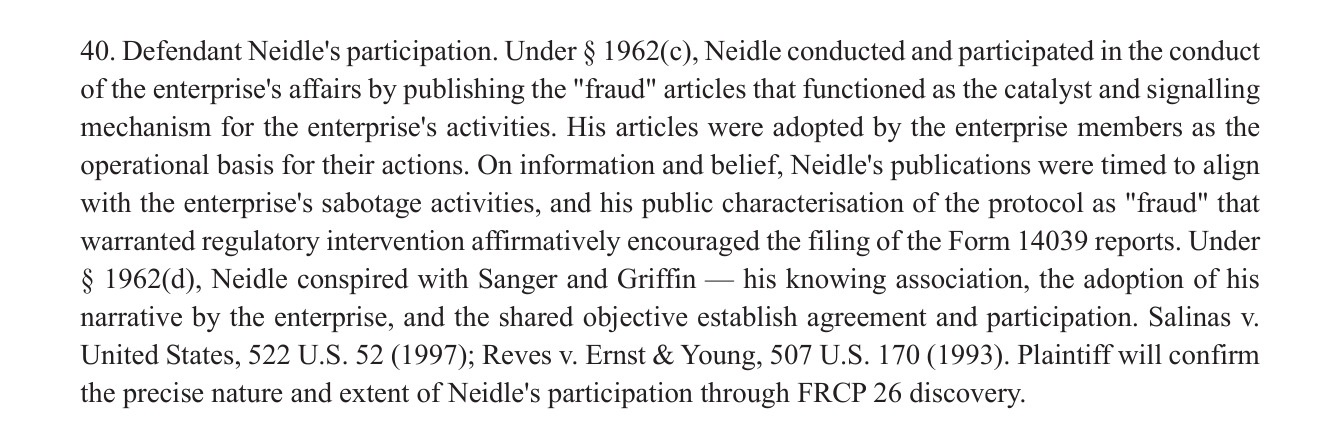
Stamp admits he has no evidence, but thinks people reading an article suggests a conspiracy by the author.
Stamp plays the same trick a few paragraphs further down. He’s suing Amy Sanger, a former colleague, in a separate case in New York over who owns about $900,000 of gold, silver and cash. Stamp tells the court he believes I’m funding Sanger’s lawyer:
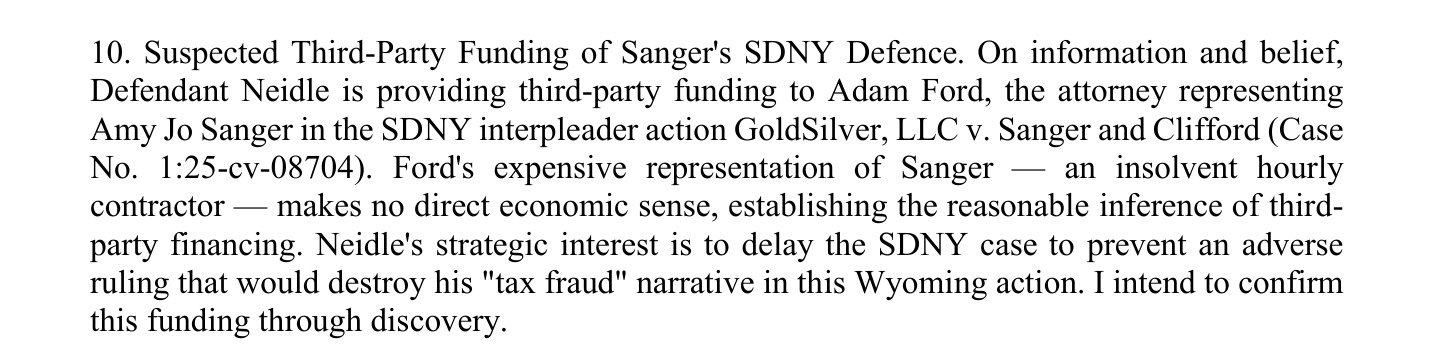
Again he has no evidence, because I’m not. I have zero desire to help Sanger, and have never had any contact with her or her lawyer.
Stamp’s “reasonable inference” rests on her lawyer being expensive and three of her old companies having missed their annual filings in Colorado. That’s not a “reasonable belief”, it’s a guess, and not a very good one.
The complaint admits Stamp’s fraud
Stamp’s US tax scheme isn’t unusual: the IRS has been warning about it since 2009, and promoters are regularly sent to prison.
The unusual element is that Stamp has now incriminated himself in his own court documents.
His court filings claim that, when a British individual borrows under a loan, their “signature credit energy” means they are owed income by a US bank. This is gibberish, but Stamp often says it, and would presumably claim he believes in it.
The problem is that he then says his trusts file a form telling the IRS that a bank withheld US tax from the borrower:
“the 98-series foreign grantor trusts — armed with HDC standing under UCC §§ 3-203 and 3-302 — file the corrective Form 1099-OID in the stead of the investment bank nominees. … The trust lists the nominee bank as the payer (attaching its specific EIN and CUSIP identifier) and the trust’s own 98-series EIN as the recipient, reporting the OID income and the associated federal tax withheld (Box 4).”
Obviously, that did not happen. The information being put down on the form is false, and I think Stamp must know that it’s false.
Stamp makes clear he expected to take a cut fromthe phoney refund claims:
“When Defendants’ conduct froze the recoupments, Plaintiff lost approximately $120
million in equitable trust property he was entitled to direct and receive — property he intended to shelter in the OSN Foundation for the benefit of the ROS Ecclesiastical Trust”
His declaration, under penalty of perjury, adds that his own trust’s IRS transcript “confirms $4,477,610”, and gives the trust’s taxpayer identification number.
Stamp appears to have done the prosecutor’s work for him.
Is Stamp misleading the court?
Aside from Stamp’s unreasonable “reasonable beliefs”, there are numerous points where his court filings contain statements that appear to be untrue:
Stamp says that a case called SEC v Wyly supports his position, and “affirmed that foreign grantor trusts operate under private international law and are recognised as distinct taxable fiduciaries”. The judgment says nothing of the kind. The term “private international law” doesn’t appear anywhere in it. The court held that the offshore trusts in question were taxable to their American grantors, and rejected the purported independence of the foreign trusts. Stamp has cited a case in which a US court found that two businessmen used offshore trusts to perpetrate a massive securities fraud and conceal hundreds of millions of dollars in profits from the US tax authorities – and is claiming it shows his own offshore trust arrangements are legitimate.
Stamp cites another case – “Newsome v. Penobscot 391 F. App’x 783 (10th Cir. 2010) – which doesn’t appear to exist at all.
Stamp swears in his court filings that he is appealing the UK contempt ruling. Southwark Crown Court told us in August 2026 that it could find no record of an appeal.
Stamp’s Wyoming complaint swears that he is “an individual residing in the United Kingdom”. The same complaint says he has been forced into “constructive exile”. Those two statements cannot both be true. He makes the same two contradictory claims in his New York filings. His website, his videos, his “referral” to the International Criminal Court and his own affidavit to Southwark Crown Court all say he is in Northern Cyprus, keeping out of reach of his prison sentence. I don’t know where he is, but all these statements cannot be simultaneously true.
The lawsuit includes a declaration from Stamp’s associate, William Kimball. There is a curious inconsistency in where Kimball claims to live. His sworn declaration from October 2026 says he is a “Wyoming resident”. His filings include a notification from the IRS sent to him at an address in Denver, Colorado. In the New York case earlier this year, his filings gave a New Hampshire business address and included a notarised New Hampshire driving licence. That’s consistent with his LinkedIn account (which appears to be actively maintained), and says he works in Portland, Maine.
The complaint says the IRS “validated” Stamp’s scheme. It also says the IRS froze every dollar of it. Both can’t be true.
Stamp’s ridiculous damages claims depends on him personally having suffered $120m of loss (because it’s him and his companies who is suing). So he told the court he holds MLITR Research LLC as “bare trustee” – someone who holds property for the benefit of somebody else. But, in the same document, he said he holds the “beneficial and equitable interest” in the company. These statements can’t both be true. And other documents contradict them. William Kimball’s declaration on the same date says that he is the 100% owner of the company – suggesting he, not Stamp, is the bare trustee. And, just the day before, Stamp published documents showing completely different ownerships.
It’s impossible to say what is a mistake, what is a lie, and what is an AI hallucination.
My response
Stamp’s website says I’ve been served with the Wyoming claim. That’s not true, and the court documents are clear that I haven’t been.
Cross-border service of a civil claim isn’t straightforward, and I don’t know if Stamp and his AI will ever figure out how to do it. I can’t, however, completely ignore a $795m claim, so I’ve instructed Laura Prather of Haynes Boone, one of America’s leading First Amendment litigation specialists. Laura helped write the Texas anti-SLAPP statute, and is the only American on the European Commission’s expert group on SLAPPs.
What happens next?
The court will decide whether the case survives the order to show cause, probably in the next few months.
Stamp should, however, hope that his case does not survive. Once we start making applications to the court he should expect the case to become expensive for him.
Thanks to everyone who’s supported our Stamp investigation, and particular thanks to Laura Prather.
I didn’t ask Laura to review this report – she has many better things to do with her time. US legal content is courtesy of I and V, for which many thanks.
Some documents, images, and videos (c) Iain Stamp and his various entities, and used here for purposes of criticism and review, and in the public interest.