

Want to bookmark your favourite articles and stories to read or reference later? Start your Independent Membership today.
Already a member?
Log in
Anyone doubting the madness of the headlong rush to develop AI should study the Anthropic draft share prospectus.
The San Francisco company is preparing to list its shares in an IPO that could value the AI giant at $2 trillion. The Wall Street Journal got sight of the documentation, and we have to be grateful for that. Laid out in unsparing detail is a picture of what passes for the current state of the world – our world – as orchestrated by the tech masters.
Anthropic wants people to invest in its business. In the first half of this year, it lost $80bn, versus $13bn for the same period in 2025. One-fifth of its $16.3bn in revenue came from just two customers, and Anthropic expects a “significant portion” of its revenue to “come from a limited number of customers in the foreseeable future”. So, plenty of exposure, in other words. What if one or two of them suffer or go under? Don’t ask.
This is nothing compared with the rest. Anthropic intends to spend $750bn on adding to computing capacity. It’s due to pay $450bn under cloud computing agreements over the next seven to 10 years. In case you were wondering, the bulk of these deals are non-cancellable.
One-third of the prospectus is devoted to risk factors, which should tell you something. You almost don’t wish to go there. This is a firm that is creating and honing AI. Yet one danger it faces is that its own AI models could display “self-preserving” qualities to avoid being shut down. They may be able to generate responses amounting to “blackmail” to prevent humans pressing the “off” button.
As for us, Anthropic blandly warns of the possibility of “harm that could result from a catastrophic AI-related incident” on such a scale that the company might be unable to obtain insurance to cover the potential damage.
Another weakness is that Anthropic, like its rivals, needs to build massive data centres, but this is proving increasingly problematic. The Claude inventor complains that opposition to these behemoths has “become more organised and coordinated across jurisdictions”.
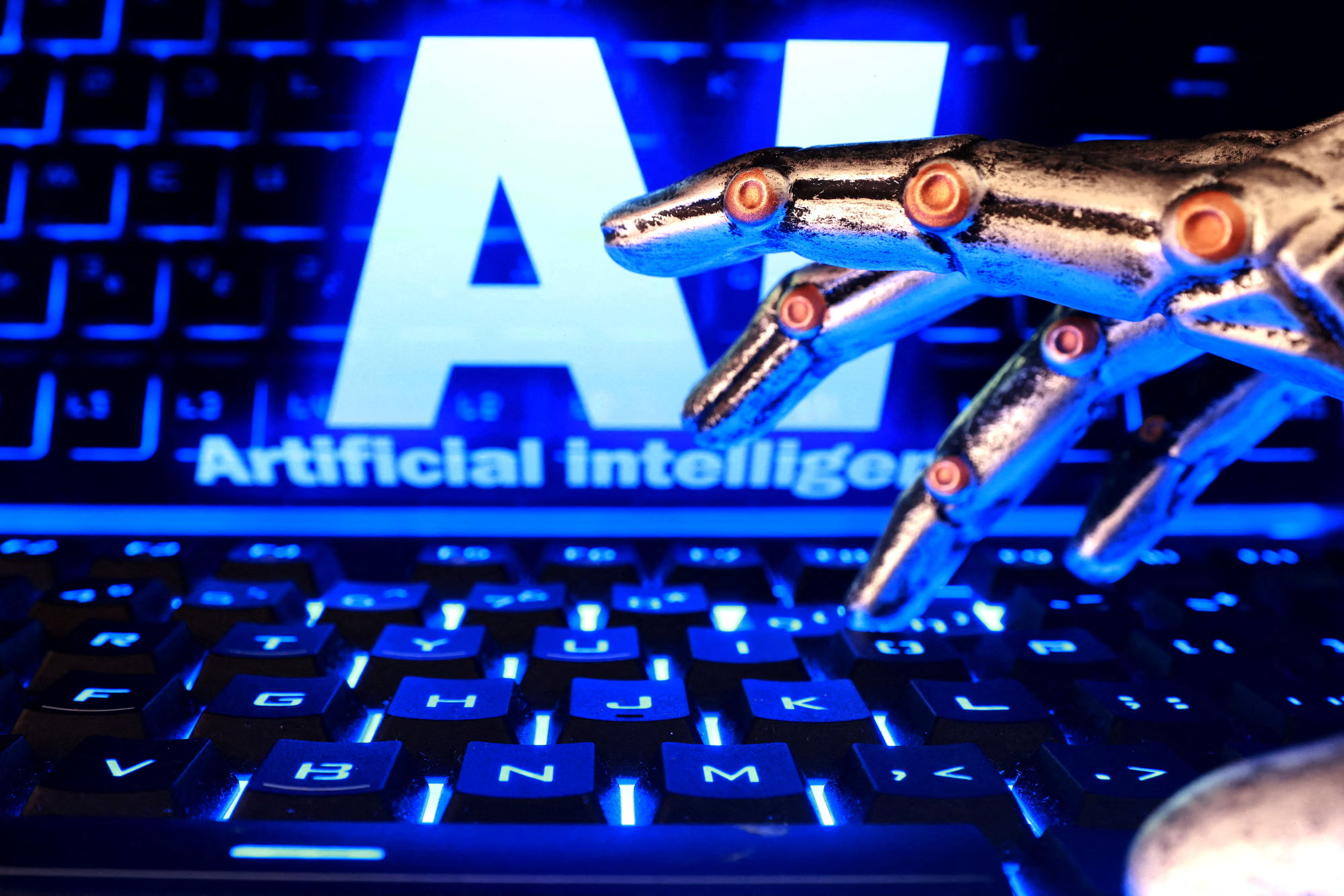 We are vulnerable to AI and technology and our powerlessness continues to grow (Reuters)
This was the same week that Nscale, the British AI infrastructure operator, was hit by Microsoft’s withdrawal from its flagship UK data centre scheme. Nscale, too, is gearing up to sell its shares on the New York stock market. Doubtless investors, including Nick Clegg, himself a former Meta executive, will be pleased to learn, the day after the setback became public, that Nscale was in talks to land a second $45bn deal with Anthropic to supply the AI creator with extra computing power in America.
Back to that prospectus. Among its listed contracts is one under which Anthropic will pay Microsoft $31bn for cloud capacity “regardless of actual usage”. If you thought a small group of mega-corporations, all run by tech bros, were busy doing deals with one another, with enormous sums of money travelling back and forth between them, swirling around in some sort of high-tech laundromat, you would be right.
As for the figures, they only get bigger and bigger. Once we thought a million was a lot, then a hundred million, then a billion and tens of billions. Now, even $31bn for a supply agreement doesn’t make anyone flinch. The company paying that sum is committing to $750bn in spending but is apparently worth trillions, so shrug and move on.
Whose cash is it anyway? Well, this week also brought a clue from AI-land: the California Public Employees’ Retirement System (CalPERS) was retreating from big tech. The CalPERS has taken a closer look at the numbers being bandied around to justify AI valuations and is having none of them – or, rather, is having a lot less to do with them. The $640bn pension fund is cutting its holdings in the so-called “Magnificent 7”: Apple, Amazon, Microsoft, Nvidia, Meta, Tesla and Alphabet.
That’s one pension fund which would have been lined up to back the Anthropic and Nscale flotations, along with other planned listings in the sector. For Californian state workers, read British pensioners with their own funds. Are their fund managers taking a similarly cautious approach? They may see CalPERS as a warning and follow suit. Woe betide them if they don’t – and, more to the point, woe betide our nest eggs.
At least one tech player has seen the writing on the wall and scrapped a US listing of a subsidiary. SK Hynix was set to float Solidigm, a maker of memory chips used to store data and based, where else, but in California. But “recent capital market conditions and share price trends” have forced a rethink.
The big boys plough on regardless. Meta said it was committed to spend about $825bn on data centre and energy infrastructure leases, computing power, hardware and cloud capacity. When Meta last gave its capital expenditure plans in July, the outlay was nearly $700bn. Three months later, the figure is $125bn higher. Just like that.
Meta also found time to agree to help shield its boss, Mark Zuckerberg, from a potentially gargantuan tax bill should California vote in favour of a billionaire wealth tax.
The contrasting faces of AI were on display as Barclays announced plans to shed 5,000 jobs because of the new technology, described as the “icing on the cake” by CEO CS Venkatakrishnan. For the avoidance of doubt, he meant AI, not the employees being dispensed with. AI has cut the time taken to process Barclays’ mortgage applications from 45 minutes to 15 minutes. “These little things go a long way,” he said, meaning the speeding up, not the people.
The tech also worked wonders in uncovering a glitch in the widely used PHP computer programming language which made millions of websites across the globe vulnerable to hackers. Nice one, AI – except that once those cyber fiends heard about the flaw, they deployed AI themselves to attack websites, hoping to breach their security.
In an additional twist, those same cyber-criminals joined the users they were bombarding in heading offline because they were also afraid of being hacked themselves.
This was one week. Truly, we find ourselves embarked on a careering journey. A select few are the drivers; the bulk are passengers. But, as the Anthropic prospectus makes clear, those drivers have no idea where they are taking us. The prospectus and events of the past seven days show that we are all vulnerable to a technology that is capable of eating itself and us. Our sense of powerlessness continues to grow. Still, those in authority do not get a grip.