
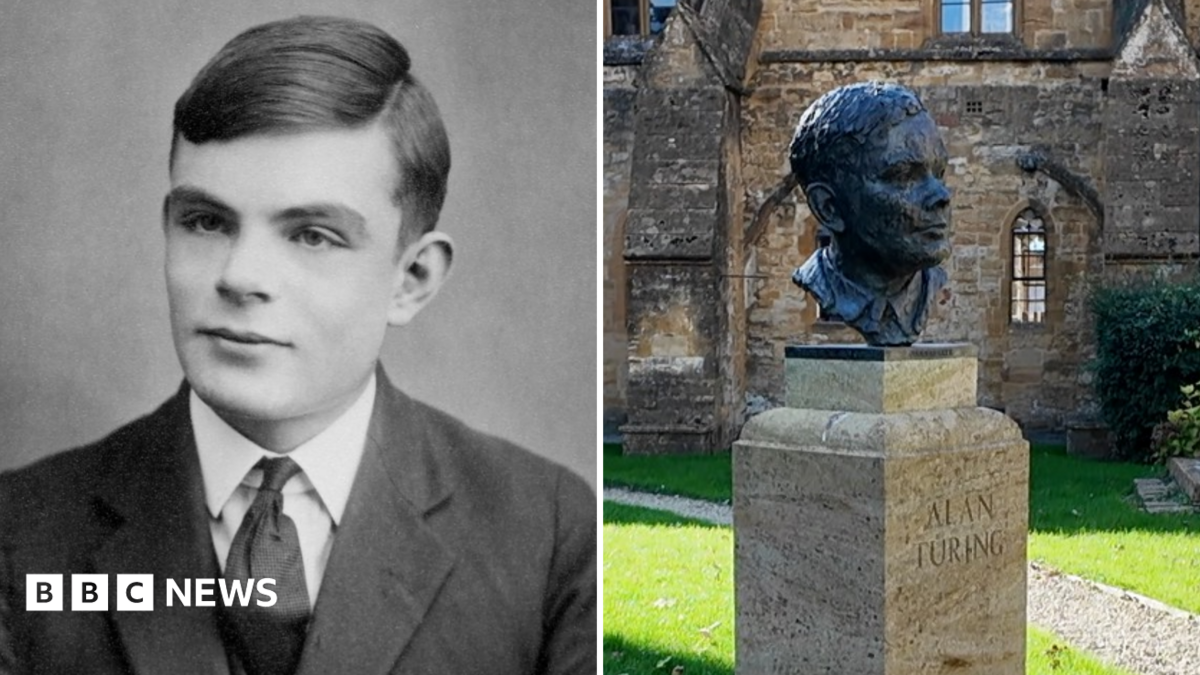
During World War Two, Turing played a crucial role in breaking encrypted German military communications at Bletchley Park in Buckinghamshire.
He helped develop the Bombe, a machine used by codebreakers to identify settings of the German Enigma encryption machine, providing vital intelligence to Allied forces.
“He saved between 14 and 21 million lives,” said Alastair Poulain, Turing Project lead for Sherborne Schools.
He added: “He hasn’t been honoured in the way he should have been and so, as a school, we are really keen to recognise him and to grow awareness and our links to him and our legacy.”
Turing was a pioneer of modern computing. In 1936, he developed the concept of a theoretical machine capable of carrying out calculations by following instructions, helping lay the foundations for computer science.
After the war, he worked on designs for early electronic computers and explored whether machines could demonstrate intelligence.
In 1950, he proposed what became known as the Turing Test, which explored whether a machine could imitate human conversation convincingly enough to be mistaken for a person.
Despite his achievements, Turing faced persecution for his homosexuality, which was illegal in Britain at the time.
He was convicted under gross indecency laws in 1952 over his relationship with Arnold Murray and was subjected to hormonal treatment.
He died two years later, aged 41, in what an inquest ruled was suicide.
In 2013, Turing was given a posthumous royal pardon after an official apology by former Prime Minister Gordon Brown in 2009.