
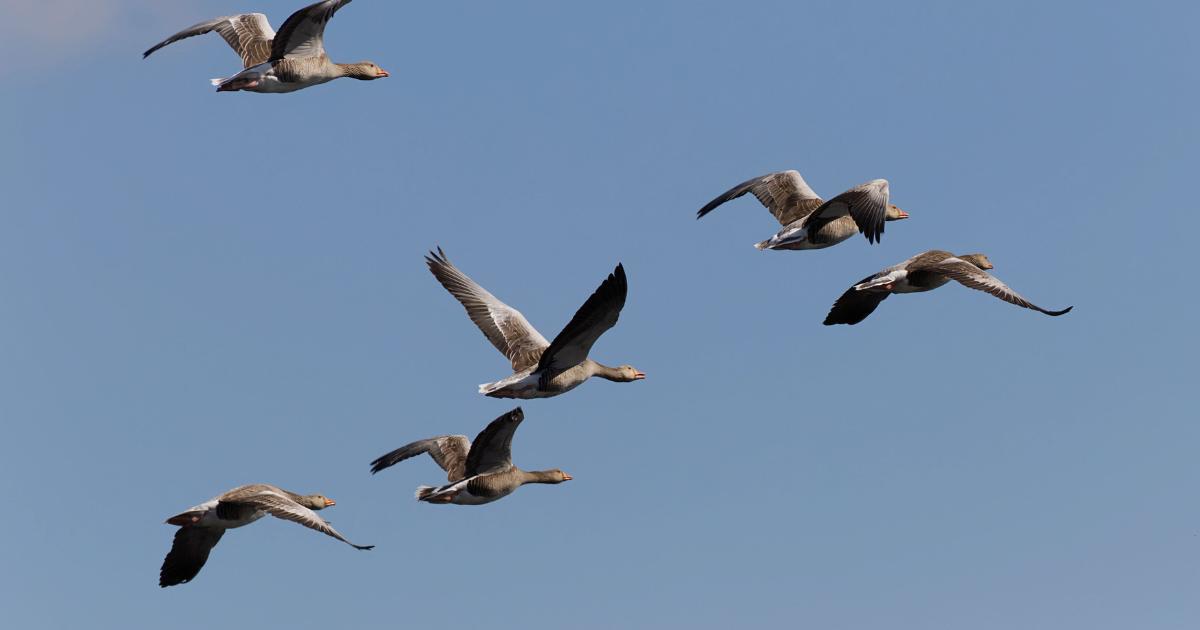
The noisy groups, known as skeins, are a common sight at this time of year as thousands of birds make their seasonal movements across the country.
And Warrington’s location in the north west means residents can find themselves underneath some particularly impressive movements of geese during the autumn.
One species likely to be responsible for some of the large groups being spotted across the region is the pink-footed goose, which migrates to Britain each autumn.
According to WWT Martin Mere, in Lancashire, pink-footed geese arriving there have travelled from Iceland and eastern Greenland, where they spent the Arctic summer breeding and raising their young.
As autumn arrives, shorter days, falling temperatures and changes in food availability prompt the birds to head south.
Their journey to Britain can cover more than 800 miles and can take around two to three days, including a stop in the Faroe Islands.
That helps explain why the spectacle is particularly noticeable at this time of year.
The main arrival of pink-footed geese into Britain takes place from September into October, although the birds continue moving around the country after arriving.
One of their most important destinations happens to be relatively close to Warrington.
WWT Martin Mere, near Ormskirk in Lancashire, says as many as 40,000 pink-footed geese can gather there at once, using its open water to roost while feeding on surrounding farmland.
The scale of the autumn arrival was evident earlier this month, with WWT Martin Mere advertising the chance to witness up to 20,000 pink-footed geese at its North West Bird Watching Festival on October 17 and 18.
However, not every flock seen above Warrington will necessarily be newly arrived from Iceland or Greenland.
Once in Britain, the birds move between roosting and feeding sites and can also relocate between different parts of the country.
This means a flock seen overhead could be making a relatively local journey, rather than completing the final leg of its migration from the Arctic.
Pink-footed geese move around considerably during winter, with flocks capable of travelling between Scotland, Lancashire and Norfolk.
Their characteristic formations can also make them particularly conspicuous.
Travelling in groups produces those long lines and V formations which are accompanied by frequent calls between the birds, making a passing skein difficult to miss even before it comes into view.
So, if you’ve been hearing honking above Warrington and looking up to find dozens of geese crossing the autumn sky, don’t be too surprised.
Late October puts the town right in the middle of one of the most spectacular periods of Britain’s autumn bird migration.