
The strange political tensions of Cold War Germany are encapsulated by a reimagined trip across the freshly divided state in “Fatherland.” Director Paweł Pawlikowski’s film screened at Culbreth Theatre Sunday, selected as part of the Virginia Film Festival’s “International Oscar Contenders” category. The Polish director previously won an Academy Award for “Best International Feature Film” in 2015 for his historical fiction piece “Ida.” His newest film, “Fatherland,” closes out his trilogy of Cold-War period pieces — which began with “Ida” — followed by 2018’s aptly named “Cold War.”
The film follows the story of historical figures Thomas Mann and his daughter Erika Mann, played by Hanns Zischler and Sandra Hüller, respectively. Mann wrote against the Nazi regime and fled into exile to the U.S. in 1939, where he continued broadcasting lectures against Nazi Germany throughout World War II. He and his daughter return to Germany, as Thomas accepts accolades across his homeland in both West and East Germany. The film was introduced by Bilal Qureshi, broadcaster, essayist and critic for NPR. Qureshi warmly thanked the volunteers and organizers of the festival, and also highlighted the historic influence of one of the film’s central characters, Thomas.
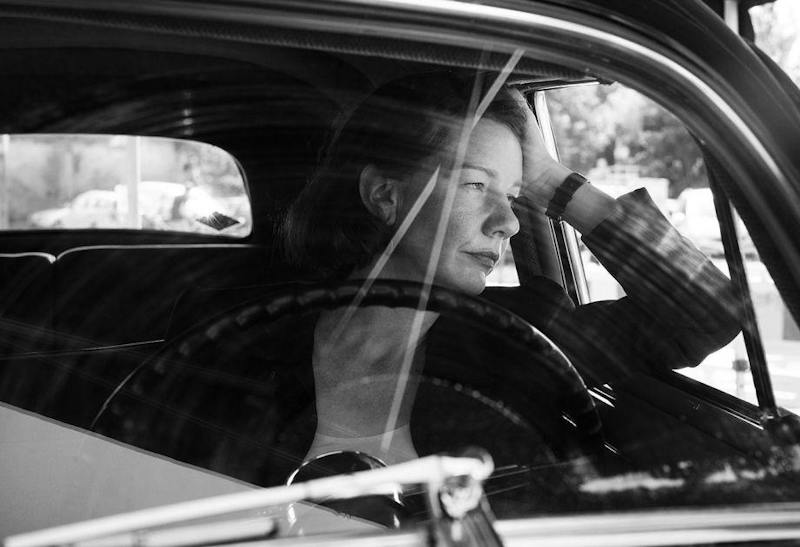
Though the real Thomas did take a trip to Germany following the end of World War II, Pawlikowski avoids rotely aiming for historical accuracy in the story. Instead, the film revolves around invented discussions over legacy and homeland between Thomas, Erika and the swathes of German officials they deal with. While “Fatherland” is a fictional piece, its largest feat is its ability to mimic a historical documentary drawn out of Germany’s distant past. Pawlikowski’s signature practice of filming entirely in black and white creates a distinct composition and evokes a sense of antiquity in each scene. Michael Newell-Dimoff, audience member and class of 2026 alumnus, took particular notice of the film’s monochrome style.
“The black and white film was pretty cool,” Newell-Dimoff said. “I think not only does it make things a little harsher, but [it gave] it a timeless quality.”
“Fatherland” plays with its contrast frequently, as the color palette evokes the unfamiliarity and distance the Mann family seemingly feels in returning from political exile. In an early scene, Thomas arrives in West Germany to receive an award. As he emerges from his car to greet a crowd of darkly dressed officials, he stands alone, dressed entirely in stark white. The film even opens with the striking image of Thomas’ son, Klaus Mann, played by August Diehl, half-dressed and dejected, mourning the pointlessness of any attempt to repair his home country. Klaus’s despair is drawn out by the grayscale backdrop, as cold white light streams in from a window. His ensuing diatribe against his father’s writing directs the film, as Thomas’ hopes of bettering Germany battle against the dreary pointlessness of his resistance.
As Thomas is welcomed back to a homeland that once considered him a traitor, “Fatherland” appears almost optimistic. In West Germany, Thomas exalts in the celebrations following his acceptance of the Goethe Prize, an award which parallels him to the acclaimed German writer Johann Goethe. An energetic band serenades a crowd of Germany’s new upper crust celebrating alongside Thomas, and the lively energy is a reassuring change from the earlier formalities. Yet, underlying the pomp of his reception is the almost sinister twisting of Thomas into a symbol to be captured by either side of the country, rather than a resident.
In fact, the film’s concerns with identifying home are bound inseparably with Thomas’s own alienation from his home country. Much of the film hinges on Thomas’s embrace of his political responsibility, as he strives to turn himself into a symbol of a more united, neutral Germany. Zischler brings a brilliantly stoic seniority in portraying Thomas, managing to portray his sense of obligation as well as his occasional self-absorption.
Thomas’s daughter Erika mirrors his reserved wit, as Hüller projects the tense professionalism which viewers of “Project Hail Mary” may remember from her role as Eva Stratt. Nonetheless, in “Fatherland,” she provides a more approachable, doubtful perspective as Erika, who pushes against her father’s obsession with his own influence. Jordan Simmers, audience member and second-year College student, said he particularly admired Hüller’s distinct performance in “Fatherland” in comparison to her role as Stratt.
“That was a complete turn of character. I think that’s good that she’s not been typecast into one specific type of role, and that she was able to hold her own in this movie,” Simmers said.
Indeed, Hüller’s performance stands out from the rest of the cast. Hüller’s emotional range is on full display in “Fatherland,” as Erika grapples with her and her father’s powerlessness to stop the new German regime. One moment, Erika quietly watches the rain fall on the street, while the next she breaks down and screams at the fascists singing outside. In private, Erika tears at her father’s preoccupation with politics, as Thomas coldly ignores a death in the family for the sake of continuing the trip.
The crux of “Fatherland” is simple — Thomas cannot avoid being drawn into the political spectacle of either half of Germany. Cleverly, the film both endorses and mocks Thomas’ self-importance through Pawlikowski’s strangely severe backdrops. Thomas’ speeches are received by rows of silent, black-clad spectators in the West, and he is welcomed in the East by an orderly group of uniformed, chanting children. As unsettling as “Fatherland” may be, these absurd scenes of conformity act as a wisely ordered break from its bleak political debates.
The scoring of “Fatherland” also carefully contributes to its heavy and yet surreal tone. In East Germany, choirs of men in army uniforms sing anthems to commemorate dinners, as displays of traditional art meld with the serious political nature of the Mann family’s visit. After the film, Qureshi said he was particularly struck by the soundtrack.
“Sometimes there’s movies that use music and they smother the movie with music to make you feel things. What I love about this film is that it is about music, but it’s used so effectively,” Qureshi said. “And when it comes in, it is really saying something about the history, the place where the music is heard [and] the choral music that’s used.”
Ultimately, “Fatherland” captures both the ideologies of Cold War Germany and timeless issues of belonging, grief and political responsibility. Its uniquely dream-like filmography combined with Hüller’s impressive outbursts of emotion create a story of perseverance in a harsh, strange period of history. This screening of the unique and passionately produced “Fatherland” embodied a main goal of the Virginia Film Festival of providing audiences with “the best of the international film scene.”