
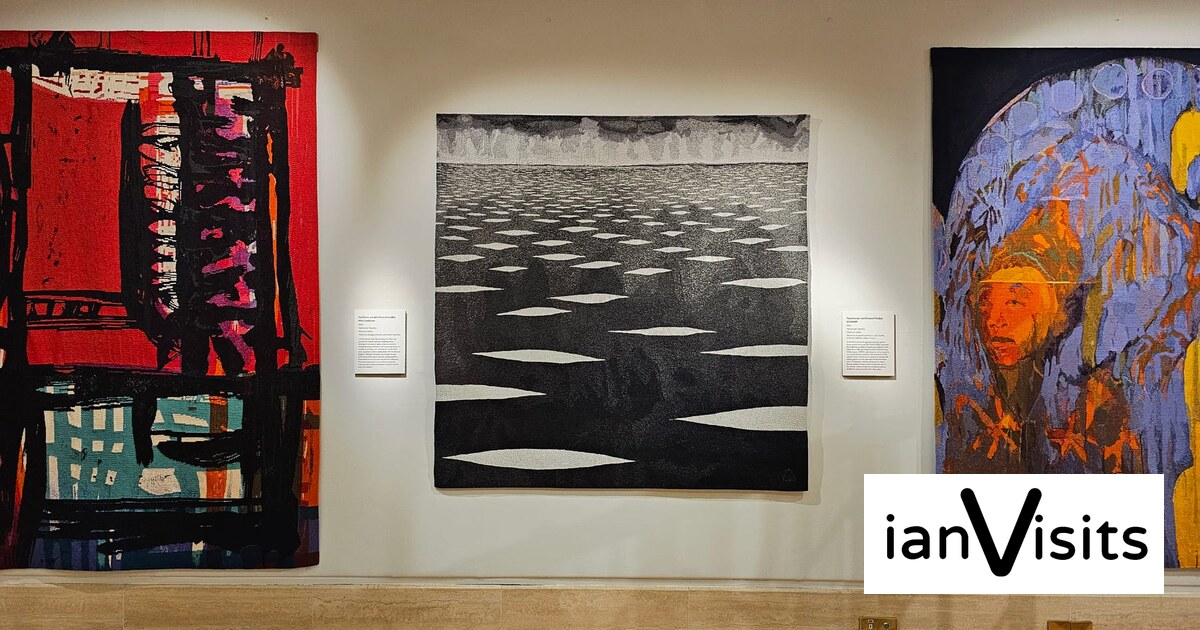
It’s tapestry season in London, and while the big one is historic, the Guildhall Art Gallery is also showing a collection of modern tapestries.

The exhibition, Beyond Bayeux: Tapestry Now, brings together work made by Edinburgh’s Dovecot Studios, exploring how artists and weavers turn paintings, drawings and digital designs into textiles. Although the title takes its cue from the Bayeux Tapestry, the exhibition focuses on tapestry’s ongoing development as a modern art form.
Founded in 1912, Dovecot has roots in the Arts and Crafts movement. Two weavers from William Morris’s Merton Abbey workshop moved to Edinburgh to establish a studio for the 4th Marquess of Bute. The studio eventually took its name from a historic dovecot next to the purpose-built workshop.
That gives the exhibition’s historical foundation, but much of its interest lies in explaining the decisions involved in making a tapestry. As the exhibition explains, weavers have to study brushstrokes, accidental paint drips and changes in tone to find ways of expressing them through different fibres and combinations of coloured yarn.
And what appears from a distance to be a single colour can, when you get very close, turn out to contain several yarns blended to create depth and tonal variation.
One of the highlights of the show is a David Hockney commission which is based on a painting he made of a tapestry – so it’s a tapestry of a painting of a tapestry. Very meta. Peter Saville’s After, After, After Monarch of the Glen draws on Edwin Landseer’s famous stag painting and Peter Blake’s later Pop Art interpretation, before evolving those earlier versions into tapestry.

Meanwhile, Farshid Moussavi Architecture’s The Garden Carpet uses computer-based modelling and geometric shapes to reinterpret the Persian garden carpet. Christina Kimeze’s Blue Door, by contrast, presents a different challenge, which was to preserve the marks and drips of an oil painting in woven form.
However, the largest work on display is Hurvin Anderson’s The Lincoln College Tapestry. More than five metres across, it was woven by five people over nine months for the Oxford college’s 600th anniversary. The design centres on a long table, reflecting the role of dining and gathering in College life. Around it are references to Lincoln’s academic, sporting and social life, including the University’s four academic divisions. If you squint, it’s also vaguely similar to the Last Supper.

The exhibition also connects tapestry to London’s buildings, from the British Library entrance hall to Victoria Crowe’s 52-square-metre commission for Leathersellers’ Hall. Guildhall Art Gallery itself also owns John Piper’s The Five Gates of London, woven by Dovecot in 1975.
As a collection, it shows the broad range of contemporary art in tapestry form, and while it’s easy to stand back and look at the art as a whole, it’s also worth getting up close to see the stitching and how it varies across the different hangings.

You might have seen contemporary tapestries in offices, as they’re increasingly popular artworks for large foyers with their brightly coloured hangings, and not to forget, quite good at dampening sound.
The exhibition, Beyond Bayeux: Tapestry Now, is at the Guildhall Art Gallery until 21st March 2027 and is free to visit, with donations.
It’s open daily from 10am to 5pm.
Note: The Lincoln tapestry will leave the exhibition in early March – so best to visit before the end of February to see it.