
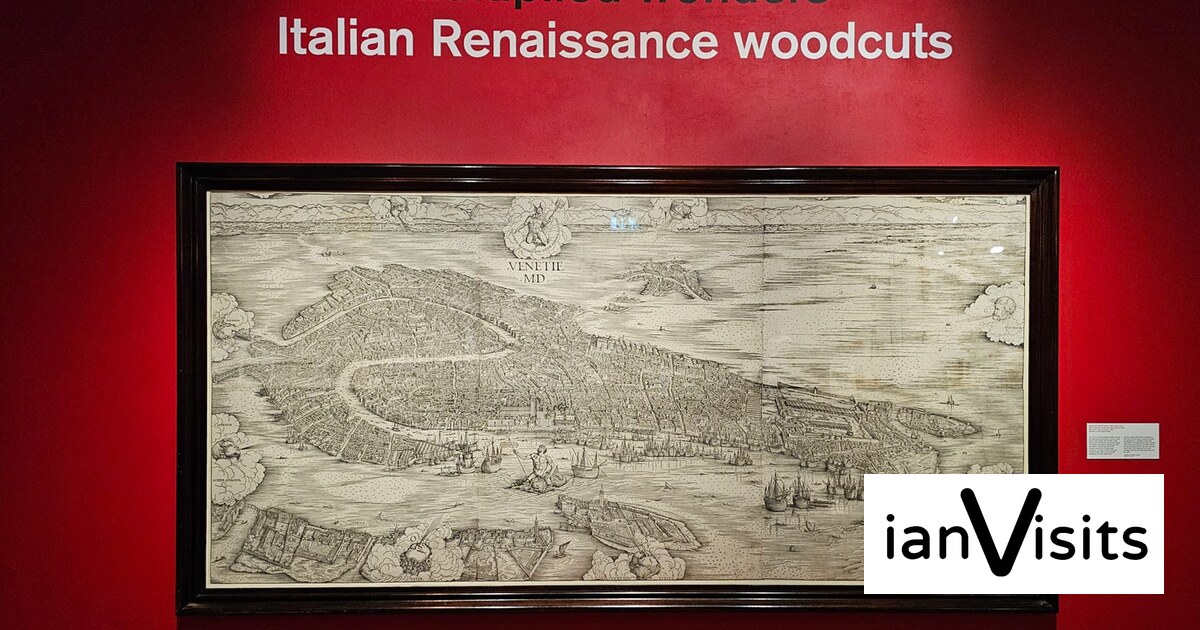
Images pasted onto walls, carried in pockets, and used for playing cards fill a room as the British Museum looks back on Italian Renaissance woodcut prints.

Although not all of them are tiny, as the exhibition opens with a huge bird’s-eye view of Venice from around 1460-1516, but the majority in the exhibition were sold as affordable art to a populace that couldn’t afford a painting.
Today, as rare survivors, they command rather higher prices, alas.
Described by the museum as the first display devoted to Italian Renaissance woodcuts, it draws on the museum’s own collection, with many works being shown for the first time. The main gallery traces the medium’s development across Italy’s artistic centres, while a smaller room examines its everyday uses.
The exhibition also repeatedly highlights the collaboration between artists, specialist cutters, and publishers. Famous names supplied designs, but translating them into printable wooden blocks depended on another set of skills.

Giovanni Britto’s work on Titian’s portrait of Suleiman the Magnificent is one example. The label highlights cutting so fine that it rivals engraving, particularly in the elaborate helmet made in Venice in 1532. Encrusted with precious stones and topped with an exotic feather, the headgear is as much the subject as its wearer.
Some of the labels also reveal the long working lives of the blocks. The impression of Lucantonio degli Uberti’s The Martyrdom of the Ten Thousand Christians on Mount Ararat dates from the 1600s, although the original design was produced roughly a century earlier. The Venetian printer Vieceri acquired older woodblocks and issued fresh impressions under his own name.
While most of the exhibition is in black-and-white, some early colour prints appear, made from separate blocks to introduce different tones.

The exhibition ranges from maps, portraits, literary scenes, and unsurprisingly for the era they were made, lots of religious imagery. And a suspiciously large quantity of naked male posteriors.

The range and antiquity of the prints make it an enjoyable exhibition, for both the artistry of the design and the technical quality of the printmakers who turned the paintings into prints.
The exhibition, Multiplied wonders: Italian Renaissance woodcuts, is at the British Museum until 21st March 2027 and is free to visit.
You can find it in Room 90 – which is at the northern end of the museum at the top of the rear stairs.
Details here.
