
There is a lot going on in the November sky with conjunctions, occultations, a supermoon and Voyager 1 reaches an astonishing milestone in unmanned spaceflight.
The Sun leaves Libra (The Scales) on 23 November at 8:12 am and
enters Scorpius (The Scorpion). Just six days later, the Sun leaves
Scorpius (The Scorpion) and enters Ophiuchus (The Serpent Bearer) on
29 November at 8:36 pm. Over the course of the month, the Sun comes
closer to Earth by 971,899 km. Daylight shortens from 09:13 (9.215
hours) on 1 November to 07:27 (7.455 hours) on 30 November so we gain
1 hour and 46 minutes of night time by month’s end.
The Moon begins the month at last quarter on 1 November at 8:28 pm in
Cancer (The Crab) and ends November in Leo (The Lion) but recedes by
6,536 km. The new Moon appears on 9 November at 7:02 am in Libra (The
Scales) beginning a new synodic (Lunar) month which will last 29
days, 17 hours and 50 minutes. Lunar apogee (furthest from Earth)
occurs on 13 November at 5:58 pm and takes the Moon to 405,650 km
away from Earth—around 21,250 km further than average—subtending
an angle of 29.4 arc-minutes. The first quarter of the new Lunar
cycle shows up on 17 November at 11:48 am in Capricornus (The Sea
Goat). The full Beaver Moon appears on 24 November at 2:54 pm in
Taurus (The Bull). Since it is at ‘perigee syzygy’, it is also a
supermoon. Lunar perigee (closest to Earth) on 25 November at 9:09 pm
finds the Moon some 359,336 km away from Earth—around 25,064 km
closer than average—subtending an angle of 33.2 arc-minutes.
On 3 November, Regulus in Leo (The Lion) will be within 1 degree of
the waning crescent Moon for several hours before sunrise, with
Jupiter and Mars lurking close by. A very similar even will occur on
30 November when the Moon is almost at last quarter. On 7 November
Spica in Virgo (The Maiden) will conjunct with the waning crescent
Moon, with brilliant Venus photobombing the show, just before sunrise.
On 28 November, in the wee small hours, Pollux in Gemini (The Twins)
will be 1.1 degrees north of the waning gibbous Moon.
For the inferior planets: Mercury remains in Libra (The Scales) all
month but recedes by 80,262,568 km (0.537 AU). The swift planet
increases in magnitude from 3.16 to -0.69 (34.74 times in brightness)
over the month. Earth and Mercury will be closest on 3 November at a
tad over 100 million km. However, on 4 November Mercury reaches
inferior conjunction and so is lost in the Sun’s glare. Perihelion on
10 November is followed by a return to a prograde orbit on 13
November. Mercury reaches dichotomy, where half the surface is within
sunlight, on 18 November. Finally, Mercury reaches greatest western
elongation on 21 November. It is around this time that Mercury can be
glimpsed about an hour before sunrise in the south-east. Venus
remains in Virgo (The Maiden) all month but recedes by 21,945,792 km
(0.147 AU). The morning star planet increases in magnitude from -4.17
to -4.89 (1.94 times in brightness). On 7 November, Venus will
conjunct with the waning crescent Moon in the pre-dawn hours and be
occulted by it during daylight. On 11 November, Venus returns to a
prograde orbit. Finally, Venus will reach greatest brilliancy all
year on 27 November and may be worth a look on that day around 6 am.
For the superior planets: Mars remains in Leo (The Lion) all month
and approaches by 38,150,368 km (0.255 AU). The red planet increases
in magnitude from 0.86 to 0.46 (1.44 times in brightness) over
November. Jupiter remains in Leo (The Lion) all month and approaches
by 69,802,937 km (0.467 AU). The gas giant planet increases in
magnitude from -2.00 to -2.19 (1.19 times in brightness) over the
month. Both Mars and Jupiter are easy to spot in November as both are
highly visible after midnight all month long. On 2 November, they
will conjunct with the waning crescent Moon but closest approach for
both will be during daylight hours. We also miss the occultations of
both planets that day. On 16 November, Mars will be 1.2 degrees north
of Jupiter close to Regulus in Leo (The Lion). Jupiter reaches
western quadrature on 18 November and Mars the same milestone the
following day. On 25 November, just before sunrise, Mars will be
1.6 degrees north of Regulus with bright Jupiter close by. On 30
November, Mars, Jupiter and Regulus will again conjunct with the
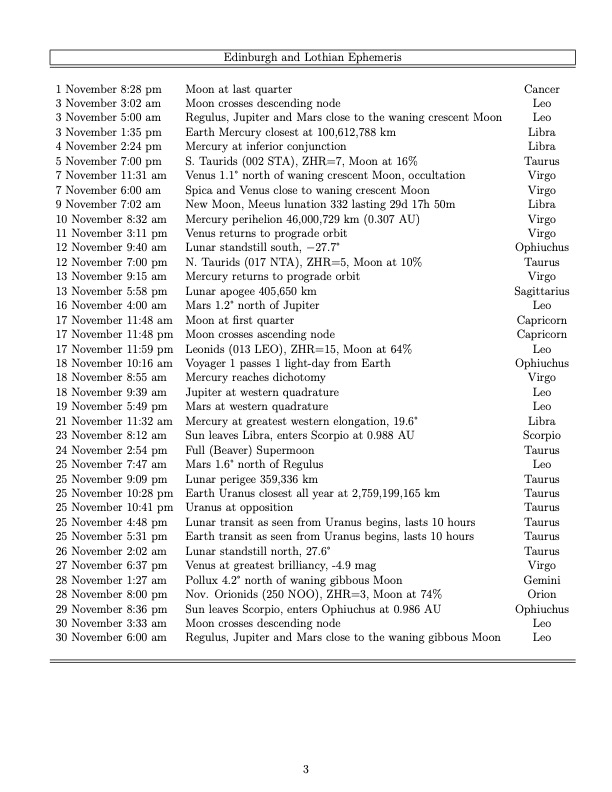
waning gibbous Moon as detailed in our ephemeris.
Saturn remains in Cetus (The Sea Monster) all month but recedes by
52,037,914 km (0.348 AU). The ringed planet decreases in magnitude
from 0.46 to 0.61 (1.14 times in brightness) across November. Uranus
remains in Taurus (The Bull) all month and approaches by 13,632,426
km (0.091 AU). The green giant increases in magnitude from 5.61 to
5.60 (1.01 times in brightness). Uranus reaches the closest to Earth
all year on 25 November lying some 2,759,199,165 km away. It reaches
opposition the same day and is best observed, with a telescope or
binoculars, at this time. Whilst you peer through your own occular
device, spare a thought for any Uranians looking back at you for they
will see a transit of the Earth and Moon on that day! Neptune remains
in Pisces (The Fishes) all month but recedes by 60,751,385 km (0.406
AU). The blue giant decreases in magnitude from 7.69 to 7.72 (1.03
times in brightness).
The Southern Taurids (002 STA) meteor shower peaks on Guy Fawkes
night with the waning crescent Moon illuminated to 16%. A week later
the Northern Taurids (017 NTA) peak with the waxing crescent Moon at
10%. The radiant is near M45 (The Pleiades). The parent comet is
2P/Encke, co-discovered by Mechain and Messier in 1786, and is
named after the astronomer who first calculated the body’s orbit.
The Leonids (013 LEO) peak on 17 November with a ZHR of 15. The
waxing gibbous Moon is illuminated to 64% but it is setting when Leo
(The Lion) rises after midnight. The radiant point is near Algieba in
Leo (The Lion) and the parent comet is 55P/Tempel-Tuttle discovered
in 1865. Lastly, the November Orionids (250 NOO) peak on 28 November
only 4 days after a full Supermoon. These are the secondary meteors
seeded by Halley’s comet so activity is low with a ZHR=3.
According to NASA, Voyager 1 will be beyond 25,902,068,356 km from
Earth on 18 November at 10:16 am. This is more succinctly put as 1
light day—an astonishing milestone in unmanned spaceflight—and it
has taken over 49 years! Apart from the amazing science it has
delivered—–Titan’s nitrogen-rich atmosphere and volcanism on Io to
name just 2 examples—–the doughty little craft photographed the
‘pale blue dot’ that is mother Earth.
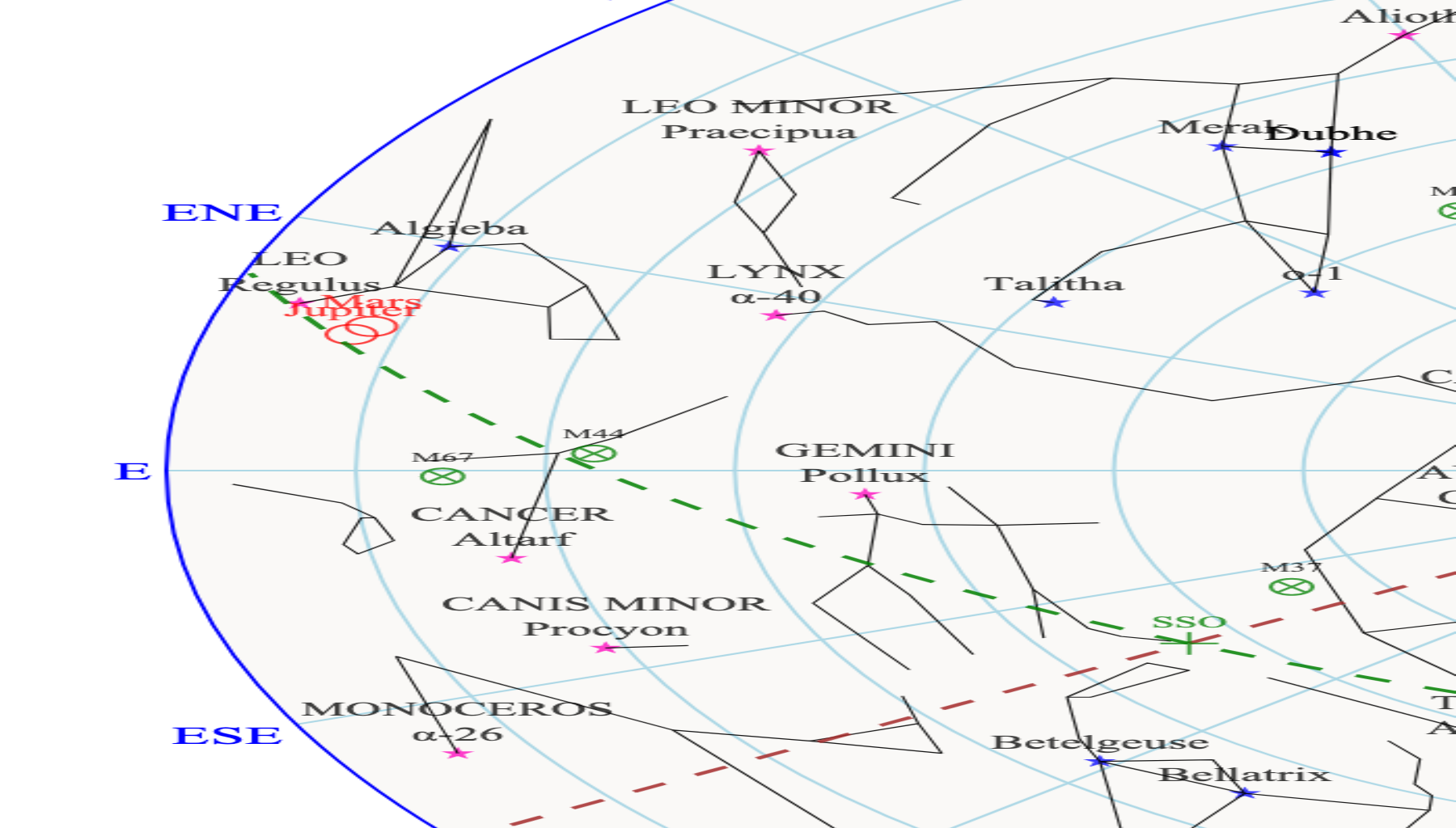
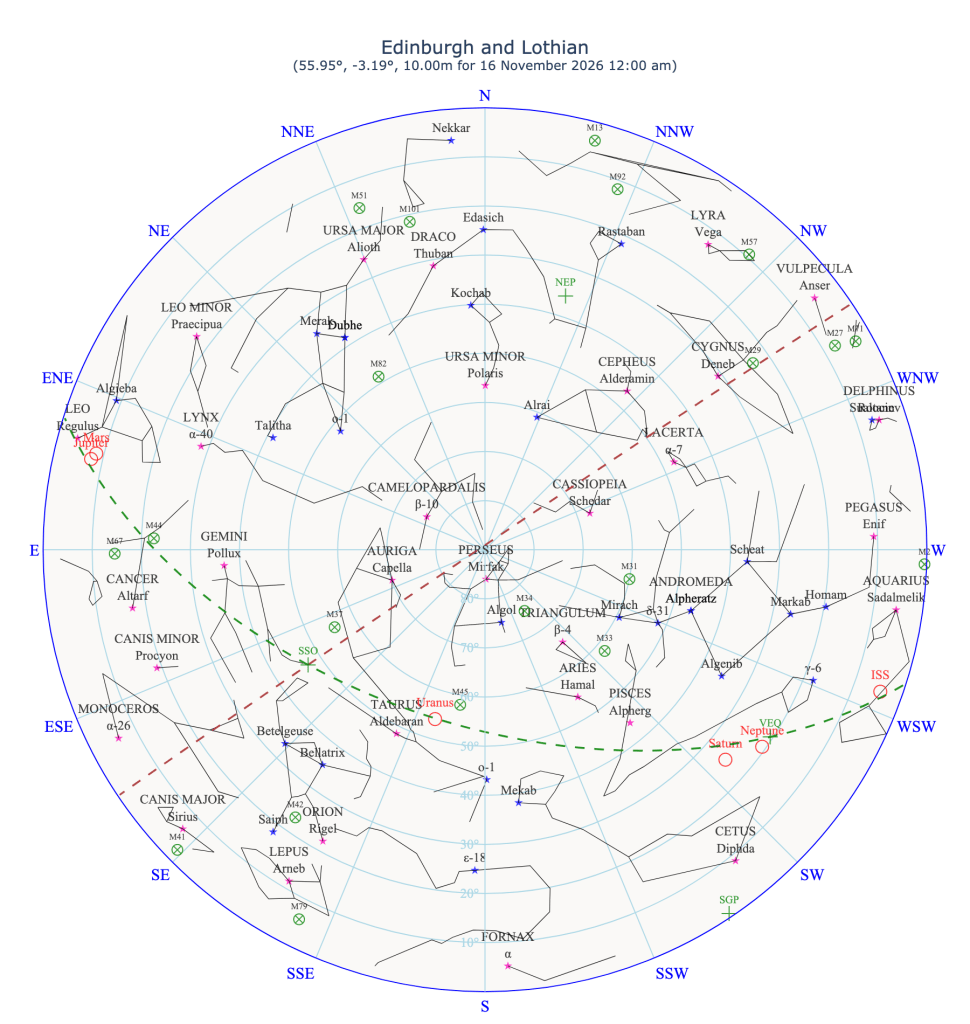
At the time of our sky map, some constellations visible are
Cassiopeia (The Seated Queen) at zenith, Bootes (The Herdsman) in
the north, Canis Minor (The Lesser Dog) in the east, Aquila (The
Eagle) in the west and Cetus (The Sea Monster) in the south. The
ecliptic hosts Cancer (The Crab), Gemini (The Twins), Taurus (The
Bull), Aries (The Ram), Pisces (The Fishes), Aquarius (The Water
Bearer) and Capricorn (The Sea Goat).
The ‘Summer Triangle’—Vega in Lyra (The Lyre), Altair in Aquila
(The Eagle) and Deneb in Cygnus (The Swan)—is prominent in the
west. The ‘Winter Triangle’—Procyon in Canis Minor (The Lesser
Dog), Sirius in Canis Major (The Greater Dog) and Betelgeuse in Orion
(The Hunter) is prominent in the east. The ‘Winter Hexagon’ (Sirius,
Rigel, Aldebaran, Capella, Pollux and Procyon) rises after midnight.
Circumpolar constellations—always above the horizon—include
Camelopardalis (The Giraffe), Cepheus (The King), Lacerta (The
Lizard) and Perseus (The Hero).
Related