
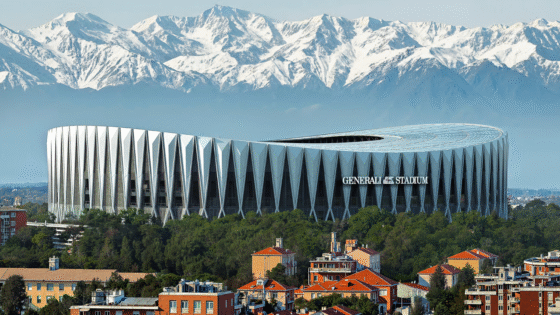
The practice, which is working with sports venue specialist Manica, said the design had been inspired by Milan’s architectural heritage, adding that its ‘powerful rhythm’ and external form ‘recall both the legacy of Italian engineering and the intricate craftsmanship of the Duomo di Milano’. The new stadium will feature a concrete X-frame structure.
In September last year, the City Council of Milan agreed to sell the 100-year-old stadium and its surroundings to AC Milan and Inter Milan – the two football clubs that both play their home games at the venue – paving the way for the demolition of one of football’s most famous grounds.
According to Fosters, the new Generali Stadium, named after Italy’s largest insurance company, has been drawn up ‘to carry the spirit of San Siro into a new era and become a new landmark for Milano’. It will sit to the west of the existing venue, which was built in the 1920s and extended in both the 1950s and 1980s.
Practice founder Norman Foster said: ‘Milano is a city shaped by makers, engineers and restless ambition. From San Siro to La Scala, buildings act as epicentres of culture and entertainment.
‘This project represents a remarkable opportunity to build upon San Siro’s legacy – channelling its powerful spirit to continue the story of AC Milan and FC Internazionale Milano. As the centrepiece of a wider urban regeneration scheme, Generali Stadium will be a year-round destination and a state-of-the-art landmark, authentically and unmistakably Milano.’
Inter Milan and AC Milan officially announced Fosters’ appointment last month, shortly after Italian national newspaper Corriere della Sera had revealed the London-based firm was on the cusp of landing the much-watched job.
Fosters’ collaborator, Kansas City-based practice Manica, was founded by David Manica, lead architect on London’s O2 arena while working for HOK Sport (now Populous). Manica is currently collaborating with Heatherwick Studio on the new ground for Birmingham City.
Fosters is also drafting designs for Manchester United’s new Old Trafford home and was famously behind the rebuilt Wembley Stadium.
The redevelopment of the San Siro has a long and complex history, including a previous contest-winning scheme in 2021 by Populous. This proposal was scrapped amid delays partly caused by the threat of a heritage listing for the San Siro.
Fosters’ designs include ‘diamond-shaped entrance structures’, a continuous 360-degree bowl with two seating tiers providing ‘exceptional sightlines’ and a double-curved roof.
The practice said this roof was ‘more than an architectural statement; it frames and emphasises the two iconic “curvas”, creating a powerful visual identity while integrating photovoltaic technology, acoustic optimisation and other sustainability features essential to a modern stadium.’
It added: ‘While the architecture is new, the ambition is clear: preserve the atmosphere, emotion, and sense of belonging that makes San Siro one of football’s most iconic stages. The new stadium has been designed around one principle above all else: bringing supporters closer to the action and maximising the intensity of the matchday experience.’
The planned demolition of the original ground has proved controversial. In 2020, more than 175 architects, writers, historians, professors wrote to Milan’s Beppe Sala calling for the stadium to be saved and for its continued use. The letter included the lines: ‘We would rather avoid the repetition of what happened to the Wembley Stadium in London – another symbolic building barbarously demolished in 2003 and replaced by a much more banal structure. Not to mention the enormous disposal costs of steel and reinforced concrete structures, both in economic and environmental terms.’
Fosters’ Milan stadium, which will sit within a wider 281,000m² urban regeneration project, is expected to start on site in 2028, once the latest plans are approved. The clubs hope to play their first matches in the new ground in the 2031/32 season.
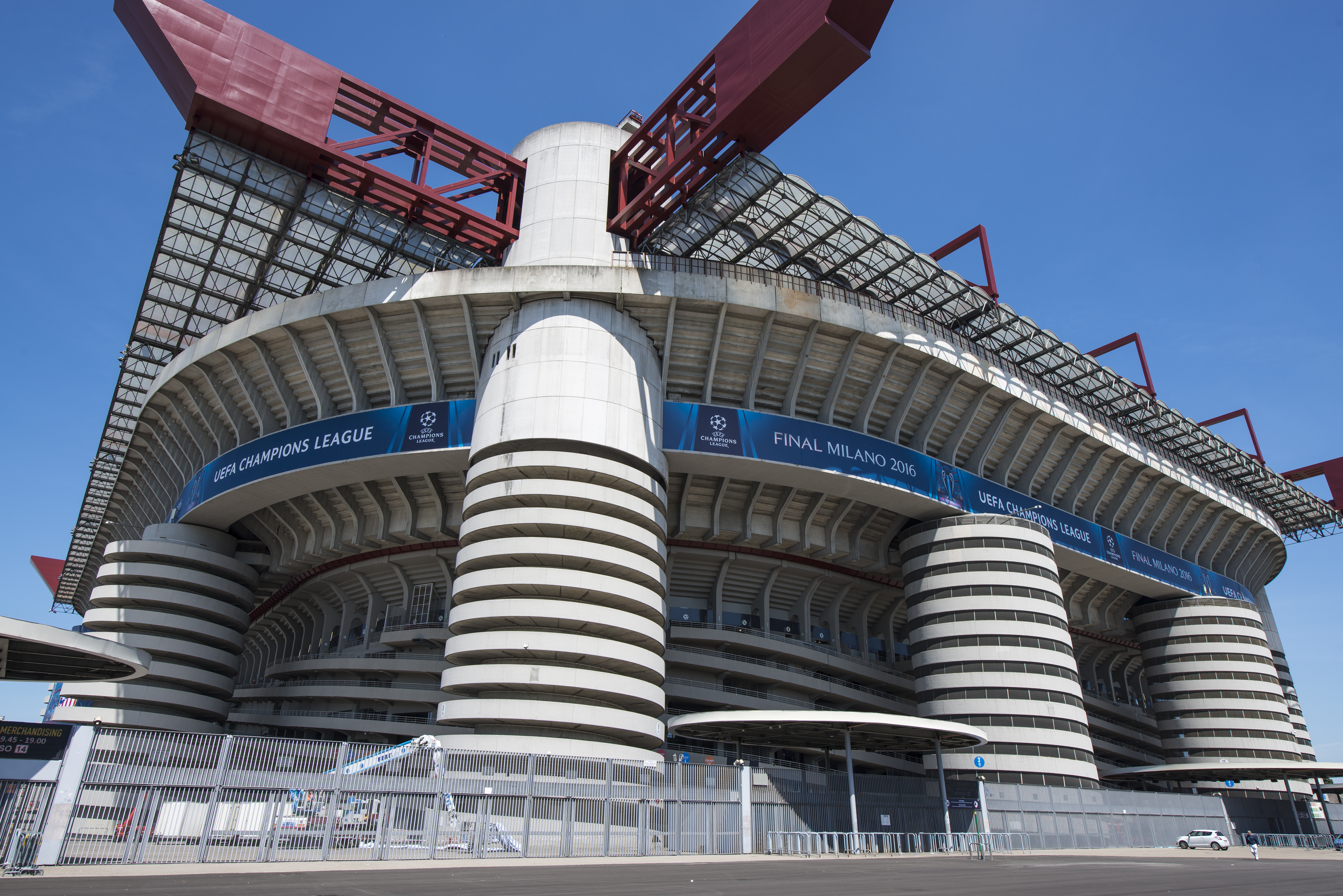
The original San Siro stadium
Source: Shutterstock/Arcansel
2018 predictions: Will the profession continue to be marginalised?