
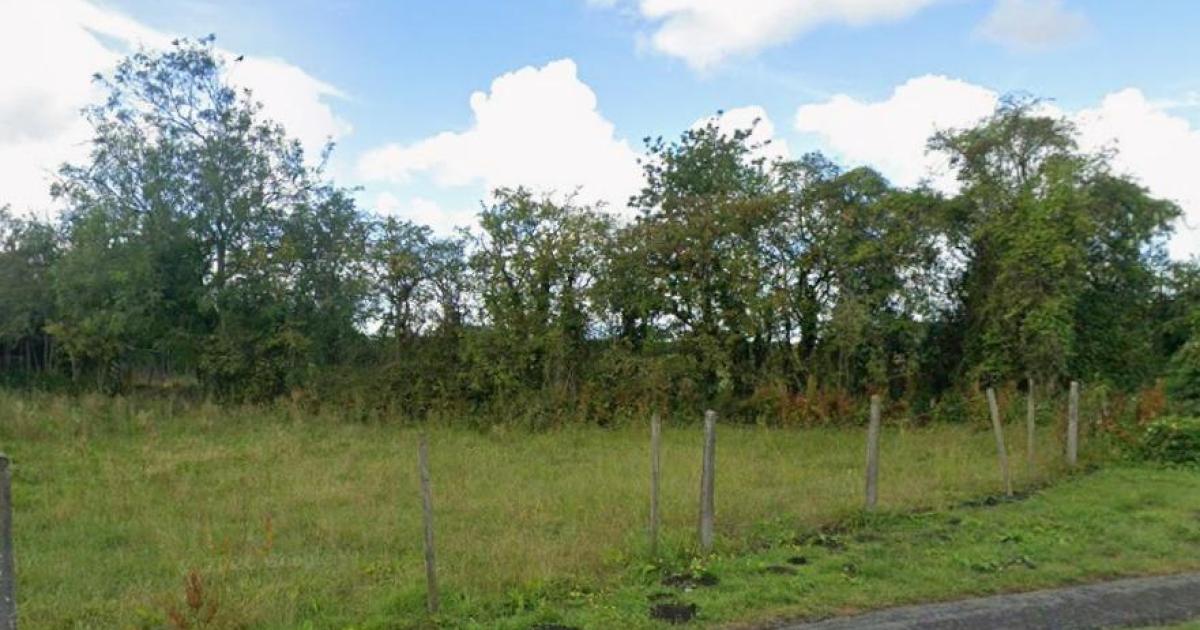
In June, it was reported that Culcheth residents were bracing themselves for the possibility of even more homes being built.
Residents were informed that a developer had begun early engagement and enquiries with parish councils over a new ‘large-scale’ development for land to the west of the village.
This is separate to a formal planning application being submitted by Peel Lane to build 200 homes on land at Turret Hall Farm in neighbouring Croft, which led to residents staging a protest.
The following month, Redrow Homes approached Warrington Borough Council for an environmental impact assessment (EIA) screening opinion request.
This is in relation to a potential future full planning application for the construction of ‘up to 450’ dwellings, along with open space and associated infrastructure, on land to the west of Hob Hey Lane in Culcheth.
An EIA screening opinion request is not a full planning application, and a screening opinion is issued by the council, if it is deemed necessary, to advise whether an EIA is required with a future planning application or not.
An EIA ensures that project decision makers think about the likely effects on the environment at the earliest possible time to avoid, reduce, or offset them.
Peel Land has also since issued a similar EIA screening opinion for a further 450 homes on land off Warrington Road in Culcheth, directly next to Culcheth High School and opposite the existing Story Homes development.
But the council has now ruled that the Redrow development does not require an EIA because it is well below the Government’s threshold of 1,000 homes for developments likely to have significant urbanising effects.
The council concluded that impacts relating to natural resources, waste, pollution, health, traffic, and the loss of agricultural land were unlikely to be significant and could be addressed through normal planning controls and mitigation measures.
A document submitted by Redrow as part of the application stated: “The approximately 19-hectare site comprises an irregularly shaped parcel of greenfield land currently in arable agricultural use.
“The surrounding area comprises a mixture of uses. To the east is the residential area of Culcheth.
“To the north is Leigh Golf Club, beyond which are agricultural fields and associated farm buildings, and to the west and south are agricultural fields and associated farm buildings.
“The applicant proposes to submit a planning application for up to 450 residential dwellings, including amenity spaces, landscaping, and associated infrastructure.
“Dwellings will be no more than three storeys in height.
“Two separate vehicular access points are proposed into the site – one from Clifton Avenue to the north-east of the site, and one from Swinehoe Place to the east.
“Pedestrian access will be provided alongside the vehicular access, with connections provided through the site, incorporating the existing public right of way.
“The proposed development will deliver open space and biodiversity enhancements and also incorporate a sustainable drainage system and other associated infrastructure.”
Culcheth and Glazebury Parish Council previously confirmed that Redrow Homes, through planning agents Lichfields, has made contact to begin early engagement on a potential planning application for land to the west of Culcheth.
“Residents will remember that this land has been considered before during the Local Plan process, and the community made its views very clear at that time,” a spokesman said.
“The parish council has consistently opposed large‑scale development on this site, and our position remains unchanged.
“This land sits outside the village’s defined settlement boundary, is valued greenfield space, and has repeatedly been shown to be unsuitable for major housing development.
“Concerns raised previously by residents – including pressure on local infrastructure, traffic, and road safety, the loss of green space, and the impact on the rural character of Culcheth – remain highly relevant.
“The parish council will therefore continue to represent the community’s long‑standing objections and will robustly challenge any future planning application brought forward for this site.”