
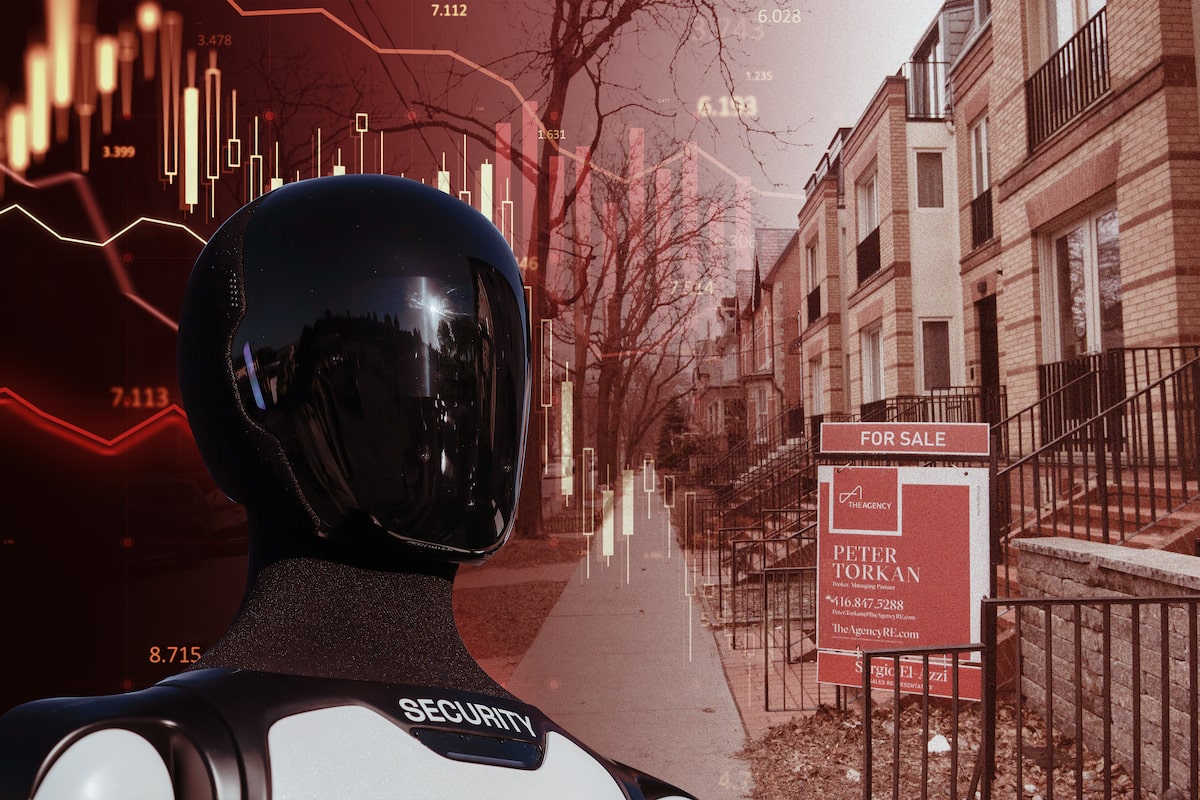
Photo Illustration by The Globe and Mail. Sources: Heather Diehl/Getty Images, Fred Lum/The Globe and Mail, iStockPhoto
There’s a lot to be frightened of in the global economy: soaring bond yields, trade wars and an artificial intelligence boom that could very well steal your banking information or your job.
Canadian mortgage holders got an early Halloween scare on Wednesday, when the Bank of Canada raised interest rates for the first time in three years, in what’s expected to be a series of hikes.
With so much risk on the horizon, Globe and Mail staff share what’s keeping them up at night.
Canada’s housing market is frightening
Few things are scarier than Canada’s ailing housing market. Adjusted for inflation, the typical national home price has plunged by roughly 33 per cent since a peak in early 2022. Some parts of the country (for example: Quebec City) have held up well, but others are in shambles. Home prices have cratered by 38 per cent in Greater Toronto and by nearly 45 per cent in the Oakville-Milton region from their highs in 2022. The latter has seen the biggest drop in the country, and the top 10 laggards are all in Southern Ontario.
Rising interest rates helped to douse the pandemic-era home-buying frenzy and kick off a prolonged slump. But just as the real estate industry was eyeing a rebound this year, mortgage rates are climbing and the Bank of Canada is back to raising interest rates. Strap in for an even longer slump. – Matt Lundy
Mortgage renewal jump scare
The great mortgage shock of 2026 has not proven quite as ruinous as many feared it would be. According to the Bank of Canada, arrears (or late payments) have remained low this year, meaning that Canadians generally weathered whatever shocks came their way from a wave of mortgage renewals five years after extremely low borrowing rates during the early pandemic.
Still, CMHC’s Annual Mortgage Survey estimates that 35 per cent of renewers this year are now facing higher payments – up by an average of $375 a month across all products.
Additionally, turmoil in the bond markets has some economists wondering if the great mortgage renewal wall of 2025-26 could be shifting into 2027. The Bank of Canada estimates that 12 per cent of mortgage holders will need to renew over the next 12 months, and their payments will increase by 15 per cent on average, and the CMHC estimates that delinquency rates will rise in Ontario and B.C.
Combine that with the economic uncertainty caused by a trade war, and 2027 could be a very scary year indeed for homeowners. – Dexter McMillan
The U.S. government’s heart-stopping debt spiral
The U.S. could be heading for a debt crisis as soon as 2028, according to a warning from BofA Securities rates and currencies strategist Meghan Swiber. In a report to clients, Ms. Swiber emphasized that the interest expense on U.S. federal debt – which recently crossed the US$40-trillion threshold – is compounding quickly as borrowing costs climb.
The strategist estimates that current government borrowing costs are about 100 basis points or one percentage point above the Congressional Budget Office’s baseline expectations. The higher rate would add US$4-trillion to interest costs in the next decade.
Debt crises occur when the interest expense grows faster than nominal GDP. More bond issuance is required to make interest payments and this borrowing adds to interest costs, requiring more issuance, and the debt spiral accelerates. This is not a problem yet – U.S. growth remains strong – but as higher borrowing costs slow GDP growth, Ms. Swiber’s warnings become more salient. – Scott Barlow
A chilling look at AI’s potential job impact
As artificial intelligence models become more powerful, there is some good news in the labour data about the feared AI job apocalypse. Unless you’re a young worker, that is.
The Digital Economy Lab at Stanford University has been tracking the effect of AI on the U.S. job market, where adoption of the technology is further ahead than in Canada. So far, the lab’s latest report found, there is no evidence of AI causing widespread job displacement across the economy.
However, the lab has detected signs that workers in their early 20s in AI-exposed occupations are suffering. Employment among workers in those sectors (such as software developers, customer service reps, translators, tax preparers and writers) is now 19 per cent below where it would have been if they’d kept pace with workers the same age in less-exposed jobs. The lab’s report states that it’s still too early to draw a causal link between AI and the employment weakness, but warns these entry-level workers may be the “canaries in the coal mine” – the first to be affected by AI adoption. – Jason Kirby
Are Ottawa and the provinces headed for a debt scare?
When the federal government releases its 2026 budget next week, the outlook for the national debt will draw plenty of scrutiny. But Ottawa is far from alone in piling on debt at a frightening pace. Across the country governments have fallen deep in hock, driven by heavy spending and rising interest costs.
When measured by gross debt as a share of gross domestic product, the combined financial obligations of Canadian governments are getting perilously close to the levels in the mid-1990s, when the country experienced a fiscal emergency brought on by heavy borrowing, a sluggish postrecession economy and soaring interest costs.
On a net debt basis, which subtracts governments’ financial assets, the figure looks considerably better. Canada boasts the lowest net debt in the G7 – particularly when compared with the U.S. – and it’s a point the federal government highlights at every opportunity. But gross debt is what must be refinanced as interest rates rise, as they are now. – Jason Kirby
Decoder is a weekly feature that unpacks an important economic chart.