
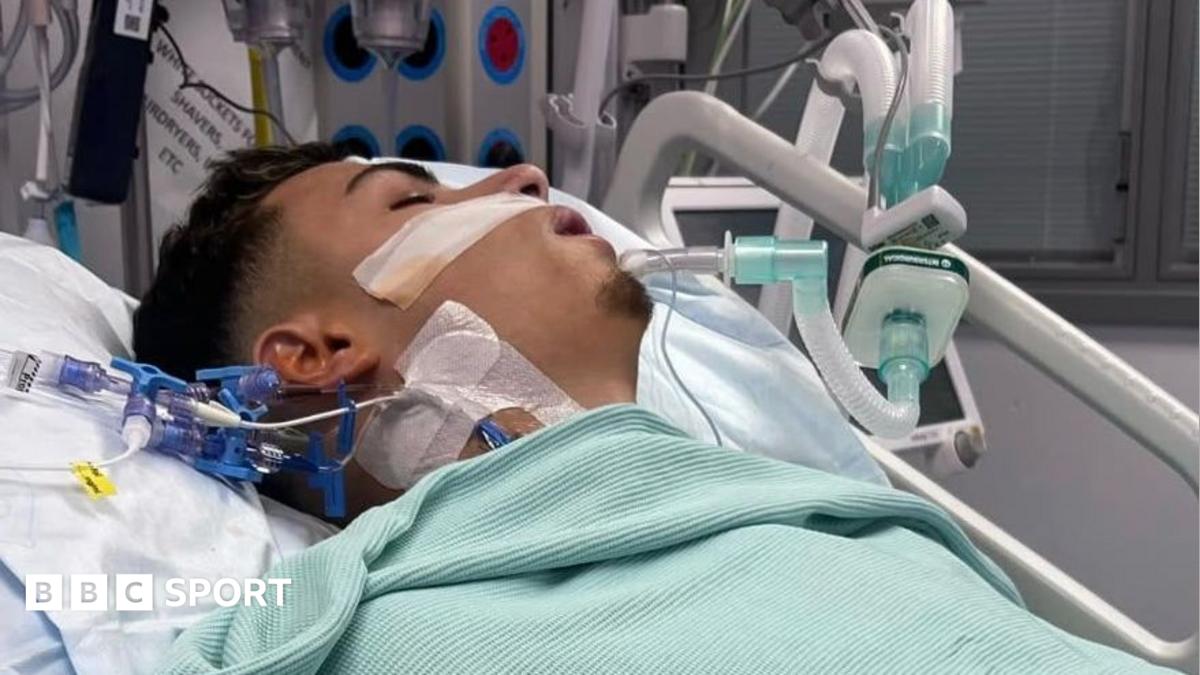
In January 2025, Williams underwent valve-sparing aortic root replacement surgery, followed by a dual-chamber pacemaker implantation.
But complications meant he was admitted to an intensive care unit (ICU) and treated for sepsis, a collapsed lung and respiratory failure.
After 11 days in ICU, Williams recovered and underwent a second, successful operation in September 2025, which he hoped would allow him to continue playing.
“When I got back, I couldn’t perform at 100%. I would sprint up the pitch, and I’d feel gassed, out of breath, and my legs were heavy,” he said.
“Initially, I thought it was my fitness after returning from a second heart surgery.
“But I had heart failure. My ejection fracture percentage was only 37%, meaning my heart was not pumping as well as it should be.”
Most fit and healthy adults will have a left ventricular ejection fraction (LVEF) that ranges between 50% and 70%.
Williams was given medication to combat his LVEF – he now takes five tablets every day – and was fitted with an upgraded pacemaker.
“I still didn’t feel 100%. Again, I thought it was my fitness, but I was still feeling the same two months later when I should have been back to normal.”
A recent echocardiogram showed practically no sign of improvement. Williams’ LVEF had only increased to 38%.
“That’s when I decided that I will have to stop playing because I couldn’t carry on physically with how I felt,” he said.