
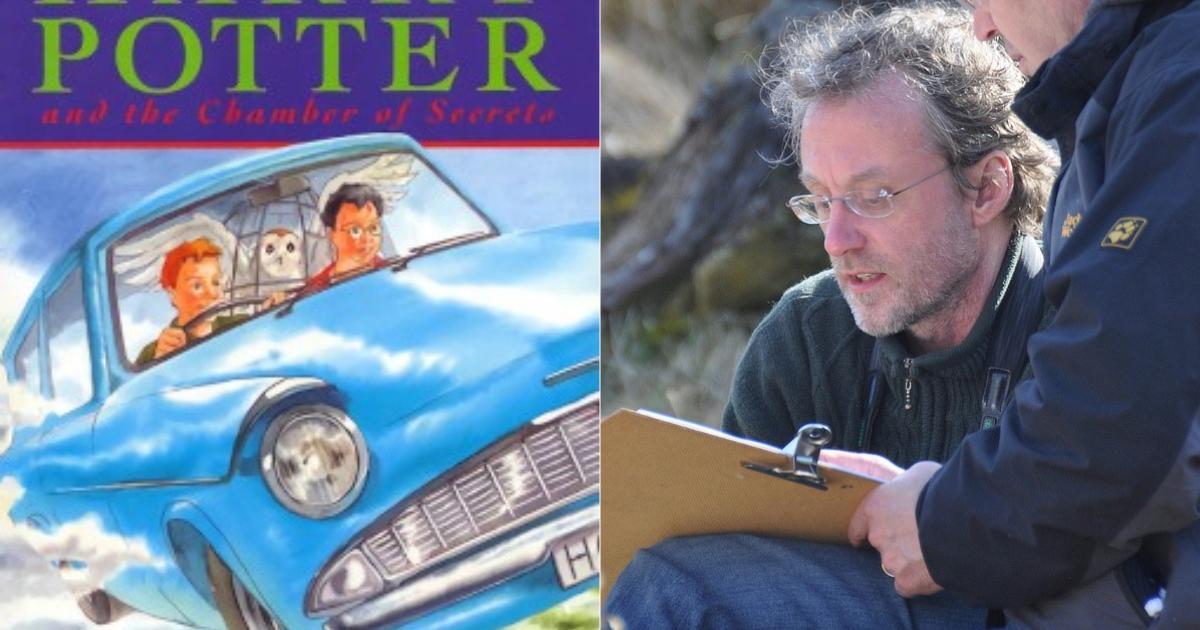
But few will know that the man responsible for bringing that magical scene to life grew up on the clifftops of Newhaven, where he lives to this day.
Cliff Wright, 63, is the artist behind the original covers of Harry Potter and the Chamber of Secrets, and Harry Potter and the Prisoner of Azkaban.
When he was first approached to illustrate the second book in JK Rowling’s series – which was published in 1998 – he had little idea of the extraordinary phenomenon it would become.
“It was just another job because,” he said. “There was none of the Harry Potter hype that there is now.”
Cliff’s cover for Harry Potter and the Chamber of Secrets, which was published in 1998 (Image: Wikimedia)
By that point, Cliff had already established himself as a successful children’s book illustrator, having spent years building a career after graduating from Brighton College of Art in 1986.
Publishers commissioned him to illustrate the second Harry Potter book, giving him a relatively loose brief and suggesting a passage from the story for the cover.
The resulting illustration, featuring Harry and Ron Weasley flying the enchanted Ford Anglia, would become one of the defining images of the series.
But creating it presented some unusual challenges.
“I’m no car expert,” Cliff admitted.
“I had to do some research to get flying angles of Ford Anglias. And you couldn’t find many pictures of Anglias flying, obviously, because that’s magic.
“So that was a challenge.”
Cliff has spent many years teaching drawing and giving workshops around the world (Image: Cliff Wright)
The final painting, an A3-sized watercolour, was produced following a series of exchanges with the publishers and author JK Rowling.
“I would get comments from her via faxes to the publisher, which were then passed on to me,” he said.
“I remember one about a castle that was going on the back cover. After a first rough drawing I’d done, the comment came back from JK Rowling that the castle wasn’t ‘shambolically turreted’ enough.
“I put many more turrets on after that.”
Although the character would later become one of the most instantly recognisable fictional figures in the world, another challenge was deciding what Harry Potter himself should look like.
“The character descriptions are limited in the book,” Cliff said.
“All we’re really told is that Harry has dark hair, a scar on his forehead, and heavy-rimmed glasses.
“In terms of inventing the character, that was all left to me.”
Cliff’s cover for Harry Potter and the Prisoner of Azkaban, which was published in 1999 (Image: Wikimedia)
Cliff went on to illustrate the cover of the third book, Harry Potter and the Prisoner of Azkaban (1999), featuring Harry and Hermione riding the hippogriff Buckbeak.
It was following that book’s publication that he began to grasp the extraordinary scale of the phenomenon he had become involved in.
“Once that third book was published, it was breaking records all over the world and people were queuing in bookshops like they never had before,” Cliff recalled.
“That was when I realised.”
More than two decades later, his illustrations remain familiar to generations of readers around the world.
In recent years, Cliff has been taking commissions for portraits in the style of his famous Harry Potter illustrations (Image: Cliff Wright)
For Cliff, the experience is still slightly surreal.
“It’s really odd,” he said. “It’s amazing. You can’t tell that’s going to happen when you create the piece.
“And to be honest, it isn’t the best work I’ve ever done. But it’s easily the best known.
“It’s very strange how these things happen. I look back on it with fondness because that work is recognised all over the world.”
He remembers travelling to Nepal shortly after the publication of the third book and discovering just how far his artwork had travelled.
“I was in the middle of the mountains, in the middle of nowhere, signing kids’ books,” he said.
“It was just bizarre. And of course wonderful as well, at the same time.”
A self-portrait of Cliff, who said growing up on the clifftops in Newhaven inspired him to draw as a child (Image: Cliff Wright)
Despite his place in Harry Potter history, Cliff is not overly devoted to the wizarding world.
“I wasn’t particularly into the first two books,” he said. “But I did think the third one was a good read and a good page-turner.
“Then I got 50 or 60 pages into the fourth book and got bored to death.
“So I never read the rest of them.”
Long before Hogwarts entered his life, Cliff’s artistic imagination had been shaped by the natural landscape surrounding his childhood home in Newhaven.
Growing up on the clifftops, he spent much of his time exploring the countryside and observing wildlife – interests which have remained with him throughout his life.
He began drawing from an early age, despite having no particular family background in the arts.
Harry Potter author JK Rowling, who gave feedback on Cliff’s illustrations throughout the process (Image: John Mathew Smith)
Between 1982 and 1986, Cliff studied at the Brighton College of Art – now part of the University of Brighton – before embarking on a laborious journey into professional illustration.
For more than two years, he travelled regularly to London, sometimes visiting three or four publishers in a single day.
One idea in particular – a children’s book he had written and illustrated himself – began attracting interest.
He eventually secured a deal for When the World Sleeps, which was published in 1989 and was named runner-up for the Mother Goose Award for best debut.
Cliff was immediately offered a second book by the same publisher, and never looked back.
His artistic talents have also found an outlet in one of Sussex’s most distinctive traditions: Lewes Bonfire Night.
Over the years, Cliff has helped create some of the enormous effigies, specialising in caricature heads.
Cliff spent a number of years working on effigies for Lewes Bonfire Night, designing heads for figures including Osama Bin Laden
Among those he has depicted are Osama bin Laden, George Bush, Peter Mandelson and Gordon Brown.
“I loved being involved,” he said. “It’s nice to build something that you give to somebody else who fills it with fireworks and blows it to pieces.
“It’s a good way of letting go of your artwork.”