
Elena:
I knew 100% I wanted to work in football. Football’s been my life since I was a kid, so I was willing to do whatever it took to get into the industry.
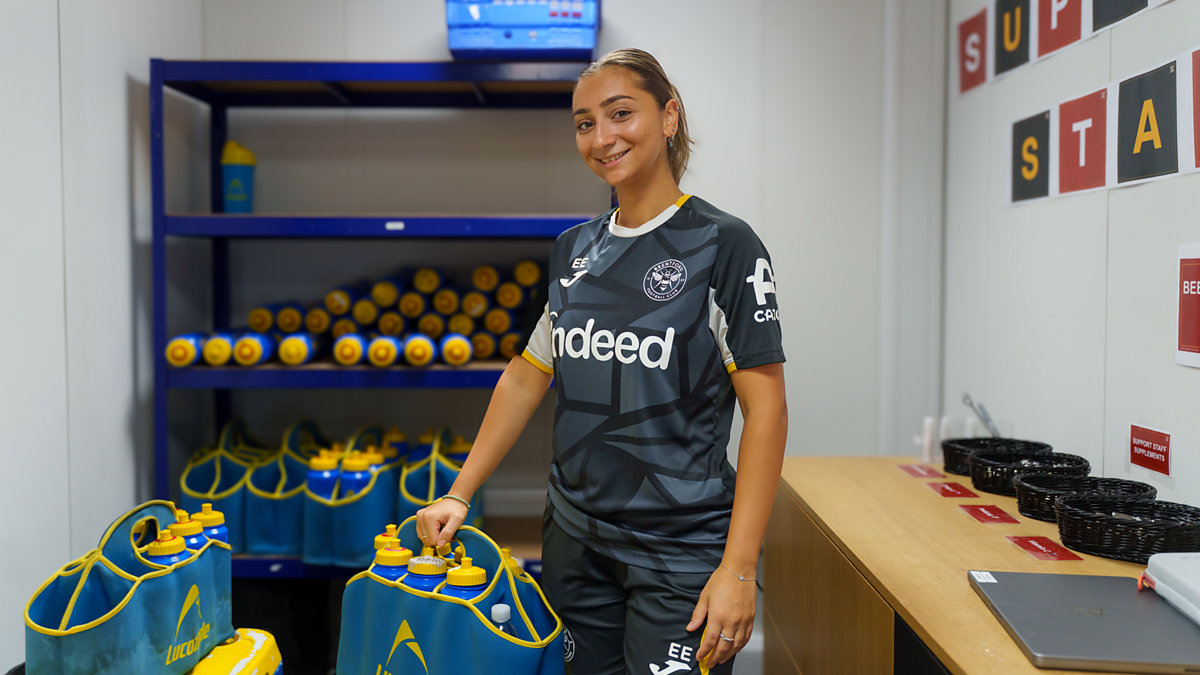
I’m Eleanor Efstathiou, and I’m the first- team nutritionist at Brentford Football Club.
My role includes making players the healthiest they can be to maximise how many games they play during the season, and also their performance on the pitch. I help structure what is available to the players, both from a food point of view and a drink point of view. This will help fuel their harder sessions and help give them enough energy for games. Not only will it do that from a performance point of view, but it will also help with their recovery overall.
I’ve been massive on football as long as I can remember. I used to play myself.
Spectator (out of vision):
Watch number nine. Someone…Oh, well done. Well done, well done.
Elena:
I used to go to watch Spurs games with my dad because he was a big fan. And then at university, I got my placement in nutrition and football, and then from there, it’s just led me to where I am today.
I start my day with all the preparations for the day, initialling things up. I’ll put that all out in the canteen area for the players to see and have access to. And then I’ll head right into the canteen and just have those chats with the players in terms of what is most important for them from the breakfast area to fuel their training sessions ahead. I might be working with a player on their hydration status.
Elena to footballer:
So we’ve got a bit of a hydration test today, don’t we?
Elena:
We also have an igloo full of energy drinks and gels and can help fuel those sessions which are more energetically demanding.
The skills you need to do my job as a nutritionist are mainly soft skills. You need to be approachable. The players need to feel comfortable with you to come and ask you for questions.
You need to display a lot of care so that the player will trust you when you’re speaking to them, because ultimately, every nutritionist can have the knowledge. It’s the way you translate that knowledge to the players. You don’t want it to be too overbearing for them.
You want to drip-feed information in a nice, relaxed, and informal way.
I was quite big on the sciences at school, and then when it came to choosing university options, I knew Loughborough was one of the best to go to for sport. So I studied human biology, and I got my chance to also play football at Loughborough, which was really cool.
I got my first undergraduate placement at Nottingham Forest in the academy. So I went up to the first team at Nottingham Forest, and it gave me a larger perspective on nutrition.
After Nottingham Forest, I came back down to London and I got on a sport and exercise nutrition master’s course.
So I applied for a job, and it was at Watford Football Club, and I actually was successful. So I had a part-time job during my master’s program. I started to work more with the development players going up to the first team.
It was going really well for me, and then the Brentford role came out, and I was so excited. I feel like, “Oh, yeah, that’s perfect, I get to be in the first-team environment again, Premier League, living the dream.”
I applied for the job at Brentford, and yeah, I got the job.
It’s a small world, football. The more connections you make and the sort of impressions you make on people, they do really matter, and they can give you those opportunities and open doors.
For instance, I went to a conference at West Ham, and I met someone there and we were on the same table, and now that person is my boss.
Any work experience, any placement you can get, it’s all worth it. Any day that you do spend in an environment, you do get something out of it, whether it’s a conversation with someone or something you’ve heard that changes your perspective or it’s something that you absorb in terms of your learning.
Anything you can do from your own back, taking your own initiative, it will help channel you into a better place long-term.
I think it was my first home game that I worked, and it was against West Ham, and we won, and it was also a time where aplayer came back from a really long-term injury, and the emotion that I felt in that dressing room, it was unbelievable.
Even if I played the mini part of that player’s rehab, you feel so part of a team, and it’s an unbeatable feeling and thing to witness and experience.
I 100% recommend working as a nutritionist in football. There are rewarding factors, whether you’re at the academy level, first-team level. There’s small wins, there’s making a difference, and you can see that difference being made, and there’s nothing better than actually knowing that you’re helping someone and doing a good thing for someone’s career.
To find out what other careers you can have in football, explore the BBC Bitesize Follow Your Passion collection