
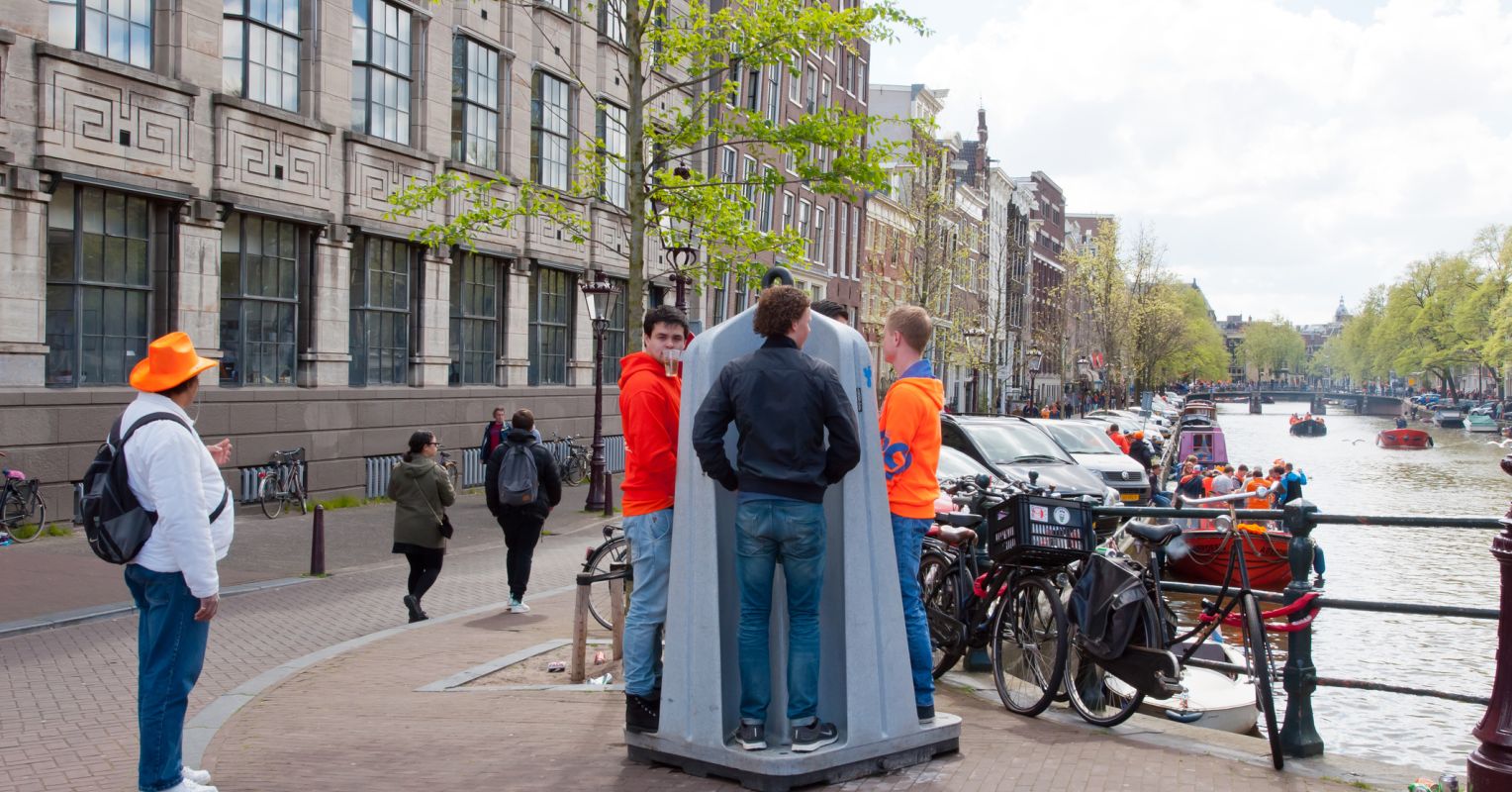
On a recent trip to Amsterdam, I was surprised to find urinals prominently placed on public streets. These were designed in such a way that a man could simply stroll up to it, unzip, and relieve himself without having to reveal his penis to anyone else on the street. And no one seemed to care or be offended or embarrassed!
This started me wondering why bathroom and locker room etiquette in the U.S. has changed so much even over my lifetime. When I was growing up, it wasn’t uncommon to find urinal troughs in public restrooms, men standing side by side relieving themselves while running water flushed away the used beer they drank. After sports competitions and in workspaces requiring heavy physical labor, men showered together side by side in group showers that held a dozen showerheads.
Did men sneak a peek at the others who were there? Most likely. After all, we are a curious bunch, and we spend much of our lives comparing ourselves to others in numerous ways. Such evaluation appears to be hardwired into us, part of our survival mechanisms, perhaps. More men look than are willing to admit it, and looking doesn’t automatically mean sexual attraction.
Apparently, though, it does to some men.
A while ago, I created a video on social media about urinals and men sneaking peeks and began reading men’s subsequent comments. Some said it is a boundary, a moral violation, and wrong for another man to look. Others found it humorous, where men joked about not minding being looked at … “just don’t wink” at them. Still others said that some men do engage in sexualizing the experience, finding it erotic to be in a space to be able to view another man’s penis.
There were many comments saying that it is an invasion of privacy to look at another man and goes against another man’s consent. The issue is that a urinal without partitions is a semi-private space. You can reasonably expect other men not to stare at or harass you, but you can’t reasonably expect that no one will ever see or glance at your body. Privacy and invisibility aren’t the same thing. The question is whether a glance constitutes an invasion.
In no way does this defend intrusive behaviors, but we need to challenge the idea that seeing, looking, nudity, sexual interest, and harassment are all interchangeable. They are not.
Homophobia
Some men in the video’s comments believe it is a result of homophobia that men are so skittish in locker rooms and at urinals. Is that where some of the intensity comes from in the comments when they refer to a glance in the restroom as “perverted,” “disgusting,” “creepy,” or “sexual harassment”? Homophobia could be at issue for some men who may think that being seen by another man carries an implied threat: What if someone thinks I like it? Or what if that guy is looking at me sexually? The anxiety isn’t about nudity alone. It is about being placed in what feels like to them a homoerotic situation.
And there are men who simply have a strong preference for bodily privacy. You can want privacy without turning another man’s glance into pathology.
Locker Rooms
In his article “On the Loss of Nudity in the Men’s Locker Room” in the Journal of Psychological Perspectives, Barry Miller examines how men’s locker rooms have shifted from places where male nudity was ordinary toward modesty, distancing, and discomfort with seeing and being seen, and considers gay liberation among the cultural influences involved.
Something strange has happened in recent decades. In the broader culture, beyond military barracks and professional sports locker rooms, we appear to have become quite sensitive and rather shy about our bathroom etiquette. Where urinals still stand side-by-side, there are now metal partitions blocking any sort of glimpse of the penis of the man a few feet away. Newer restrooms are even being built with urinals in between sit-down stalls so that there is not even proximity between urinating men.
In a space designed for changing and showering, when and how did we become so insecure about our masculinity, so “modest” that we’re afraid of being seen unclothed? This doesn’t feel to me like a healthy direction for men in our society.
Some men in the comments to my video said that the locker room is not a place to “flaunt oneself,” which assigns sexual intent to ordinary nudity.
There definitely is a difference between Gen X, younger men, and boomers. In my experience, boomers often have no body shame and walk around without towels and even casually start talking to other men while naked like they are dressed. Younger men put a towel around their bodies before taking off their underwear.
Men vs. Women
Women often talk to each other while in public restrooms. Men? Almost never.
When in public places, women often will ask a female friend to accompany her to the restroom. Men? Never.
I always joke that a woman can say to another woman, “I have to use the restroom; would you like to come with me?” and often the other woman will. If a guy says to another guy, “I have to take a leak. Do you want to come with me?” he would be looked at suspiciously.
We seem prone to further isolation and less openness about ourselves and our bodies than our predecessors. Anthropologists have argued that men’s restroom etiquette is a ritual of masculinity. It demonstrates that “I’m not looking at you,” “I’m not interested in you,” and “I’m here for one purpose.” These norms communicate respect and emotional distance, removing any anxiety about being confronted with challenges to one’s sexual identity.
Shy Bladder Syndrome
Some men experience shy bladder (paruresis) and can’t get their urine stream started in the presence of other men. One study (there are very few such studies) suggests that such personal space invasions produce physiological changes associated with arousal. Could it be that homophobia (in these cases, suppressed attraction/arousal) is behind the growing emphasis on distance and privacy in restroom and locker rooms? Right now, we have no evidence to support this idea.
Shame and comparison surrounding penis size have been suggested as reasons for this movement toward “modesty” in our restroom culture, but why would this phenomenon be rising in our culture now? Could this help explain all the hysteria around trans people using the correct restroom?
Right now, the only thing of which I am convinced is this: Talking openly about things like this can be successful at decreasing a person’s shame about them. So, I would encourage other men to share their experiences about restroom etiquette.
But the simplest solution for everyone would be just to use a stall. Then none of this becomes an issue. But I do find it curious.