
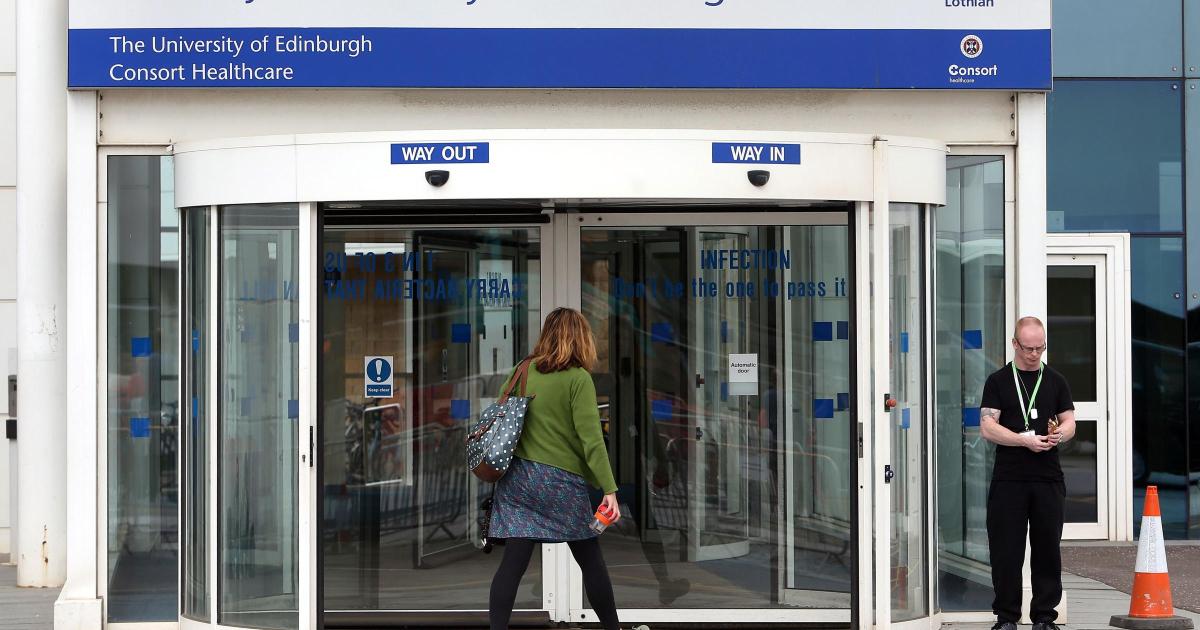
That is significantly above the highest grade in NHS Scotland‘s executive and senior management pay scale.
A circular issued by the Scottish Government in December 2025 revealed that all NHS executives would receive a 4.25% pay hike from April 1, 2025.
On top of that, every senior NHS manager can receive an extra 1% to 3% depending on the result of their annual performance rating.
A second circular, issued in February, shows that it is 1% for an “incomplete” rating, 1.25% for “fully acceptable”, 2% for “superior” and 3% for “outstanding”.
Anyone rated “unacceptable” gets nothing.
The document also makes clear that however good the rating, “no employee will receive more than the maximum consolidated salary for their pay range”.
This means if someone is £1,000 below the top and earns a 3% rise worth £6,000, they should only get £1,000.
In Prof Hiscox’s case, the most this system could give her is the 4.25% uplift plus 3% progression.
That works out at about £209,000–£215,000 on her old salary, and never more than £216,921, the top of Grade I. Her reported £225,000–£230,000 is far above that ceiling.
Earlier this year, BBC Scotland reported that Prof Hiscox and Prof Jann Gardner, chief executive of NHS Greater Glasgow and Clyde, had been given temporary 10% pay increases worth up to £20,000 a year for leading the new sub-national planning and delivery committees.
Both boards confirmed the uplifts were in place under NHS Scotland guidance on paying staff who take on temporary additional responsibilities outside their own board.
However, unions criticised the payments, pointing out that their members regularly took on extra responsibility without extra pay.
Following the backlash, then Health Secretary Neil Gray asked boards to suspend the supplement “pending full evaluation of these roles”.
A 4.25% uplift and a 10% supplement paid for the whole year on a salary of £195,000–£200,000 would come to about £224,000–£229,000, which is in line with the figure in the NHS Lothian accounts.
The Tories said there were questions about whether Prof Hiscox did receive “this hike in her income, despite the intervention of the then SNP health secretary”.
A 10% supplement for the three months the extra responsibility payment was in force for would come to about £5,000. Added to the 4.25% uplift and the highest rate of progression, it would take Prof Hiscox salary to about £220,000 at most.
The remuneration report carries no note explaining Prof Hiscox’s salary bump, though it does for some other senior figures.
The accounts explain the salary of the board’s chair, Prof John Connaghan, includes between £20,000 and £25,000 a year for additional duties.
Local MSP and Conservative health and care spokesman Miles Briggs said there were “serious questions” to answer for both the board and the government.
He said: “Scots being hammered by the cost-of-living crisis will wonder if a top NHS boss did receive this hike in her income, despite the intervention of the then SNP health secretary.
“Given the huge backlogs in NHS Lothian services, they must come clean on whether this inflation-busting salary got the green light and the justification for doing so.
“After the well-publicised suspension of these bonus payments, taxpayers deserve to know if any secret backroom deals were struck after all.”
Tom Power, Director of People and Culture at NHS Lothian, said: “NHS salaries and pay rates are set nationally and conform to Scotland’s national Public Sector Pay Policy. We do not comment on the salaries or employment details of individuals.”
A Scottish Government spokesperson said: “The salaries of NHS Scotland Chief Executives are independently assessed and reflect their roles as leaders of large and complex public sector organisations providing vital public services. Scottish Ministers have not sanctioned any pay raises above the nationally published pay rates.”
John Swinney has announced plans to reduce the number of health boards from 14 to two. (Image: Robert Perry/Getty)
Prof Hiscox, a nurse by background with more than 30 years in clinical and senior leadership roles, became NHS Lothian’s chief executive after three years leading NHS Grampian and a spell as interim chief executive at NHS Tayside.
Soon after she joined, the Scottish Government directed health boards to organise themselves into two sub-national planning and delivery committees.
SPDC East is led by Prof Hiscox and takes in NHS Lothian, Borders, Fife, Forth Valley, Tayside, Grampian, Highland, Orkney and Shetland.
NHS insiders believe the committees are also the model for the government’s plan to cut the number of territorial boards from 14 to two, one for the east and one for the west.
The Cabinet decided on Wednesday August 27 to cut the number of boards, and John Swinney announced it in his Programme for Government in September. One board would cover the west and one the east, with separate arrangements still to be confirmed for Shetland, Orkney and the Western Isles.
Last week, The Herald revealed ministers are merging the boards without a business case.
Internal papers prepared for the first meeting of the NHS Simplification Programme Board on October 22 show the outline business case will not be finished until March 31, 2027.
A formal risk assessment dated October 20 scores the danger of delays, higher costs and instability at 200, against a target of 75 by June 2028. That is more than two-and-a-half times the acceptable level.
Ministers will make the reforms using secondary legislation under existing powers, which the 1978 NHS Act allows as long as there is more than one territorial board.
A single national board would have needed primary legislation and full parliamentary scrutiny.
The Public Bodies (Joint Working) Act 2014 still applies, so the new boards must negotiate integration schemes with all 32 councils.
Officials warned that a phased transition would be safer than a “big bang”, and board chiefs asked for regular updates to avoid an “information vacuum”. One insider put a realistic completion date at 2028 or 2029.