
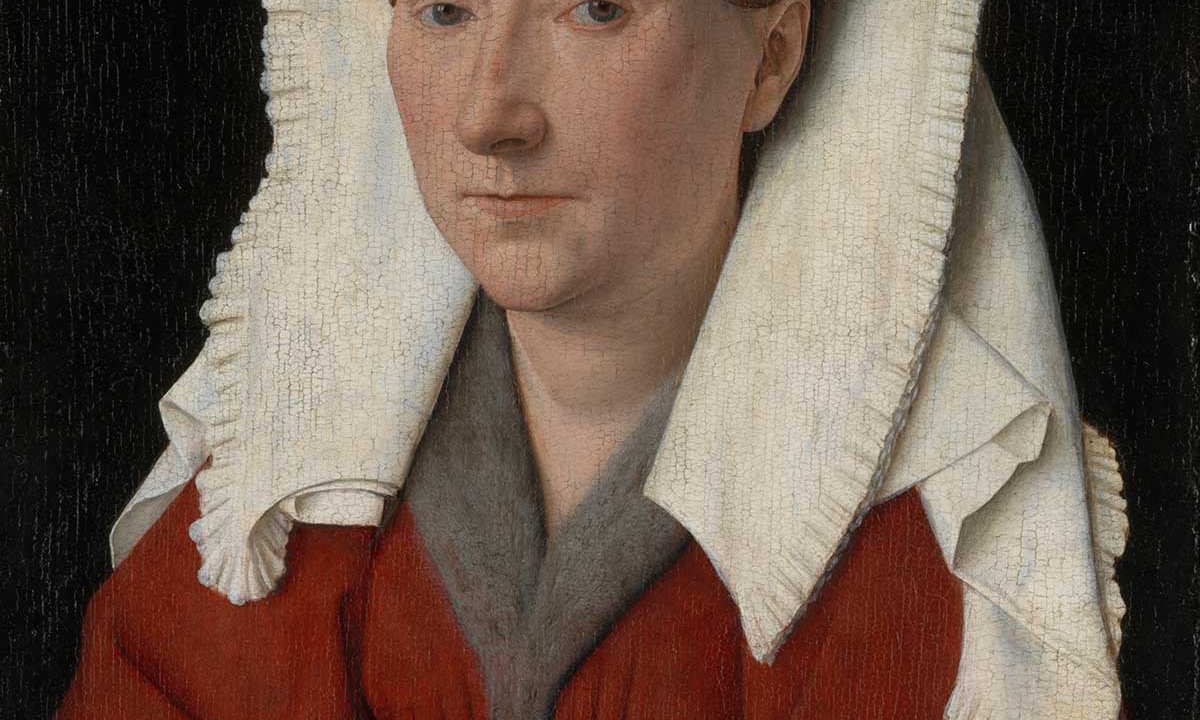
There is a lot we do not know for certain about Jan van Eyck, including where and when he was born. What we do know is that his career—from the early 1420s until his death in 1441—helped launch the Early Netherlandish school, influencing the use of oil paint far beyond his native Low Countries and instilling a new and arguably everlasting value of verisimilitude in Western art.
But we stand to know a lot more about him this month, when London’s National Gallery brings together all nine of his surviving panel portraits along with his lone surviving drawing, also a portrait. The bijoux blockbuster show will give scholars a unique opportunity to compare scattered works of singular importance. Van Eyck: The Portraits—with a checklist that expands all the way to 13 through the addition of three works on paper by his followers—is built around some remarkable pairings.
Fresh from a conservation treatment completed in 2024, the National Gallery’s own Portrait of a Man (Self-Portrait?) (1433) will meet up with Portrait of Margaret van Eyck (1439), the artist’s wife, on loan from Bruges, where Van Eyck had his workshop when he was the court painter to Philip the Good, Duke of Burgundy.
The National Gallery’s Arnolfini Portrait (1434), Van Eyck’s enigmatic view of an elegantly dressed couple in an impressive reception room, will be shown for the first time with its related work from the Gemäldegalerie in Berlin clearly showing the same man, Portrait of a Man (Giovanni Arnolfini?) (around 1435-38).
Vienna’s Kunsthistorisches Museum is loaning Portrait of an Elderly Man (A Scholar?) (around 1438). It will be shown with the preparatory drawing from Dresden, in goldpoint and silverpoint on prepared paper, with its revealing notes on how to colour the painting itself.
Van Eyck’s devotional portraits, such as those in his groundbreaking Ghent Altarpiece and the Musée du Louvre’s recently treated Madonna of Chancellor Rolin (around 1435), are outside the scope of the National Gallery exhibition.
Some of the portraits have reverse imagery of fictive marble, and the museum is placing them in cases so visitors can view both sides. “We’re really excited to be able to show people how amazing the reverse is,” says Nicholas Flory, who is curating the show along with Emma Capron, the museum’s curator of early Netherlandish and German painting. Flory says the elaborate reverses suggest that “these objects were not designed for a single kind of specific space or to be flat against the wall”, but rather “to be interacted with”.
Newness abounds in the show. The Arnolfini Portrait had long had an ornate Gothic Revival frame until it was replaced in 2024 by a 15th-century gilded frame. Meanwhile, the Berlin work, showing its male figure in distinctive red chaperon headgear, completed a conservation treatment in 2023 that removed distorting yellow varnish. The result of that treatment, says Stephan Kemperdick, the curator of Netherlandish paintings before 1600 at the Gemäldegalerie, has been to “make the palette cooler”. Before, he says, the chaperon was “fire-engine red”, and the man’s face looked “suntanned”, whereas now, he says, the face is “pinkish or whiteish—a feature that distinguished people from the better classes in the 15th century”.
The London exhibition, which Kemperdick calls a “once-in-a-lifetime” event, is a culmination of sorts. Several Van Eyck works, including the Ghent Altarpiece, have undergone recent treatments, which Flory says has been “an impetus in Van Eyck scholarship”, and the National Gallery show reflects new research into Van Eyck’s technique, his original frames and inscriptions. Recent analysis of the National Gallery’s self-portrait, examined during its recent treatment, revealed how Van Eyck modulated the blueness of the background in the lower-right corner to “throw the sitter’s shoulder forward”, Flory says, creating a 3D effect.
Arnolfini not Arnolfini?
Just out of view of the show itself, lurking in Kemperdick’s catalogue essay, is a possible bombshell: that the couple shown in the Arnolfini Portrait are not the titular Italian merchant and his wife at all, but rather Van Eyck and his wife. This would also mean that the Gemäldegalerie’s Portrait of a Man (Giovanni Arnolfini?) is also a self-portrait.
The Arnolfini Portrait is among the gallery’s most popular works, and the minuscule size of the show is in marked contrast with the likely museumgoer interest. However, Flory says the diminutive roster is, in fact, the big attraction.
“There was the possibility to expand it beyond Van Eyck and show his work in the context of his contemporaries,” Flory says. “But because he is such a monumental figure in the history of Western painting, and his portraits are so special, we really wanted to focus the exhibition on just Van Eyck himself.” Luckily, he adds, the remarkable loans, which have involved several museums sending some of their most precious works, mean “we got everything we were hoping for”.
• Jan van Eyck: The Portraits, National Gallery, London, 21 November-11 April 2027