
This is the second in a multipart series examining gambling and sports in Western Pennsylvania.
In February 2022, Rob Minnick was sitting on a toilet in a Paris hotel room, thumbing through his phone.
He was 23 and told himself he was going to be a professional gambler, previous debts be damned. He was going to make money — a living — from sports betting. He was going to get good at this. A big win had funded a lifelong dream of traveling the world, and the first stop was France.
Minnick had touched down in the capital, arrived at his hotel and, within 10 minutes, retreated to the bathroom, where he was gambling on a slot machine in his casino app. Not long after, still sitting there peering down at the fluorescent screen, the leftover money he had stashed away — a substantial sum he said, declining to share specifics — was gone.
“Usually you have moments of clarity after you make the terrible decisions,” said Minnick, a native of New Jersey and gambling addict in recovery. “So on that day I was sitting there, and I was looking at the phone like, ‘Why did I just do that?’”
This story discusses suicide. If you or a loved one are having thoughts of suicide, call or text 988, or use the online chat option at http://988lifeline.org/chat.
Minnick had started gambling at 18, beginning with daily fantasy sports and later migrating to casino games and sports betting on crypto sites. Once, in 2018, he emptied his balance wagering on spring training baseball.
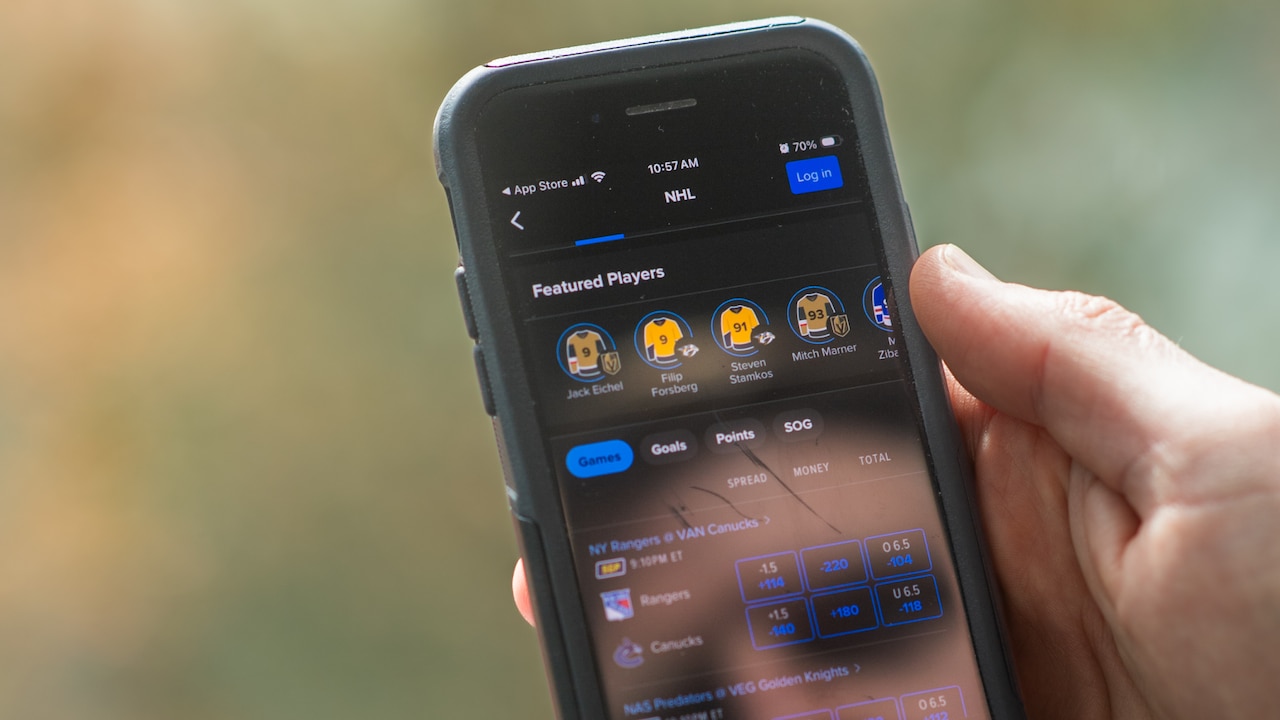
Young people around the country have been increasingly engaging in gambling and sports betting through apps like FanDuel and DraftKings, which, across their collective platforms, claim tens of millions of active users. Last year, those two companies alone generated more than $13 billion in combined revenue.
In no small part, the trend is being driven by young men. The reasons for the rise are numerous — and include ease of access, as well as a lack of financial literacy and legislation.
At the same time, research has identified a nationwide trend in growing rates of addiction and suicide, and the Post-Gazette found those themes repeatedly raised in interviews with more than a dozen people involved in gambling in the Pittsburgh region and beyond.
Multiple individuals interviewed cited concerns about the design of sports betting platforms, alleging they deploy intentionally addictive technology to keep bettors active.
A DraftKings spokesperson denied such claims, saying in an email, “DraftKings is the only U.S. operator with a Chief Responsible Gaming Officer, who reports directly to the CEO and leads a team of more than 50 full-time employees focused on responsible engagement.
“DraftKings built unique proprietary tools — My Budget Builder and My Stat Sheet — and offers player-set deposit, wager, time and loss limits to help customers play within their means,” the spokesperson said. “Responsible engagement is embedded across our business and essential to DraftKings’ long-term sustainability.”
An April Siena poll found that more than half of American men under the age of 29 have a sports betting account on FanDuel, DraftKings, Caesars or BetMGM. Compared to the American population as a whole, men ages 18-49 are also twice as likely to place bets. The number of gamblers polled who called a hotline or sought help increased in recent years based on at past Siena polls.
“If they feel financially behind, lonely, isolated, they’re struggling to find their identity, all of a sudden all they have to do is win betting on sports,” said Minnick, who made his last bet on Nov. 12, 2022. “It presents itself as the false solution to so many of the problems that people experience.”
He added: “I view it as just … a really, really bad trap.”
Betting nearly everywhere
The NFL’s “Thursday Night Football” matchup and a few college football games were streaming on television screens inside the BetRivers Sportsbook Lounge during the Penguins’ home game against the Florida Panthers on Oct. 22. The $2.3 million space, which PPG Paints Arena markets as “a unique setting that will leave every guest feeling like a winner,” opened in 2021.
Taped to each of the wooden cocktail tables in the 200-person capacity lounge are exclusive, in-arena advertisements for the BetRivers Sportsbook, offering 50 bonus spins upon logging into the app.
There, dozens of patrons — plenty of them young men — toggled between the joy of four Penguins goals in a shutout win and the rest of their active bets across that night’s array of games.
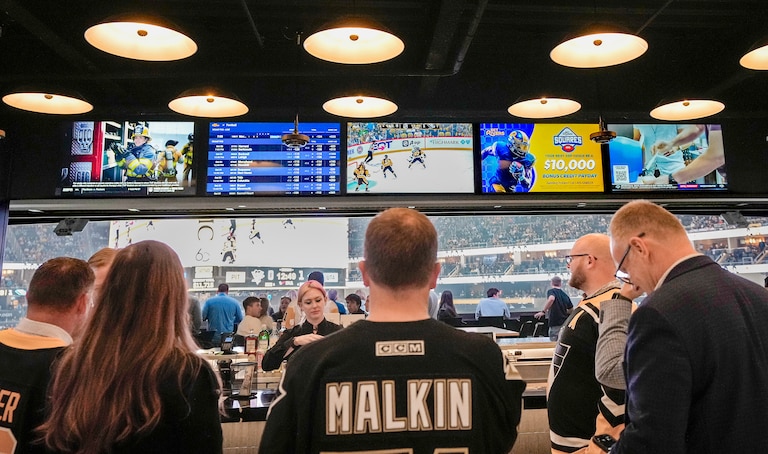 Penguins fans stand in the BetRivers Sportsbook Lounge as the team takes on the Mammoth at PPG Paints Arena on Oct. 29. (Matt Freed / Pittsburgh Post-Gazette)
Emmanuel Velez, a 36-year-old Brighton Heights resident, said he’s made tens of thousands of dollars from sports betting. He started when he lived in Tennessee in 2020 and has since slowed down; a move to Georgia, one of a shrinking number of states where online gambling remains illegal, began to curtail his activity.
Velez likes the social aspect of sports betting. “It’s fun talking over bets,” he said. “It keeps us in touch. It’s become a culture.”
Jordan Kopach, 23, described his betting activity as “pretty degenerate.” During the MLB season, he bet every single day on various games. Discussing the status of his four-leg parlay — a single bet tied to multiple different game outcomes — he took solace in the fact that he was “up on sports,” despite losing money through DraftKings’ online casino.
Recent studies find gambling reaching increasingly younger audiences. As part of a nationwide survey, an October report from Rutgers University’s Center for Gambling Studies found 42.7% of respondents as young as 13 years old reported participating in some form of gambling within the past year, and 10.8% of those aged 13 to 17 were classified as being at high risk for problem gambling.
The spike has been especially hard on parents — many of whom have watched their sons spend what little money they’re making on bets, with mixed success.
Michelle, of Bridgeville, has three adult sons who all love gambling. (She requested to be identified by first name only to protect her privacy.) They’re a big sports family, competing in fantasy football and watching the Steelers every Sunday.
But Michelle also watched one of her sons spend half his meager paycheck on bets. Another goes to the casino every weekend. She feels powerless watching that money disappear, feeling they could be saving for a down payment on a house or putting money into an emergency fund. “It’s disheartening to see they’re going through all that hard-earned money, just to find that big win.”
Pennsylvania has emerged as one of the nation’s leading betting markets since the U.S. Supreme Court’s May 2018 landmark Murphy v. NCAA ruling, allowing individual states to legalize online sports gambling. The state saw nearly $800 million wagered on sports in September alone (with over two-thirds of that handle coming from DraftKings and FanDuel), according to data from the Pennsylvania Gaming Control Board. Sports wagering revenue reached roughly $44.7 million, marking a 50.45% increase from September of last year.
In the early-to-mid 2000s, well before the ubiquity of apps and nonstop accessibility, Bala Kumar, a 39-year-old South Side resident, enjoyed gambling.
Close to a decade ago, his opinions turned sour. “What drove me away was maturing and realizing nobody is really coming up on this,” he said, eating wings at a BetRivers lounge cocktail table during the Penguins game. “I was watching other people act even more irrationally, insisting they were up. When you hear 10 different people say they’re up big, the math just doesn’t add up.”
Kumar detests how sports betting has been advertised, noting superstar athletes such as the Philadelphia 76ers’ LeBron James, who signed a reported $15 million deal with the prediction platform Polymarket in September. He sees these partnerships as harmful to young men, who might idolize certain players.
“I remember when the leagues were all against this,” Kumar said. “Now we have the athletes trying to make a quick buck off it. There needs to be some recognition that we shouldn’t be encouraging it. It’s all targeting young men.”
 Penguins fans sit in the BetRivers Sportsbook Lounge seats as the team takes on the Mammoth at PPG Paints Arena on Oct. 29. (Matt Freed / Pittsburgh Post-Gazette)‘I see the destruction’
Gary Schneider felt an inkling of the problem in 2013.
He was on the board of the Council of Compulsive Gambling in New Jersey when then-Gov. Chris Christie signed a bill legalizing internet gambling. As the practice became further normalized, Schneider worried young people would bear the brunt of the effects.
Around five years ago, he joined the board of Stop Predatory Gambling, a national nonprofit based outside Boston and centered around education and advocacy. He serves as a resource for gambling addicts and their families; in 2021, he connected with a 17-year-old who’d amassed thousands of dollars of debt.
“I saw it as an epidemic,” Schneider said. “When this young person came in, I knew it was a really bad thing.”
While online betting is only legal for those 21 and up — and certain locations allow users to be 18 — evidence shows minors often get around roadblocks by doing things like using their parents’ phones to gamble. More than a third of boys ages 11 to 17 gambled in the past year, according to a recent survey by the research nonprofit Common Sense Media.
Schneider himself is a recovering gambling addict. In the fall of 1996, he was suicidal. On New Year’s Eve, he called a recommended therapist and drove the following day to meet, crying during the entire 40-minute ride over.
“I thought I was a grain of sand buried a foot deep in cement, never to see light again,” Schneider said.
This coming March will mark 30 years for him in Gamblers Anonymous.
Through all the change he’s seen in the gambling industry — and the velocity with which online sports betting roared since its widespread legalization — he worries about “the destruction.”
As a Gamblers Anonymous sponsor, Schneider once met with a college student at Rutgers whose parents lived in Thailand, both working as doctors. The student gambled away $40,000, which he’d told his parents was going toward tuition.
In another situation, Schneider connected with an individual who made a healthy income, but lost $6 million in less than a year. The person was suicidal. He went to Home Depot and bought a rope, threw it over pipes in the basement and prepared to hang himself, Schneider said.
He didn’t go through with the attempt and later sought counseling.
“I see it every day, and on all different levels,” Schneider said, “whether it’s young, male, female, parents, grandparents, I see the destruction that goes on.”
Much of his concern stems from the design of the apps.
A New York Times investigation in September examined the algorithms and data science behind DraftKings’ targeted incentives, and a former analyst for the company told the outlet, “the goal was to direct more promotions toward the biggest losers.”
“They know who’s addicted, and they know that they’re supposed to stop them,” said Minnick, the recovering gambling addict who now runs a YouTube channel and makes online content detailing his journey. “But why would they ever do it?”
Worries regarding manipulative and targeted design are spreading beyond sports betting platforms.
Alex De Marco is a Pittsburgh resident and founder and CEO of a company behind GamFin, which specializes in financial counseling for gambling addiction treatment and recovery. He’s increasingly seen patients in the 18–24 age demographic, and said the levels of debt are “way beyond your typical consumer.”
He worries about his 8-year-old son, as he’s seen gambling mechanics built into experiences like loot boxes — randomized mystery rewards — in video games, and even trading cards.
“Gambling,” De Marco said, “is just everywhere.”
Cynthia Grant, a financial wellness counselor with a nationwide, online behavioral addiction treatment program called Birches Health, has seen an uptick in young men requesting therapy with her practice over the past few years. That trend is due in part to the way gambling and betting have evolved to become “a casino in your pocket,” she said.
Most people will not become addicted, and, according to a 2024 study from the National Council on Problem Gambling, levels of risky gambling dropped 27% since 2021.
Still, a subset of Grant’s patients have lost their livelihoods, their jobs and their relationships. They spent their tuition money, took out a second mortgage on their house.
“Gambling has just totally changed in America,” she said.
A ‘defective’ design
After being invited to the VIP programs through DraftKings, FanDuel and BetMGM, 56-year-old Philadelphia resident Reynaldo Rivera began receiving lavish perks.
A back massage kit complete with multiple Theraguns showed up at Rivera’s apartment unprompted —“expensive ones,” he said.
He was sent a Peloton bike and a $7,500 gift card to Tiffany & Co. He threw a ceremonial first pitch at a Phillies baseball game against the Texas Rangers in May 2022 and received complimentary tickets to concerts and sporting events.
Amid it all, the tow truck driver who works the graveyard shift from 6 p.m. to 6 a.m. was sinking financially.
Rivera had never gambled extensively much before; an hour or so at a casino here and there sufficed. That changed around 2020, when he began playing online casino games through DraftKings and FanDuel. By April of this year, he’d wagered more than $2.4 million through both apps and accrued around $137,000 in net losses.
Due to his high volume of gambling activity, Rivera was invited to the VIP programs across multiple platforms. The VIP hosts he connected with, Rivera said, treated him “like they were my best friends.”
“They make you feel real comfortable,” he said. “I guess they lured me in with their friendliness.”
What he didn’t expect was the inundation of betting incentives and constant communication — if there was just one day Rivera didn’t bet, he said, the VIP host reached out with a text.
Rivera filed a lawsuit in U.S. District Court for the Eastern District of Pennsylvania on Sept. 16 against DraftKings and FanDuel, which alleges, in part, that the targeted ads and frequent contact with gamblers are compulsive by design.
Asked to respond to the lawsuit, a FanDuel spokesperson said in an email, “This is a copy-and-paste lawsuit by a national plaintiffs’ firm looking to advance false claims in the hopes of a payout.
“It ignores the basic fact that millions of people use FanDuel responsibly every day to connect with their favorite teams and as a form of entertainment,” the statement continued, “and fails to mention the robust and easy-to-use suite of tools that support informed and controlled play — including deposit limits, timeouts and the ability to easily self-exclude with a few clicks.”
A DraftKings spokesperson said the company will not comment on pending litigation, but said all company employees are “trained on responsible engagement annually.”
Jennifer Hoekstra, Rivera’s attorney, is spearheading sweeping gambling litigation at both the federal and state levels.
She said her firm in Pensacola, Fla. — Aylstock, Witkin, Kreis, & Overholtz — is representing more than 10,000 clients in similar cases around the country. A case was filed against FanDuel in Allegheny County Common Pleas Court in September, raising similar allegations of targeted advertisements and exploitative incentive structures.
The 46-year-old plaintiff, who began betting through FanDuel in 2021 and lost roughly $75,000, declined to speak with the Post-Gazette.
Though Hoekstra avoided talking about specific ongoing cases, she said many of her clients began as “social gamblers” — maybe they’d take an annual trip to Atlantic City with friends — and within weeks of using the apps escalated their gambling dramatically.
The “defective” designs of the companies’ platforms, she said, lie at the crux of the argument.
“We’re so convinced that, quite frankly, not only did they know it could be defective — they intentionally designed it to be the most addictive possible scenario, because it’s a business model for them,” Hoekstra said.
“We’re not saying that gambling doesn’t have inherent risks. We’re not saying that [users] didn’t know they could lose. What they didn’t know is that these companies were tracking their data to such an extent that the company can predict they are going to become addicted before they will.”
Rivera’s gambling habits led to piles of overdue bills. He attempted to place himself on the self-exclusion list through the apps he was using, but said the consistent outreach from VIPs made quitting outright difficult.
Grant has seen men of all ages try to opt out, only to receive emails with discount codes and ads on social media trying to lure them back. Grant said some patients told her it “felt like a drug dealer who kept coming.”
“No one thinks they can drink their way out of an alcohol problem,” she said. “But in gambling, there are so many cognitive distortions that they truly believe if they gamble more, it will fix their problem.”
Rivera has lost his apartment and is staying with his mother, “stressed out” and working extra hours “slowly trying to climb out of this hole.”
The Gen Z view
The introduction of access to gambling at a time in life when they’re just learning how to handle money has been an issue for many young people.
“Gen Z views prediction markets as a way to invest,” said Grant. “A lot of the young group does not have much financial literacy. They haven’t had to set a budget before.”
De Marco, of the financial counseling platform, raised a related idea called “financial nihilism.” He’s seen, particularly with college-aged men, pessimism about the current job market, the growing prevalence of artificial intelligence in the workforce and their future prospects for affording a home.
That world view helps make them more inclined to use sports betting or prediction markets as a way to get ahead, he said.
“The risk management, risk control part of your brain isn’t fully formed until you’re about 25-26,” De Marco said. “Thinking about an 18-year-old making these decisions, the spending, the risky behavior escalating, and it’s not their money until they start losing and they need to find access to cash.
“It becomes a progression of riskier and riskier behavior … That’s where the harm gets really severe.”
Back at the Penguins game in late October, Alec Hutchins was relieved he won his bets on the team following the Pens’ four-game losing skid.
Hutchins, 30, has been betting online since it became legal in Pennsylvania. He and his friends frequently bet on sports — and they love to play blackjack at the casino — but Hutchins said his gambling activity has slowed as his bills have gone up.
“It’s super easy to get addicted to,” he said. “At the end of the day, the house always wins.”
This story discusses suicide. If you or a loved one are having thoughts of suicide, call or text 988, or use the online chat option at http://988lifeline.org/chat.