
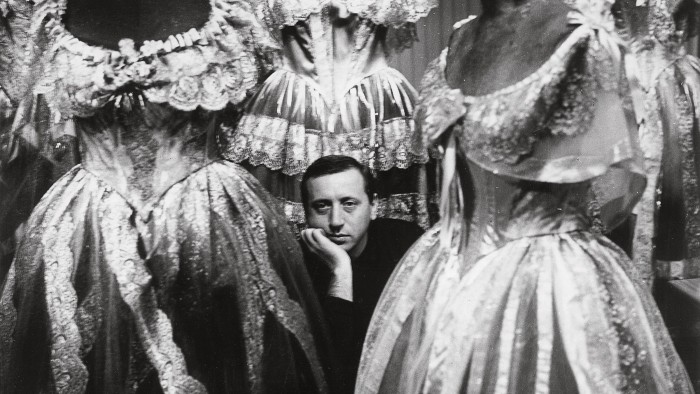
You probably don’t know the name Danilo Donati, but you have almost certainly seen his work. He was the secret magician of Italian cinema, responsible for turning the wildest visions of Fellini and Pasolini into tangible reality. He created costumes for some of the defining films of the 20th century, winning two Academy Awards. From the cross-dressing libertines in Pasolini’s Salò (1975) to a swaggering Richard Burton in The Taming of the Shrew (1967) to the prisoners in striped pyjamas in Roberto Benigni’s Life is Beautiful (1997), Donati had an outsized influence on the look of cinema and its peculiar visual power. When I came to write a novel about the death of Pasolini, I realised he was the ideal person to cast as my hero.
The first time I consciously noticed one of his costumes was in Pasolini’s The Canterbury Tales (1972). I kept freezing the frame to examine a pouting boy, dressed in a particoloured velvet jacket with puffed shoulders, a standing collar and two shiny heraldic brooches on his chest. It was so sumptuous, so sexy, so totally bizarre, as if Hedi Slimane were making biker jackets for slutty medieval squires.
 Costumes by Danilo Donati in The Canterbury Tales (1972), directed by Pier Paolo Pasolini © Bridgeman Images
The man responsible for this dazzling outfit was, in Fellini’s own words, “a great connoisseur of art in the body of a variety show dresser”. Donati was a master illusionist who rejected a career as a painter, serving an apprenticeship in television and opera before putting his talents at the service of Pasolini and Fellini, two undisputed giants of Italian film. Unlike most costume designers of the period, he wasn’t especially interested in creating historically accurate garments. Instead, he approached each project as an artist, creating clothes-as-sculpture that conveyed the radical essence of a film.
It was as if Hedi Slimane were making biker jackets for slutty medieval squires
His collaboration with Fellini began in 1969 with Satyricon, an erotic phantasmagoria of life in Ancient Rome with the winking tagline: “Rome. Before Christ. After Fellini.” Donati’s task was to produce “something timeless and unreal . . . to destroy any reference to factory-produced clothing . . . to remove everything, leaving only the metaphysical.” The luridly draped coquettes and catamites he created pleased Fellini so much that he promptly invited Donati to design the sets as well as costumes for Roma (1972) and Casanova (1976).
 Donati’s creations for Fellini’s Casanova (1976) © Bridgeman Images
For decades, Donati’s centre of operations was Cinecittà in Rome. His workshop in Studio 16 was an alchemist’s chamber where he might be found rolling out pastry on the cutting table, surrounded by bubbling vats of dye. He forged rather than stitched his costumes, his passion for cheap, unlikely materials amounting to a kind of Arte Povera of cinema. For the famous ecclesiastical fashion show in Roma, with its roller-skating cardinals and bicycling monsignors, the lace is made from the cardboard plates found under pâtisserie cakes, while the jewels are halved Christmas ornaments.
Donati once said working with Fellini was “like walking on the edge of a knife blade”, a balancing act that demanded everything he had and drove him to fits of fury and despair. He might be asked to create a whale in three days, or produce a realistic Roman mosaic by morning (he used boiled sweets). “You must never listen to Federico, only interpret,” he concluded. “If you listen to him, you only arrive at madness.”
 The ecclesiastical fashion show in Fellini’s Roma (1972) © Bridgeman Images
They offer a warning about the danger of too much compliance
His relationship with Pasolini was different. If Fellini was the great dictator, controlling every aspect of his films, Pasolini was a natural collaborator who, having picked his team, gave them the liberty to do their jobs. They started working together in 1964, on The Gospel According to St Matthew, and their collaboration continued until Pasolini’s murder in 1975. Both men were gay, and both had come of age under the horrors of fascism: hard facts that made an indelible bond between them.
Working with Pasolini allowed Donati to be at his most original, to expand the vocabulary of cinema by way of clothes. For Oedipus Rex (1967), he constructed the costumes by weaving rags, hand-dyeing them in strange shades of peach and brown. He made hats and masks from shells, grass and feathers. To get the right texture for the soldiers’ helmets he stirred sawdust into black paint.
 Alida Valli as Merope in Oedipus Rex (1967), directed by Pasolini © Alamy
 Sergio Fascetti and Renata Moar in Pasolini’s Salò (1975) © Alamy
While I was writing my novel, I realised many of Donati’s costumes still exist, preserved at Sartoria Farani, a Roman atelier established by Donati’s close friend and collaborator Piero Farani in 1962. It’s now under the stewardship of Luigi Piccolo, who told me tales of Donati’s charisma, talent and formidable capacity for bearing grudges while simultaneously modelling a soldier’s helmet and a remarkable undergarment made from shells and knotted strips of tea-coloured rags.
 Olivia Lang’s new novel The Silver Book, to be published on 6 November
I set The Silver Book in 1975, during the making of Fellini’s Casanova and Pasolini’s Salò. It was Donati’s annus mirabilis. He brought to life the decadent, deadening vacuity of Europe in the 18th century, and he also created the visual language for Pasolini’s nightmarish masque of fascism, his terrifying and prophetic final film. On the one hand foaming pink lace, and on the other garments to portray power and submission, annihilation and total control.
Anyone who has watched Salò will remember the clothes of the young victims: bourgeois, conventional, demure. I saw them again at Farani, a rail of cream-coloured schoolgirl dresses with neat white collars and cuffs. They wouldn’t have looked out of place at Prada. Of all Donati’s films these clothes are perhaps the most prescient and powerful; they offer a warning about the fatal danger of too much compliance, too much obedience, when fascism storms the gates.
 Satyricon (1969) was Donati’s first film with Fellini © Bridgeman Images
Donati never stopped making movies. He died in 2001, at work on Roberto Begnini’s Pinocchio. In his last years he also wrote a novel, Il Coprifuoco (The Curfew), which was nominated for the 2001 Strega Prize. He despaired about cinema towards the end, disgusted by the phoney effects of CGI, but he’s had an unexpected afterlife in fashion. Multiple designers have attested to his influence, from Karl Lagerfeld’s Casanova-themed collection for Chloé in 1977 to Moschino’s AW19 show at Cinecittà, inspired by Satyricon, a film much referenced by Dolce & Gabbana too.
Recommended

I thought of him in particular when I watched Gwendoline Christie weaving and jerking down the runway in the Margiela Artisanal Haute Couture SS24 show. Her face was like porcelain. She looked like a giant doll, a lovely automaton, and I immediately recalled the most gorgeous of all Donati’s inventions: the dancing doll Rosalba, who waltzes on the frozen Grand Canal at the end of Casanova.
Cinema was like that, you see. It was a repository of dreams, built by hand by people like Donati: a man who dedicated his life to producing illusions that don’t lie, that are beautiful, provocative and sustaining still.
The Silver Book will be published by Hamish Hamilton on 6 November